John England Quotes
Thus, if this document condemned our domestic slavery as an unlawful and consequently immoral practice, the bishops could not have accepted it without being bound to refuse the sacraments to all who were slave holders unless they manumitted their slaves; yet, if you look to the prelates who accepted the document, for the acceptation was immediate and unanimous: you will find, 1st the Archbishop of Baltimore ... 2d, the Bishop of Bardstown ... 3d, the Bishop of Charleston ... 4th, the Bishop of St. Louis ... 5th, the Bishop of Mobile ... 6th, the Bishop of New Orleans ... and, 7th the Bishop of Nashville ... they all regarded the letter as treating of the "slave-trade," and not as touching "domestic slavery." I believe, sir, we may consider this to be pretty conclusive evidence as to the light in which that document is viewed by the Roman Catholic Church.
In Supremo {617632} condemning slavery
John England, III, 1786-1842, Roman Catholic Bishop of Charlestown, Letter to John Forsythe, the Secretary of State under President Martin Van Buren,, Ignatius Aloysius Reynolds, The Works of the Right Rev. John England III
Sourced by: Eigen's Political and Historical Quotations

One might think that this remarkable pronouncement would have put an end to Catholic participation and support of slavery. However, in an exercise of theological hair splitting, the Southern Catholic Bishops of the United States took the position that In Supremo outlawed Catholic participation and support of slave trading but not the institution of slavery itself. See {617544} for their official position to the United States Government.


While this apostolic letter condemned the slave trade, it fell short of clearly implicating the entire practice of slavery. It is clear that the Catholic Church at this time was reluctant to abandon its earlier teaching which approved of “just title” slavery. This distinction approved of “slavery” in circumstances in which the person was deprived of their liberty justly. Specific examples in the past have included slaves captured in war, persons condemned to slavery for a crime, and those who sold themselves into slavery.

The Roman Catholic Church in America had a very difficult problem with slavery. Catholics were themselves a minoirty, hated and distrusted by many Protestants. In most of the country, the distrusr was based on their large immigrant population, but in the South Catholic theology was hated and the Vatican and Pope were particular targets. The Catholic Clergy generally did not want to take sides in the most contentious issue in America since its inception. The Southern Catholic Clergy did not have that option as in the South, anyone who was not a supporter of slavery was an "enemy of the community and subject to all kinds of violence." Some Southern priests were willing to take the personal risk but did not want to put their followers at risk. In a strange consequence, Catholics--especially Irish Catholics--fought on both sides of the Civil War and often against each other. While it was not an exemplary moral behavior for the Church, there were difficult pressures on Catholic leaders. Further, most of the lowest and most difficult, undesirable jobs were filled by Catholics and most Catholic laymen so and end to slavery as the start of pitting the Catholics against the Blacks. So there was not a groundswell for abolition in most Catholic parishes even in the North.


The “enemy of the human race” is the Devil, Note that the Pope labels as “allies” of the Devil those who advocate and participate in slavery. Slavery was not only immoral, but the Devil was behind it all. The fact that slavery persisted on a massive scale by Catholic countries illustrates that while the Pope was a powerful leaders and figure, even he could not influence all the “sinners.”

While this was his opinion, it was never issued in a Papal Bull or had the force of Catholic law. Meanwhile, almost all of the socialist movements in the West have had Catholics in their leadership and many democrats of modern times would have been considered socialist. Many countries with high proportions of Catholic voters have elected socialist governments in secluding Spain and Italy.

The Roman Catholic Church then maintained that salvation was dependent upon obedience to the Pope in all things civil and religious. See {595166} for the way that the Church at the time allowed some authority to civil authorities.

The Protestant Clergy issued similar statements. This was one of the few areas of agreement.

American Catholic bishops were divided during the Civil War over the slavery question. For a bishop’s view opposing abolition of slavery, see Hughes {611579}.


Husayn Ali Nuri

The King Outlawed Protestant Worship.
The Church exercised the law enforcement and censorship authority in all Catholic countries. Note the offense of saying anything which is “offensive to pious ears”. The particular example that “offended” the pious was that a heretic should not be executed. These were the cultural values of the day.

Philip II, by this statement, and his subsequent behavior, made a major step forward in France for the separation of church and state. Previously, French kings played a major part in the selection of the bishops and other high clerics of the realm. Phillip ceased that type of interference. He did however, close down a religious commune for misbehavior, but that was at the request of both the church and civil authorities. See {617074} . The religious authorities at the time were delighted with this form of separation of church and state, but they were adamant that their church should be able to influence the monarchy and laws of the realm. In contrast today, the Chinese government does not allow any religion to interfere with the operation of the government, but insists that the Dali Lama and the Bishops of the Catholic church can only be appointed with their approval. Separation of church and state is a two way phenomenon.

The Catholic Papacy was very ambivalent regarding the morality of slavery. Callistus, in effect authorized the morality of enslaving “infidels.” In the past this was a reaction to the Muslim ethic of banning slavery of Muslims but allowing it for “infidels.” This bull has been used to defend slavery ever since despite the fact that there are several other (before and after) Papal pronouncements condemning slavery. See {617550} , {617880} , {617632}
After he wrote that there was no such thing as witches he was imprisoned.
Olivi was a brilliant scholar who ran afoul of the religious authorities on several occasions. He was accused of being a heretic for his writings, but was exonerated after intensive trials and debates. In this quotation, he attributed the religious error of Jews and others, not to the anti-Christ, human venality, or even fault of character, but from a difference in human perspective. He was a pioneering original thinker, who while not well appreciated in his lifetime, had a significant cult following including several cardinals of The Church that arose after his death. However, other conservative forces then decided that he was a heretic after all. They burned his writings and destroyed his tomb. Today, there is a street in France named for him.

Executed by the English for his part in the Easter Uprising. His observations seem even more prescient as later theocracies like Iran ruined their societies and progress and twisted the Islamic religion. Ireland’s independence did not separate the state from the control and influence of the Roman Catholic Church despite the warnings of Connolly and others. However, conflict with the Church in 2010 over the church sexually assaulting children and impeding the civil authorities from investigating and protecting the criminals led to a reexamination and a diminution of the role of the church in Ireland.

The Vatican & the Chinese Communist Government had been at odds for years with much of the Chinese church going underground. Fr. Jin had been jailed for a decade. Then the government allowed him and the Catholic Church and operate openly, but there were still Vatican conflicts over numerous issues including the right of the Government to approve senior appointments of church officials—a privilege the church claimed exclusively. The Vatican ordered Jin not to cooperate and especially not to reopen the national theological seminary which the government had ordered closed. There had been no training for Chinese priests and Jin wanted to reopen the national theological seminary but the Vatican refused cooperation waiting for the government to capitulate to the Vatican’s various demands. Fr. Jin defied the Vatican & reopened the seminary. Without officially admitting their failed tactics, the Vatican let the discipline issue against Jin drop & the national theological seminary thrived.
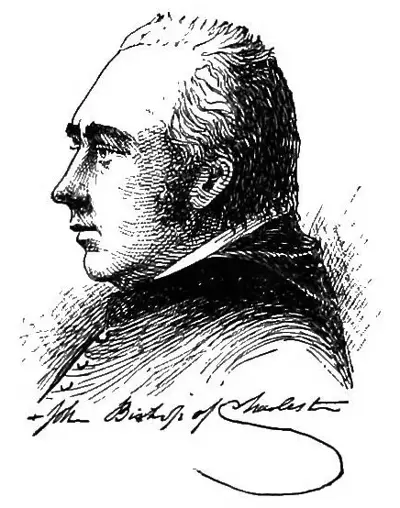
- Born: September 23, 1786
- Died: April 11, 1842
- Nationality:
- Profession:
John England was the first Roman Catholic Bishop of Charleston, South Carolina. England served as a priest in Cork, where, before being appointed to Charleston, he was very active in the movement for Catholic Emancipation.
