PHILIP II OF SPAIN
(Philip II | Philip the Prudent)
The King, a religious fanatic, was a great supporter of the Inquisition whose excesses were even more horrible during his reign than others.
The King, a religious exremist fanatic, was a great supporter of the Inquisition whose excesses were horrible during his reign.
Europe has had a tradition of communes—communities of like-minded people who wanted to live apart and differently from the majority of society. Most of the early communes were religious in nature—monasteries and abbeys being the most common example. The civil government–in this case the King of France—would grant the commune independent status and the residents would not have the duties (or get the benefits) of citizens at large. This particular commune began interacting with the major society and the commune offended others somehow. The King of France. Ended the commune at the request of both the church and civil authorities. However, it was reinstated later and today is a tourist attraction in Paris. The quote also gives us an idea of the military service requirements of the period as there is not a great deal of material about this period.
Philip II, by this statement, and his subsequent behavior, made a major step forward in France for the separation of church and state. Previously, French kings played a major part in the selection of the bishops and other high clerics of the realm. Phillip ceased that type of interference. He did however, close down a religious commune for misbehavior, but that was at the request of both the church and civil authorities. See {617074} . The religious authorities at the time were delighted with this form of separation of church and state, but they were adamant that their church should be able to influence the monarchy and laws of the realm. In contrast today, the Chinese government does not allow any religion to interfere with the operation of the government, but insists that the Dali Lama and the Bishops of the Catholic church can only be appointed with their approval. Separation of church and state is a two way phenomenon.
Felipe, capitalizing on the death of the Portuguese King, declared in 1580 his intention of uniting the Iberian peninsula under his rule.
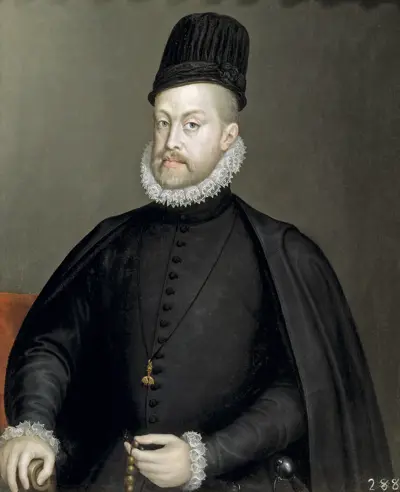
Philip II was King of Spain (1556–1598), King of Portugal (1580–1598, as Philip I, Portuguese: Filipe I), King of Naples and Sicily (both from 1554), and jure uxoris King of England and Ireland (during his marriage to Queen Mary I from 1554 to 1558). He was also Duke of Milan from 1540. From 1555 he was Lord of the Seventeen Provinces of the Netherlands.
