Philip II of Spain Quotes
Let all men, both present and future, know that on account of the injuries, oppressions and troubles that the commune of Etampes carried out against both the churches and their goods and the knights and their goods, we have quashed the same commune and have conceded to the churches and knights that at Etampes there will henceforth be no commune. The churches and knights shall regain those liberties and rights that they held prior to the commune, with the exception that all men and their servants shall attend our army and our expeditions, just as our other vassals do; and we will impose the taille on the vassals and servants of both the churches and the knights who are in the castle and suburbs of Etampes who were members of the commune.
Europe has had a tradition of communes—communities of like-minded people who wanted to live apart and differently from the majority of society. Most of the early communes were religious in nature—monasteries and abbeys being the most common example. The civil government–in this case the King of France—would grant the commune independent status and the residents would not have the duties (or get the benefits) of citizens at large. This particular commune began interacting with the major society and the commune offended others somehow. The King of France. Ended the commune at the request of both the church and civil authorities. However, it was reinstated later and today is a tourist attraction in Paris. The quote also gives us an idea of the military service requirements of the period as there is not a great deal of material about this period.
Philip II, 1165-1223, Philip Augustus, King of France
Sourced by: Eigen's Political and Historical Quotations

Philip II, by this statement, and his subsequent behavior, made a major step forward in France for the separation of church and state. Previously, French kings played a major part in the selection of the bishops and other high clerics of the realm. Phillip ceased that type of interference. He did however, close down a religious commune for misbehavior, but that was at the request of both the church and civil authorities. See {617074} . The religious authorities at the time were delighted with this form of separation of church and state, but they were adamant that their church should be able to influence the monarchy and laws of the realm. In contrast today, the Chinese government does not allow any religion to interfere with the operation of the government, but insists that the Dali Lama and the Bishops of the Catholic church can only be appointed with their approval. Separation of church and state is a two way phenomenon.

Monroe visited his daughter who was attending school in Paris. She observed that the French roads were much finer than those in America:


The founder was Charles E. Coughlin, 1891-1979, a demagogic Catholic Priest who drafted the principles and invited others to join him. Hundreds of thousands did in this organization which began in idealism, and ended in scandal and hate mongering, so much so that Father Coughlin was ordered off the radio and out of politics by the Catholic Church. The National Union in 1936 had morphed into the Union Party which ran Presidential candidates in the 1936 election. In this principle there were two purposes: First to have the wealthy sacrifice something in time of war. Historically wealth could keep a man from the draft if he so wanted. Second, when the company went to war the argument went it was the rich who could profit who had more political influence and could make the war. This way, they would pay a high price and might oppose war. Many of Coughlin’s followers were pro-German and wanted to keep the country out of the European war.


Gandhi was asked if the King had offered and encouragement for Indian Independence from England.


Compare to the language of Jefferson in the Declaration of Independence. Jefferson and his colleagues were familiar with this document.


After being castigated by Pope Gregory XVI, Lameddais broke with the Church and concentrated on publishing and politics.


Note the propaganda use of the fear of sexual contact between Black men and white women. Ironically, America was at the time even more fearful of interracial union. The rape accusations had never been documented, but when many racial bigots saw colored offspring of mixed sexual union, the assumed that the white woman must have been raped. This official pamphlet was used in German schools starting in 1934. This propaganda was so effective that by the time the Nazis started the military aggression setting off WWII, the Germans already despised the French, Poles, Russians and other Europeans and were highly anti-Semitic. Americans and others in the world knew about the Catechism but did not believe that such nonsense would be believed by anyone. We have the same reaction today to the propaganda that the Palestinians and some Islamic nations use in their schools teaching hate for America, the Christian West and the Israeli and other Jews.

Nostradamus made thousands of prophecies most of which seem not to have occurred as he predicted. However there were a few that some people believe predicted later events. In this case some think that he predicted the colonization and independence of America.


The prophet warns the Jews about wanting a king.

Essentially, she was telling all the political forces that they were in the wrong and had to compromise. One could not tell the King, Louis XIV, that he was wrong at that time and place, so she told him that he was poorly advised, but everyone, including the king knew what she meant.

This was the first contact between the colonists and the French government. The French agent was very non committal and the parties were just feeling each other out. Franklin made it perfectly clear that the colonists would not trade the English King for a French one and become part of the French empire.
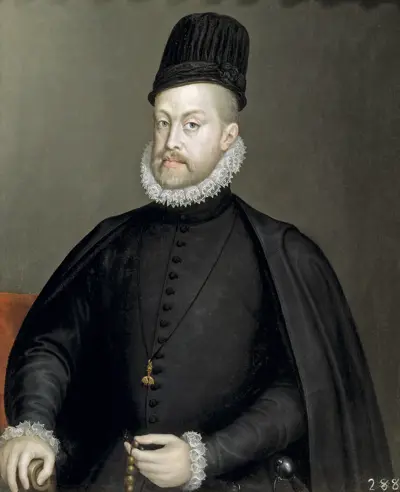
- Born: May 21, 1527
- Died: September 13, 1598
- Nationality: Spanish
- Profession: King
Philip II was King of Spain (1556–1598), King of Portugal (1580–1598, as Philip I, Portuguese: Filipe I), King of Naples and Sicily (both from 1554), and jure uxoris King of England and Ireland (during his marriage to Queen Mary I from 1554 to 1558). He was also Duke of Milan from 1540. From 1555 he was Lord of the Seventeen Provinces of the Netherlands.
