Margaret Postgate Cole Quotes
Though the Military Service Act allowed exemption on grounds of conscience, it was regrettably vague in its definition of either "conscience" or "exemption"; and the decision as to whether a man had or had not a valid conscientious objection, and if he had, whether he was to be exempted from all forms of war service or from combatant service only, or something between the two, was left to local tribunals all over the country, who had no common standard or guidance, and generally - though not by any means invariably - took the view that every fit man ought to want to fight, and that anyone who did not was a coward, an idiot, or a pervert, or all three.
Margaret Postgate Cole, 1893-1980, British Feminist, Writer and reformer, Description of Conscription in Britain during WWII
Sourced by: Eigen's Political and Historical Quotations


Webb was opposing the all volunteer army which became a reality despite his and others objections.


This Biblical quotation has been used to justify and legitimize military conscription.

The founder was Charles E. Coughlin, 1891-1979, a demagogic Catholic Priest who drafted the principles and invited others to join him. Hundreds of thousands did in this organization which began in idealism, and ended in scandal and hate mongering, so much so that Father Coughlin was ordered off the radio and out of politics by the Catholic Church. The National Union in 1936 had morphed into the Union Party which ran Presidential candidates in the 1936 election. In this principle there were two purposes: First to have the wealthy sacrifice something in time of war. Historically wealth could keep a man from the draft if he so wanted. Second, when the company went to war the argument went it was the rich who could profit who had more political influence and could make the war. This way, they would pay a high price and might oppose war. Many of Coughlin’s followers were pro-German and wanted to keep the country out of the European war.


Debs was jailed for sedition for this speech.


The Shakers were an American religion and pacifists Lincoln learned. He was so impressed with their sincerity and way of life that he exempted Shaker men from the draft—the first conscientious objectors formally recognized in America. However, Lincoln made the statement to the Shakers which greatly impressed them and caused much reflection. Quakers had been pacifists also, but until the Civil War Draft there was no mechanism to test.


Theoretically every male citizen was supposed to serve in the Militia at that time. But if one did not, the penalty was a small fine. It became a status symbol. Those middle and upper class men who could get commissions as officers would serve, but those who did not have the political connections or the money to equip his own troops, would rather pay the fine than serve with men he thought beneath him. There is a , romantic American myth about the Militiamen in Colonial and Revolutionary America—the citizen soldiers who would leave their farms and rise to the military necessity of the day. However, not only were the militia very hard to muster to duty, but most actually didn’t own or have experience with firearms, and the prevailing opinion of knowledgeable military leaders from George Washington on down was that the militia were not very good soldiers. See {613015}, {613016}, {613022}, {613027}, {621987}, {621988}, {613030}, {613033}, & {613056}
While most modern armies treat officers and enlisted men who desert equally or even favor the officers, the Visigoths made desertion by an officer the severest of crimes. A centurion was the officer in charge of 100 men. There were 10 decurians (leaders of 10) under him, They were the modern equivalent of the Sergeants—non-commissioned officers. Their penalty for desertion was only the paying of a heavy fine. It was the officers who had to set the example. This set of laws is the most formalized and sophisticated compendium of laws of the so-called “barbaric peoples” of Europe. The compilation was in many ways a documentation of the traditional laws of the Visigoths that had evolved over hundreds of years.
This principle became the Civil War Draft. Ironically, when the draft was legislated by Congress, there were relatively few men drafted as enlistments increased. See {621897} .

Wood was one of the first to call for conscription for a peacetime army as well as in wartime.
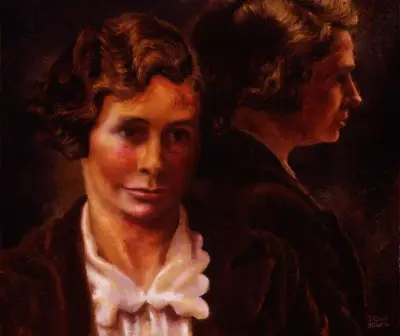
Dame Margaret Isabel Cole DBE was an English socialist politician, writer and poet. She wrote several detective stories jointly with her husband, G. D. H. Cole. She went on to hold important posts in London government after the Second World War.
