BILL CLINTON
(William J. Clinton | William Jefferson Clinton)

This quotation has much more meaning that similar statements of dozens of other people who claimed Bush should be impeached. The reason is that Fine was a strong conservative wanting to impeach a conservative President and he was the person who drafted the articles of impeachment against President William Clinton which passed the House but Clinton was acquitted by the Senate. So Fine was generally seen as a partisan for Republican Conservatives like Bush and a man who acted strongly against Clinton, and yet he observed in this quotation that Bush’s crimes were more serious. See {583797} for a concurring view on impeachment of Bush.

President Clinton had engaged in sex with an intern in the Oval Office and lied about it in investigations. Clinton had been an embarrassment anathema to the Republicans by producing a remarkably strong economy without cutting taxes, reducing government deficits, cutting the size of government, winning the Serbian war without a single American soldier dying, and preempting many of their programs. So the Republicans who controlled both Houses of Congress decided to impeach Clinton for the lies. Wexler argued that there was no damage done to the nation and the sex and lying did not rise to the required level of an impeachable offense. On a party line vote, Clinton was impeached, but the Republicans could not even get the majority of the Senate which they controlled. Most senators agreed with Wexler. See {583801} for a later summary of the absurdity of impeaching Clinton who left office as one of the most popular presidents in modern times.


The inhale word was made famous in this context in the William Clinton quotation: {585948}.


A master of political dirty tricks, Tuck was then working for the Republicans against the election of William Clinton. The web site provided “dirt” and negative material about Clinton, much of which was exaggerated or untrue.


This was not the first time a beleaguered White House had believed a conspiracy existed. See Theodore Roosevelt’s quotation.
Nussbaum was her boss at the time. She was working as a staffer for the Congressional committee that was investigating the possible impeachment of Richard M. Nixon.


The Congressman became the focus of the national media when it was discovered that he had been engaged in a series of extra-marital affairs including one with an intern who had disappeared. He had at first lied about it. He had been one of President William Clinton’s harshest moral critics when the President had engaged in an affair with an intern, and there were no calls for Condit’s resignation.


He was referring to the success of the Clinton Administration.

Although they were free to vote against the President, they did not. The Clinton impeachment was a partisan party vote.


Asserting that her campaign was not dealing in negative campaigning:


Referring to President Bill Clinton:

Referring to President William Clinton and his first 100 days:


LaPierre, who had a reputation for extreme statements, found many of his usual anti-gun control allies distancing themselves. See Gerald Ford {641384}.


The sexual behavior of President Clinton with a White House intern had started a sequence of events and investigations, eventually leading to an impeachment inquiry. The Republican House Speaker, Newt Gingrich, resigned (later admitting that he was having his own adulterous affair with a member of his staff). Henry Hyde, the Republican Chairman of the House Judiciary Committee handling the impeachment hearings, admitted to adulterous conduct and fathering an illegitimate child. Livingston was then selected by the Republicans to be House Speaker. He then shocked the country with this announcement, and refused the Speaker’s post and then resigned as a member of Congress. The impeachment was voted by the House on a partisan vote, but failed in the Senate.
Livingston could not stop the process, which had built up a momentum of its own among most Republicans. The debate went on, and, despite public opinion favoring the President, on a highly partisan party line vote Clinton was impeached by the house. The impeachment, only the second in U. S. history, then failed in the Senate.

His reference was to his experience as an undergraduate at Dartmouth, which he and associates views as a liberal organization, while others viewed it as a conservative bastion of the establishment.

Lawrence Summers, and Alan Greenspan, and the Secretary had come to recommend their plan to maintain the stability of Mexico. It worked, and was one of the many great financial successes of the Clinton administration.

When President Clinton left office, there was a huge fiscal surplus that Rubin had engineered, & President George W. Bush advocated a tax cut for the wealthy. Greenspan, who was very influential, did not oppose the tax cuts. He did urge that the tax cut be very carefully crafted so that the tax cuts would only be effective if the surplus continued. Rubin urged him not to take such a nuanced position as it would be perceived as support for the Bush tax cut which would not have the safety valves Greenspan advocated. Greenspan did not take Rubin’s advice. The tax cuts passed the Republican Congress with no safety valves with Greenspan’s statements being interpreted as support for the Bush plan just as Rubin had warned. The Bush Administration & the Republican Congress then increased spending enormously in almost all areas. With no safety valves rescinding the disastrous tax cuts, the surplus evaporated & became the largest deficit in history.
The last 5 years of the 1990s were the last of the Clinton administration where he was the principle architect of economic policies for that period. While this statement was somewhat self serving, the economic and fiscal performance of the Clinton years were astoundingly superior to those before and after.

He was discussing the Presidential Primary Race.


The President tends to keep increasing the number of Americans who are opposed to his policies, or felt he did not live up to his promises, or has been sufficiently negatively trashed by his opposition that his negatives are driven up and positives, down. The only exception to this is President William Clinton, who ironically is the only President who was impeached since Andrew Johnson, a terrible President. However, the pettiness and partisanship of the impeachment attack on Clinton caused the Senate to acquit him where the Republicans who controlled the Senate could not even muster a majority, much less the two-thirds necessary, for conviction. Meanwhile, with all the distractions of impeachment, Clinton managed the strongest economy in American history, not only balanced the budget, but created a surplus for the first time in modern history. So Clinton left office, a hero and his popularity was sustained after his presidency as George W. Bush, following a new Republican ideology, squandered the surplus, created very few jobs, and then crashed the world economy triggering the Great Recession of 2008. He left the Presidency as one of the more unpopular Presidents in history. By contrast, Clinton’s accomplishments were even more appreciated as Bush was his foil.


The most commonly cited part of this quote is in bold. The full quote is provided for context.
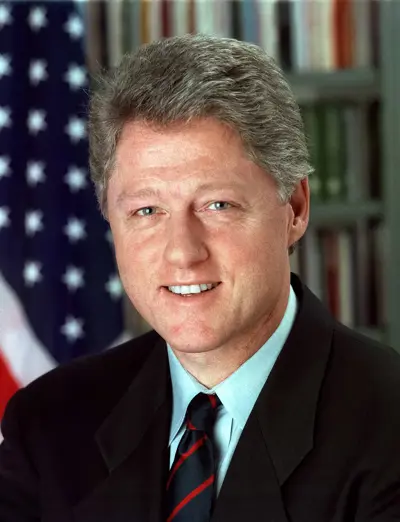
- Born: August 19, 1946
- Nationality: American
- Profession: 42nd American President
William Jefferson "Bill" Clinton is an American politician who was the 42nd President of the United States from 1993 to 2001. Clinton was previously Governor of Arkansas from 1979 to 1981 and 1983 to 1992, and the Arkansas Attorney General from 1977 to 1979. Clinton was born William Jefferson Blythe III – he changed to his stepfather's name at age 15.
