Paul III Quotes
Seeing this and envying it, the enemy of the human race, who always opposes all good men so that the race may perish, has thought up a way, unheard of before now, by which he might impede the saving word of God from being preached to the nations. He has stirred up some of his allies who, desiring to satisfy their own avarice, are presuming to assert far and wide that the Indians of the West and the South who have come to our notice in these times be reduced to our service like brute animals, under the pretext that they are lacking the Catholic Faith. And they reduce them to slavery (Et eos in servitutem redigunt), treating them with afflictions they would scarcely use with brute animals….Therefore, We, ... noting that the Indians themselves indeed are true men and are not only capable of the Christian faith, but, as has been made known to us, promptly hasten to the faith, and wishing to provide suitable remedies for them, by our Apostolic Authority decree and declare by these present letters that the same Indians and all other peoples-even though they are outside the faith-who shall hereafter come to the knowledge of Christians have not been deprived or should not be deprived of their liberty or of their possessions
The “enemy of the human race” is the Devil, Note that the Pope labels as “allies” of the Devil those who advocate and participate in slavery. Slavery was not only immoral, but the Devil was behind it all. The fact that slavery persisted on a massive scale by Catholic countries illustrates that while the Pope was a powerful leaders and figure, even he could not influence all the “sinners.”
Paul III, 1468-1549, [Alessandro Farnese], Roman Catholic Pope, Sublimis Deus, June 2, 1537
Sourced by: Eigen's Political and Historical Quotations

The Catholic Papacy was very ambivalent regarding the morality of slavery. Callistus, in effect authorized the morality of enslaving “infidels.” In the past this was a reaction to the Muslim ethic of banning slavery of Muslims but allowing it for “infidels.” This bull has been used to defend slavery ever since despite the fact that there are several other (before and after) Papal pronouncements condemning slavery. See {617550} , {617880} , {617632}

This decree is an example of the Catholic Church’s official response to the advent of slavery in the New World. Slavery here should be distinguished from what the Catholic Church called “just title” slavery, which approved of the practice in circumstances in which the person was deprived of their liberty justly. Specific examples have included slaves captured in war, persons condemned to slavery for a crime, and those who sold themselves into slavery. For an example of a type of “just title” slavery being legitimatized, see Nicholas V {612174}. The practice of enslaving entire ethnic groups like South American natives was, however, “never before heard of” and was immediately condemned. In many cases the line between slavery for no morally justifiable reason, i.e. racial slavery, and “just title” slavery remained unclear to Catholic laity and clergy alike.


One might think that this remarkable pronouncement would have put an end to Catholic participation and support of slavery. However, in an exercise of theological hair splitting, the Southern Catholic Bishops of the United States took the position that In Supremo outlawed Catholic participation and support of slave trading but not the institution of slavery itself. See {617544} for their official position to the United States Government.

Although English, Cobett spent time in America and published a newspaper, The Porcupine Gazette, in Philadelphia. We was very conservative but on the issue of slavery his resembled a liberal point of view. He never used sugar, coffee, or rum because slave labor produced them. However, he advocated legally enslaving lazy people, blacks and whites, who would not work.

This moral statement from a New jersey Quaker abolitionist is not particularly noteworthy, However what makes this quote important is that Woolman traveled throughout the South preaching this as his main theme. At that time — before the American Revolution — he did so and was not attacked or intimidated; he was mostly ignored by the Southern authorities. At the time, the South was very confident of its ability to continue slavery. Years later, when the abolition movement grew larger and stronger, a Northern Quaker Preacher doing this not not escape with his life.


American Catholic bishops were divided during the Civil War over the slavery question. For a bishop’s view opposing abolition of slavery, see Hughes {611579}.


In Russia at the time, serfs were little better off than slaves. Not only did they have to obey their landlords in all things, but any who advocated disobedience on their part were beaten and sent to Siberia. Exile to the Siberian Gulags was not an invention of the Communists of the 20th century although they used that punishment in unprecedented numbers. It was used by the Czars and the Empress.

There were some who kept no slaves and morally opposed slavery at the time or the birth of Christ.

She was referring to the political leaders of the South who were patriots and slave owners.


Also known as Ferdinand II or Aragon. We have provided an extensive quotation from the letter. In retrospect, it is incredulous today that Ferdinand would make such demands or even would believe that the Indians would understand the terms or their consequences, the threats. Even the promises that are made were ignored because of the Indian’s “intransigence.”
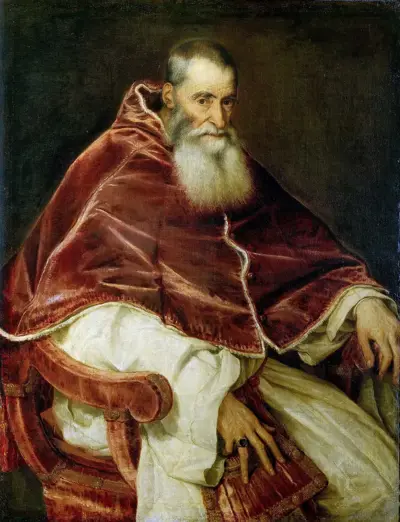
- Born: February 29, 1468
- Died: November 10, 1549
- Nationality:
- Profession:
Pope Paul III, born Alessandro Farnese, was head of the Catholic Church and ruler of the Papal States from 13 October 1534 to his death in 1549.
