Paul III Quotes
The enemy of the human race [Satan] … inspired his satellites who, to please him, have not hesitated to publish abroad that the Indians of the West and the South, and other people of whom We have recent knowledge should be treated as dumb brutes created for our service, pretending that they are incapable of receiving the Catholic Faith…. We define and declare by these Our letters … Indians and all other people who may later be discovered by Christians, are by no means to be deprived of their liberty or the possession of their property, even though they be outside the faith of Jesus Christ; and that they may and should, freely and legitimately, enjoy their liberty and the possession of their property; nor should they be in any way enslaved; should the contrary happen, it shall be null and have no effect
This decree is an example of the Catholic Church’s official response to the advent of slavery in the New World. Slavery here should be distinguished from what the Catholic Church called “just title” slavery, which approved of the practice in circumstances in which the person was deprived of their liberty justly. Specific examples have included slaves captured in war, persons condemned to slavery for a crime, and those who sold themselves into slavery. For an example of a type of “just title” slavery being legitimatized, see Nicholas V {612174}. The practice of enslaving entire ethnic groups like South American natives was, however, “never before heard of” and was immediately condemned. In many cases the line between slavery for no morally justifiable reason, i.e. racial slavery, and “just title” slavery remained unclear to Catholic laity and clergy alike.
Paul III, 1468-1549, Roman Catholic Pope, Sublimis Deus (The Sublime God), June 2, 1537
Sourced by: Eigen's Political and Historical Quotations


The “enemy of the human race” is the Devil, Note that the Pope labels as “allies” of the Devil those who advocate and participate in slavery. Slavery was not only immoral, but the Devil was behind it all. The fact that slavery persisted on a massive scale by Catholic countries illustrates that while the Pope was a powerful leaders and figure, even he could not influence all the “sinners.”

Also known as Ferdinand II or Aragon. We have provided an extensive quotation from the letter. In retrospect, it is incredulous today that Ferdinand would make such demands or even would believe that the Indians would understand the terms or their consequences, the threats. Even the promises that are made were ignored because of the Indian’s “intransigence.”

This edict in effect divided up the New World between Spain and the other Catholic countries. The Pope wanted to avoid conflict among the Catholic powers of Europe. Shortly afterward, the Pope brokered a specific deal, The Treaty of Tordesillas, dividing exploration rights between Spain and Portugal. The Pope divided up the New World, land he had never visited, people he had never met, among Catholic European powers.


Though Leo XIII was very much opposed to slavery, his claim that the Catholic Church “from the beginning” sought to end slavery overlooks the inconsistent reality of several of his predecessors’ teachings. For an example of this inconsistency one may find a relevant example as late as the 19th century, see the teachings of Gregory XVI {611428}, Pius IX {612304}, and Leo XIII {611844}


The defense of slavery in this Instruction is not a defense of the racial slavery that was prevalent in the South prior to the Civil War, but rather a philosophical defense of a just conception of slavery. Even so the Pope’s justification of the buying and selling of slaves flew in the face of a papal document issued by Gregory XVI twenty-seven years earlier {611428}. “Just titles” of slavery were approved by the Catholic Church in circumstances in which the person was deprived of their liberty justly. Specific examples in the past included slaves captured in war, persons condemned to slavery for a crime, and those who sold themselves into slavery. Even though the Vatican was defending “just titles” of slavery, this teaching has been seen as regressive and highly contradictory to true Catholicism. After this Instruction the distinction between just and unjust slavery in Catholic teaching would erode and twenty-one years later Pope Leo XIII {611844} would condemn slavery and openly support abolition throughout the world.

In this case, the Pope was obeyed on the issue of slavery. However, Papal injunctions against slavery have not always had the desired effect. See {617632}
While the Visigoths had some very advanced legal principles, this law, quoted in its entirety is typical of the nations that were part of the Catholic world. The church and its doctrines were immune from any possible criticism, explicit or implicit. This is the most formalized and sophisticated compendium of laws of the so-called “barbaric peoples” of Europe. The compilation was in many ways a documentation of the traditional laws of the Visigoths that had evolved over hundreds of years.


American reformers followed slavery issues in Africa and elsewhere. The status of Africa was particularly important as the notion of extensive American Black colonization was still viable to many.

Baron Brougham and Vaux


One might think that this remarkable pronouncement would have put an end to Catholic participation and support of slavery. However, in an exercise of theological hair splitting, the Southern Catholic Bishops of the United States took the position that In Supremo outlawed Catholic participation and support of slave trading but not the institution of slavery itself. See {617544} for their official position to the United States Government.


Even before we had a Constitution there was major opposition to slavery. The “price” of the American Union was the acceptance of the slavery of the South. But the hypocrisy of a country based on liberty to allow and enforce slavery was not lost on the founding fathers. Ironically the abolitionists among the founding fathers were certain that they could persuade the Southern slaveholders of the error of slavery in a few years and things would be set right in the land. Even George Washington {630626}, and Thomas Jefferson and some other slaveowners at the time wished to see its abolition. Slaveholding Southern Founding Fathers in general were so wary of the abolitionists that they achieved structural, disproportionate, power in the new Constitution to ward off the abolitionists attempts to reform slavery.

Butler was at the time the Union general in charge of Louisiana. He had on his hand a large group of slaves whose owners had abandoned the area. There was no emancipation yet. He wrote for instructions. The result was the first actual emancipation of slaves.


This was Wesley’s last letter. Wilberforce, a member of Parliament, had been a convert to Methodism and was the leading spokesperson in Parliament for making participation in the slave trade illegal. It would take 16 years of effort before England outlawed participation in the slave trade. Note the distinction commonly made by abolitionists at the time regarding American slavery as the worst of all.
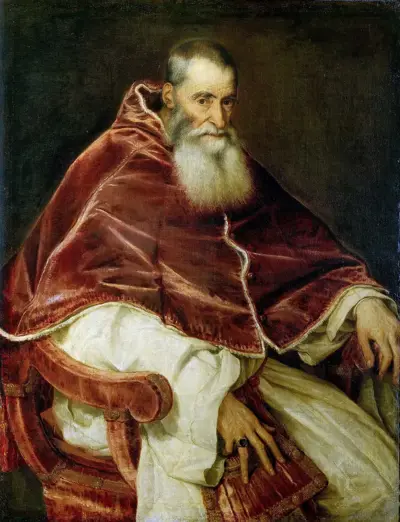
- Born: February 29, 1468
- Died: November 10, 1549
- Nationality:
- Profession:
Pope Paul III, born Alessandro Farnese, was head of the Catholic Church and ruler of the Papal States from 13 October 1534 to his death in 1549.
