Pius IX Quotes
Slavery itself, considered as such in its essential nature, is not at all contrary to the natural and divine law, and there can be several just titles of slavery and these are referred to by approved theologians and commentators of the sacred canons. It is not contrary to the natural and divine law for a slave to be sold, bought, exchanged or given. The purchaser should carefully examine whether the slave who is put up for sale has been justly or unjustly deprived of his liberty, and that the vendor should do nothing which might endanger the life, virtue or Catholic faith of the slave.
The defense of slavery in this Instruction is not a defense of the racial slavery that was prevalent in the South prior to the Civil War, but rather a philosophical defense of a just conception of slavery. Even so the Pope’s justification of the buying and selling of slaves flew in the face of a papal document issued by Gregory XVI twenty-seven years earlier {611428}. “Just titles” of slavery were approved by the Catholic Church in circumstances in which the person was deprived of their liberty justly. Specific examples in the past included slaves captured in war, persons condemned to slavery for a crime, and those who sold themselves into slavery. Even though the Vatican was defending “just titles” of slavery, this teaching has been seen as regressive and highly contradictory to true Catholicism. After this Instruction the distinction between just and unjust slavery in Catholic teaching would erode and twenty-one years later Pope Leo XIII {611844} would condemn slavery and openly support abolition throughout the world.
Pius IX, 1792-1878, Roman Catholic Pope, Congregation for the Doctrine of Faith, Instruction 20, 1866
Sourced by: Eigen's Political and Historical Quotations

While this apostolic letter condemned the slave trade, it fell short of clearly implicating the entire practice of slavery. It is clear that the Catholic Church at this time was reluctant to abandon its earlier teaching which approved of “just title” slavery. This distinction approved of “slavery” in circumstances in which the person was deprived of their liberty justly. Specific examples in the past have included slaves captured in war, persons condemned to slavery for a crime, and those who sold themselves into slavery.

Though Leo XIII was very much opposed to slavery, his claim that the Catholic Church “from the beginning” sought to end slavery overlooks the inconsistent reality of several of his predecessors’ teachings. For an example of this inconsistency one may find a relevant example as late as the 19th century, see the teachings of Gregory XVI {611428}, Pius IX {612304}, and Leo XIII {611844}


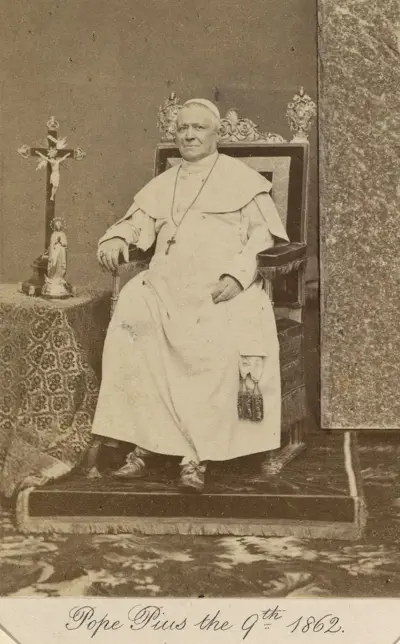
Pius IX was head of the Catholic Church from 1846 to 1878, the longest papal reign. After starting as a liberal he reversed positions and strongly condemned liberalism. He was notable for convoking the First Vatican Council in 1868 and for permanently losing papal control of the Papal States in 1870 to the Kingdom of Italy. He refused to leave Vatican City, declaring himself a "prisoner of the Vatican". His diplomacy mixes many failures with some successes such as Austria-Hungary, Portugal, Spain, Canada, Tuscany, Ecuador, Venezuela, Honduras, El Salvador, and Haiti.
