Pius IX Quotes
Slavery itself, considered as such in its essential nature, is not at all contrary to the natural and divine law, and there can be several just titles of slavery and these are referred to by approved theologians and commentators of the sacred canons.... It is not contrary to the natural and divine law for a slave to be sold, bought, exchanged or given
He was the last Pope to hold temporal power. This defense of slavery was all the more surprising because America was fighting about the issue in the Civil War and nations like England had abolished slavery. 99 years later Vatican II altered Pius IX’s statement forever. See {612715}.
Pius IX, 1792-1878, Giovanni Maria Mastai-Ferretti, Roman Catholic Pope, Instruction, June 20, 1866
Sourced by: Eigen's Political and Historical Quotations

This invalidated the official Catholic position taken 99 years earlier by Pope Pius IX. See {612301}.

This treaty shows slaves were a major currency of the times and cultures. The Arab Armies of Egypt and the Nubians with this treaty declared an armistice. The extensive Arab use of Black slaves officially begun at this time, has plagued Africa since. Arab slave traders were the middle men who met the European and American demand for slaves until the 19th century. Even at the millennium the Sudanese civil war between the Arab North and Black South has reflected this resentment and hostility and has involved the Northerner’s enslaving tens of thousands of Black Southerners.

The defense of slavery in this Instruction is not a defense of the racial slavery that was prevalent in the South prior to the Civil War, but rather a philosophical defense of a just conception of slavery. Even so the Pope’s justification of the buying and selling of slaves flew in the face of a papal document issued by Gregory XVI twenty-seven years earlier {611428}. “Just titles” of slavery were approved by the Catholic Church in circumstances in which the person was deprived of their liberty justly. Specific examples in the past included slaves captured in war, persons condemned to slavery for a crime, and those who sold themselves into slavery. Even though the Vatican was defending “just titles” of slavery, this teaching has been seen as regressive and highly contradictory to true Catholicism. After this Instruction the distinction between just and unjust slavery in Catholic teaching would erode and twenty-one years later Pope Leo XIII {611844} would condemn slavery and openly support abolition throughout the world.


Louisiana to this day has a different legal system from the rest of the United States as it was originally based on the French Napoleonic Code. Most people did not realize that Louisiana had strictures against breaking up families—even with slaves.


During the same year England outlawed the slave trade and English citizens and ships from participating in it.

This quotation illustrates the strong abolitionist tendency in the Ohio Territory. Under this clause, escaped slaves from Southern states would not be returned by the state authorities. Even more insulting to the slave enthusiasts of the South, if a Southerner brought any slaves into Ohio with them as was common for Southerners traveling with their personal slaves or horse team drivers, those slaves would be free. An interesting aspect of this clause of the Ohio Constitution was that the beginning was, word for word, copied from the Northwest Ordinance of 1787. See {618100}.

There was little thought of emancipating slaves or their value to the South by the senior officers of the Union Army at the beginning of the war. The Secretary of War however changed that. See {629184}.


In contrast to Massachusetts with had passed a law in 1641 banning slavery (Quote 643567), Maryland 22 years later became to first state to pass a law to formally recognize and allow Negro slavery.


Southern secession and the Civil War This is one of the major quotations with which historians rebut the revisionist view that the Civil War was about States’ Rights or other economic factors.


The Chinese laborers were slaves by most definitions of the word as they had been brought to South Africa on a system of indentured servitude. Slavery was illegal so the term had all kinds of political and legal significance. His statement was a masterpiece of admitting that it was almost slavery but leaving some wiggle room so as not to have classified it as such. Some use this as an example of Churchill’s capacity for hypocrisy.

The perception of the necessity of slavery was evident very early in the South.
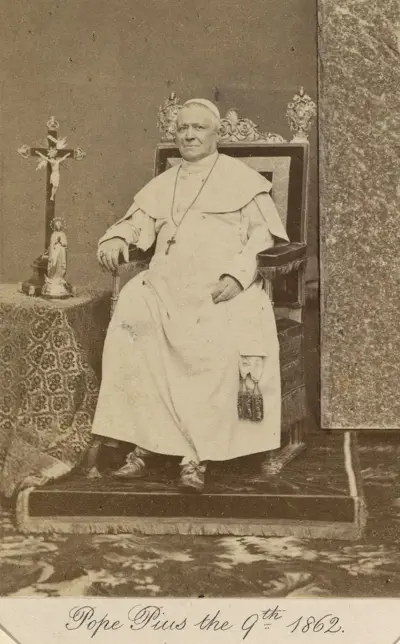
- Born: May 13, 1792
- Died: February 7, 1878
- Nationality:
- Profession:
Pius IX was head of the Catholic Church from 1846 to 1878, the longest papal reign. After starting as a liberal he reversed positions and strongly condemned liberalism. He was notable for convoking the First Vatican Council in 1868 and for permanently losing papal control of the Papal States in 1870 to the Kingdom of Italy. He refused to leave Vatican City, declaring himself a "prisoner of the Vatican". His diplomacy mixes many failures with some successes such as Austria-Hungary, Portugal, Spain, Canada, Tuscany, Ecuador, Venezuela, Honduras, El Salvador, and Haiti.
