SOUTH CAROLINA
Those who claim that the founding fathers contemplated religion as a critical component of government often point to this article of the South Carolina Constitution. However, they ignore the almost simultaneous passage of the New York constitution as in {612166}. When the framers of the Constitution met in 1787 in Philadelphia the separation of church and state issue was not really resolved and awaited the Bill of Rights where the separatists won out.
The coalescing of Public Opinion against slavery in the North was punctuated by the election of Abraham Lincoln in the eyes of the supporters of slavery left them with no where to turn within the Union. Secession followed.
The perception of the necessity of slavery was evident very early in the South.
This law was passed soon after the when South Carolina was controlled by abolitionist recinstructionists. Most blacks were trained for little else but being field hands or house servants. This was one example of several attempts to remedy that situation. Here the concept of indentured servitude was used as that had been a traditional method of an apprentice trading his labor for the opportunity to be educated and trained. It was not long before the racists again gained control of the legislature and via the Black Codes turned this program (like so many others) into variations of chattel slavery without legal ownership. Note that parental consent was required and that both Negroes and Whites could have apprentices. There were a few newly freed slaves that had developed skills and had a trade who took apprentices and some free Blacks from the North went South to start businesses, but soon were obstructed by the old Southern establishment.
The early laws regarding slaves were more protective in earlier Colonial America than they were after independence. In Colonial America all local laws and the enforcement thereof were subject to the government and king of England. When the Constitution was passed with the understanding that Slavery issue was not to be even discussed in Congress, there was NO OUTSIDE ENTITY to check any laws or lack of laws or the enforcement thereof. The Southern States were a law unto themselves on the slavery issue and the system became even more brutal and cruel with no moderating force. When such a force seemed close with the Republican 1860 victory, the South seceded. Then war was the moderating force.
This is an important quotation because it shows that slavery was the principle reason that the South succeeded and began their rebellion. In the early 20th century, there was a movement to make the Confederacy and the rebellion more noble by promoting the idea that the Civil War was fought by the South for more lofty reasons such as States Rights, Original Construction, different economic philosophies and the like. This was a more noble cause then the right to deny other human beings their rights, to own other human beings who they could beat, torture, sexually use and even murder them was a pretty selfish and demeaning reason to have started a rebellion that would then cost more Americans their lives than any other American conflict. The succession documents and others of the Southern States and the Confederacy make it clear that slavery was THE issue and fleeting references to any of the others were only made to complain about the potential effect on abolition and the refusal of the abolitionist states to cease aiding and protecting fugitive slaves.
In 1895, a Constitutional Convention was held in South Carolina in which there were no Republicans allowed and no Negroes despite the fact that 60 percent of the population at the time was Black. The constitution was do written that it would go into effect without being submitted to the people for any kind of ratification or approval. Essentially a tiny minority of wealthy white men of one particular persuasion not only determined the political future of the state, but also defined the requirements for voting so that this minority could perpetuate itself thereafter.
This agreement was not a law as an English colony like South Carolina could not pass a law that prohibited buying English merchandise. It was unofficial and great pressure was put on any citizen who would not sign it. The merchants that did import goods other than those allowed in the agreement were boycotted by most of the signers. This quotation illustrates what may have been the first organized protectionist actions to assist domestic producers and manufacturers. It is valuable for another reason. The quotation lists goods that are exempted from the boycott. These were goods that were not made in South Carolina or nearby states at the time since if they were, they would have been protected, So we can learn what was manufactured in the colony or nearby at the time—that which is nit on the list but was important to colonial life. The list tells us what was not manufactured locally, and one of the most important were firearms and ammunition. The inability to manufacture armaments plagued the colonies and early America after the revolution. One of the major public expenditures was to create and subsidize domestic arms manufacture.
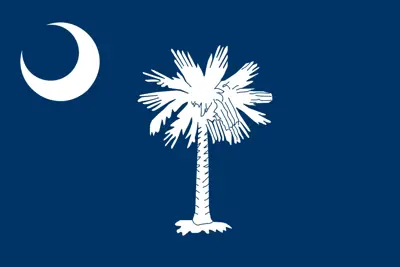
South Carolina (/ˌkærəˈlaɪnə/ (listen)) is a state in the Southeastern region of the United States. It is bordered to the north by North Carolina, to the southeast by the Atlantic Ocean, and to the southwest by Georgia across the Savannah River. South Carolina is the 40th most extensive and 23rd most populous U.S. state. In 2019 its GDP was $213.45 billion. South Carolina is composed of 46 counties. The capital is Columbia with a population of 133,273 in 2019; while its largest city is Charleston with a 2019 population of 135,257. The Greenville–Anderson–Mauldin metropolitan area is the largest in the state, with a 2018 population estimate of 906,626.
