OHIO
This quotation illustrates the strong abolitionist tendency in the Ohio Territory. Under this clause, escaped slaves from Southern states would not be returned by the state authorities. Even more insulting to the slave enthusiasts of the South, if a Southerner brought any slaves into Ohio with them as was common for Southerners traveling with their personal slaves or horse team drivers, those slaves would be free. An interesting aspect of this clause of the Ohio Constitution was that the beginning was, word for word, copied from the Northwest Ordinance of 1787. See {618100}.
The law went even further by requiring anyone employing a Black to have seen their certificate of freedom. This law in effect made slave escape to Ohio legally very difficult.
There was sufficient concern about possible corruption or the tyranny of the majority that this provision was written into the first Ohio Constitution of 1802.
This quotation illustrates a problem that had to be dealt with that we hardly think of today. Namely, can a senator or a member of the House of Representatives also hold a state or local office at the same time. Could a man be Governor and Senator? A local mayor and a Congressman? In some states this was possible but most like Ohio ruled it out.
Note the egalitarian and democratic nature of the method of selection of military officers. This was typical of frontier thinking—the men who were putting their lives on the line should have a say in who their leaders would be. The Governor and the legislature could only select the top officers like the Adjutant General or the Major General. Congress had retained the power to appoint general officers but allowed them and the civilian secretaries of the armed services to select all other officers. The latter enabled wealthy people to be appointed officers without any necessary competence and many even in the Civil War in effect bought their appointments by paying for the uniforms or bringing weapons. While America became more democratic and egalitarian over its first two centuries, the appointment of military officers is the one area where it became less democratic and egalitarian. The election of officers so popular in many states was gradually and finally abolished.
The Federal Constitution allowed impeachment only for “high crimes and misdemeanors.” This has left a vague impeachment standard and it has been a constant argument whether a particular misdemeanor has been “high” enough to reach a standard of impeachment. Ohio however, and some other states, had a much stricter standard for impeachment—any misdemeanor whatsoever can be an impeachable offense.
This clause was a throwback to the days before the separation of powers where the legislature could imprison anyone they thought contemptuous or interfering with their deliberation. Contrast this with the earlier constitution of Massachusetts which forbade the legislature from acting as a judge or prosecutor. See {616750} and {616749}. Also this was a clear invasion of freedom of the press and freedom of speech provided by the Bill of Rights. However, at the time, it was not clear that the Federal Constitution was binding on State Governments on State Matters. Modern law is still ambiguous on this general point, but not on freedom of speech and the press which is currently definitely binding on the states.
The election franchise in Ohio was originally only given to white residents who had paid state or local taxes. At the time, there were no sales or income taxes, so the only people who paid taxes were property owners. So this clause had the same effect as many other state constitutions of the time of limiting voters to the relatively wealthy. See the earlier Massachusetts Constitution {616748}. However, not that by this time race became a criterion in voting eligibility. In the Massachusetts case and some other states, a Black or an Indian who owned property could vote. But in Ohio, race per se was a disqualification if not white. This also precluded, Indians and Asians from voting in Ohio.
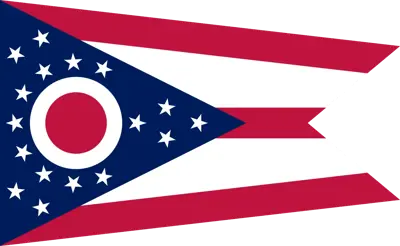
Ohio /oʊˈhaɪoʊ/ (listen) is a state in the Midwestern region of the United States. Of the fifty states, it is the 34th-largest by area, and with a population of nearly 11.7 million, is the seventh-most populous and tenth-most densely populated. The state's capital and largest city is Columbus, with the Columbus metro area, Greater Cincinnati, and Greater Cleveland being the largest metropolitan areas. Ohio is bordered by Lake Erie to the north, Pennsylvania to the east, West Virginia to the southeast, Kentucky to the southwest, Indiana to the west, and Michigan to the northwest. Ohio is historically known as the "Buckeye State" after its Ohio buckeye trees, and Ohioans are also known as "Buckeyes".
