PIUS IX
(Pope Pius IX | Giovanni Maria Mastai Ferretti)
The defense of slavery in this Instruction is not a defense of the racial slavery that was prevalent in the South prior to the Civil War, but rather a philosophical defense of a just conception of slavery. Even so the Pope’s justification of the buying and selling of slaves flew in the face of a papal document issued by Gregory XVI twenty-seven years earlier {611428}. “Just titles” of slavery were approved by the Catholic Church in circumstances in which the person was deprived of their liberty justly. Specific examples in the past included slaves captured in war, persons condemned to slavery for a crime, and those who sold themselves into slavery. Even though the Vatican was defending “just titles” of slavery, this teaching has been seen as regressive and highly contradictory to true Catholicism. After this Instruction the distinction between just and unjust slavery in Catholic teaching would erode and twenty-one years later Pope Leo XIII {611844} would condemn slavery and openly support abolition throughout the world.
He was the last Pope to hold temporal power.
He was the last Pope to hold temporal power. This was an oft repeated view.
He was the last Pope to hold temporal power. This defense of slavery was all the more surprising because America was fighting about the issue in the Civil War and nations like England had abolished slavery. 99 years later Vatican II altered Pius IX’s statement forever. See {612715}.
It is an error to say that He was the last Pope to hold temporal power. 101 years later, the Vatican rejected this view and accepted Protestantism at Vatican II.
It is an error to say that. It is an error to say that He was the last Pope to hold temporal power. Years later, the Vatican rejected this view and adopted the modern concept of freedom of conscience. See {612714}.
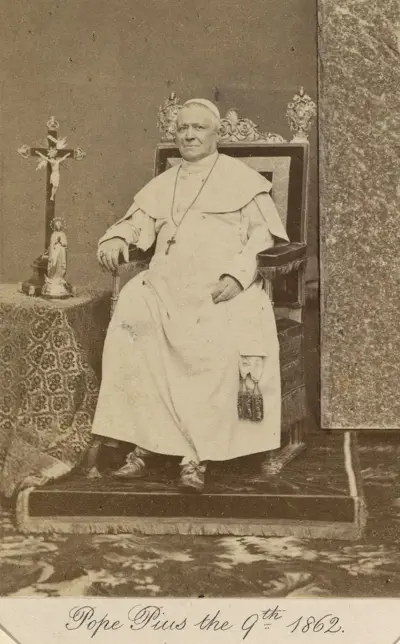
Pius IX was head of the Catholic Church from 1846 to 1878, the longest papal reign. After starting as a liberal he reversed positions and strongly condemned liberalism. He was notable for convoking the First Vatican Council in 1868 and for permanently losing papal control of the Papal States in 1870 to the Kingdom of Italy. He refused to leave Vatican City, declaring himself a "prisoner of the Vatican". His diplomacy mixes many failures with some successes such as Austria-Hungary, Portugal, Spain, Canada, Tuscany, Ecuador, Venezuela, Honduras, El Salvador, and Haiti.
