Pius IX Quotes
From Rome to America; A Roma Americae.
There are almost 200 different inscribed commemorative stones that were placed in the Washington monument at its original construction. These were sent from all over and were cemented into the inside and are still visible. However this particular stone roused the ire of the strong anti-Catholic element who violently opposed the concept that a Pope’s gift or anything from the Church would “blaspheme” the hallowed memory of George Washington. At the time, this Pope held temporal power in Italy as well as religious, and there was paranoid fear that with so many Catholics coming to America, they would want to turn over control of the American government to the Pope. A group of right wing Know Nothings broke into the warehouse and stole the Pope’s stone before it could be cemented into place. They then smashed it into pieces and spread the pieces in the Potomac River. The Know Nothings also managed to get control of the Washington Monument Society and then Congress cut off Federal Funds for the construction. When control had been wrested from the Know Nothings, the construction continued. However, the anti-Catholics had kept the Catholic stone out of the structure. In the1980s, the Papal gift stone was reproduced and placed in the Washington Monument with the other commemorative stones.
Pius IX, 1792-1878, Giovanni Maria Mastai-Ferretti, Roman Catholic Pope, Inscription of a commemorative stone sent to be placed in the Washington Monument when it was built, 1853
Sourced by: Eigen's Political and Historical Quotations


There was a private committee that was established to construct the Washington Monument. It’s cost was estimated at the huge sum of $1 million. Congress was willing to contribute the large amount of $200,000 but the rest had to be raised privately. The Committee invited all nations to contribute a block of stone to help build the monument. Pope Pius IX responded by sending an important, and historical block of marble which soon arrived in Washington, However, at the time, there was much anti Catholic prejudice in the United States. There was a very active third party populist movement and party—called the “Know Nothings” that, like the Tea Party of 2010, emerged rapidly and were quite influential politically. In particular the Know Nothings, self-professed great patriots, vowed that took no “Catholic Monument” would be part of the memorial to Washington, A group of them broke into the warehouse storing the marble block on October 20, 1853. The defaced the surfaces of the block and then dumped it in the Potomac River. Then they politically gained over of the Committee to see that such “anti-Americanism” would not corrupt Washington’s monument. The committee under the new leadership could not make any progress, and the monument, was not completed until 1884, long after the Know-Nothing Party was merely a historical footnote.


The Prime Minister, as a young child, had immigrated to America:

In Wales Tinplate factories had employed women. During a period of economic slowdown, Hattie Williams, a Welsh tinplate worker, emigrated to the United States and took a job in a tinplate factory in Pittsburgh. Labor organizations were strongly opposed to this “foreign” and “uncivilized” practice. In addition to the classic cultural arguments against women working, many labor leaders were convinced that women entering the labor force would depress wages.


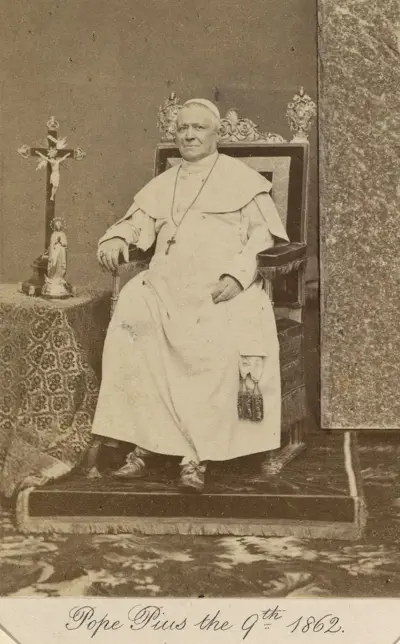
Pius IX was head of the Catholic Church from 1846 to 1878, the longest papal reign. After starting as a liberal he reversed positions and strongly condemned liberalism. He was notable for convoking the First Vatican Council in 1868 and for permanently losing papal control of the Papal States in 1870 to the Kingdom of Italy. He refused to leave Vatican City, declaring himself a "prisoner of the Vatican". His diplomacy mixes many failures with some successes such as Austria-Hungary, Portugal, Spain, Canada, Tuscany, Ecuador, Venezuela, Honduras, El Salvador, and Haiti.
