John Ruskin Quotes
The distinguishing sign of slavery is to have a price, and to be bought for it.
Ruskin, John. Munera Pulveris. Smith, Elder and Co., 1872, p. 142.


This is one of the major reasons that Slavery was so hard to end in the South. At the time, the dollar value of the Southern slaves was greater than the value of all the land, factories, inventory, and capital equipment of the South. Slaves were not only capital, they were the largest component of Southern capital and Southern wealth. There were numerous ideas of paying slave owners for the freedom of their slaves, and if this was done, it would have been far less expensive in money alone than the Civil War cost. However, the Southern leadership, like Fitzhugh, were totally intransient with culture and customs—indeed the Southern concept of manhood—was dependent in Slavery. The result was that no compensation was paid to slave owners and the South was impoverished as a result of its capital loss and it would not recover for 150 years.


Generally, Jefferson was not in favor of whipping slaves, but this quotation shows that he essentially accepted the basic principles of Southern Slavery—including the one that says if the person does not want to work for you, you may whip, beat, or torture him or her to produce “reasonable work.” This acceptance of slavery and profiting from it, is the terrible blot on the record of the man who otherwise was among the few greatest of Americans.

He was the last Pope to hold temporal power. This defense of slavery was all the more surprising because America was fighting about the issue in the Civil War and nations like England had abolished slavery. 99 years later Vatican II altered Pius IX’s statement forever. See {612715}.


John Sutter was an immigrant to California from Switzerland where he became a Mexican citizen. Slavery was outlawed in Mexico and its territories, yet Sutter and others maintained Indians as slaves. The Roman Catholic Missions of California also kept Indian slaves. This quotation is historically important because many people never realized that slavery was prevalent in California.


There was little thought of emancipating slaves or their value to the South by the senior officers of the Union Army at the beginning of the war. The Secretary of War however changed that. See {629184}.


In the Jim Crow era and well into the 20th century, many school books and historians, wanting to minimize the enmity between North and South, tended to a historical revisionism where the real brutal and immoral edge of slavery was minimized and slave owners were depicted as being in error by modern standards but well-meaning and paternalistic. Foner, with this famous quotation, put the lie to the false image of paternalistic slavery. By the beginning of the 21st century, there were very few serious historians who still tried to characterize slavery in the South as “paternalistic” otherwise humane. See {584014} for another of Foner’s famous quotes regarding slavery


American Communist Party newspaper. National Recovery Administration. The NRA was one of the key provision of FDR’s New Deal. The American right saw the program as Communist and left wing, while the Communists distrusted it as being right wing as this quotation illustrates. See also {46137}. The Supreme Court found the program unconstitutional ending this bizarre political debate. FDR was often attacked by both ends of the political spectrum but retained the support of a large coalition in the middle.

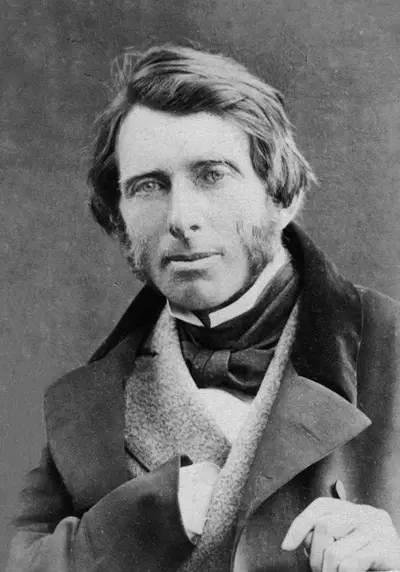
John Ruskin was the leading English art critic of the Victorian era, as well as an art patron, draughtsman, watercolourist, philosopher, prominent social thinker and philanthropist. He wrote on subjects as varied as geology, architecture, myth, ornithology, literature, education, botany and political economy.
