Daily Worker Quotes
… a slave program
American Communist Party newspaper. National Recovery Administration. The NRA was one of the key provision of FDR’s New Deal. The American right saw the program as Communist and left wing, while the Communists distrusted it as being right wing as this quotation illustrates. See also {46137}. The Supreme Court found the program unconstitutional ending this bizarre political debate. FDR was often attacked by both ends of the political spectrum but retained the support of a large coalition in the middle.
The Daily Worker Description of the NRA
Sourced by: Eigen's Political and Historical Quotations


John Sutter was an immigrant to California from Switzerland where he became a Mexican citizen. Slavery was outlawed in Mexico and its territories, yet Sutter and others maintained Indians as slaves. The Roman Catholic Missions of California also kept Indian slaves. This quotation is historically important because many people never realized that slavery was prevalent in California.


Referring to the Arawak natives he found when he landed in the "new world—San Salvador:"
Toward the end of the 19th century Cambodia became a protectorate of France. One of the first things that the French did was abolish slavery. There was a general rebellion as few in Khmer society wanted change of any kind.


The Chinese laborers were slaves by most definitions of the word as they had been brought to South Africa on a system of indentured servitude. Slavery was illegal so the term had all kinds of political and legal significance. His statement was a masterpiece of admitting that it was almost slavery but leaving some wiggle room so as not to have classified it as such. Some use this as an example of Churchill’s capacity for hypocrisy.

This is one of the major reasons that Slavery was so hard to end in the South. At the time, the dollar value of the Southern slaves was greater than the value of all the land, factories, inventory, and capital equipment of the South. Slaves were not only capital, they were the largest component of Southern capital and Southern wealth. There were numerous ideas of paying slave owners for the freedom of their slaves, and if this was done, it would have been far less expensive in money alone than the Civil War cost. However, the Southern leadership, like Fitzhugh, were totally intransient with culture and customs—indeed the Southern concept of manhood—was dependent in Slavery. The result was that no compensation was paid to slave owners and the South was impoverished as a result of its capital loss and it would not recover for 150 years.

Generally, Jefferson was not in favor of whipping slaves, but this quotation shows that he essentially accepted the basic principles of Southern Slavery—including the one that says if the person does not want to work for you, you may whip, beat, or torture him or her to produce “reasonable work.” This acceptance of slavery and profiting from it, is the terrible blot on the record of the man who otherwise was among the few greatest of Americans.


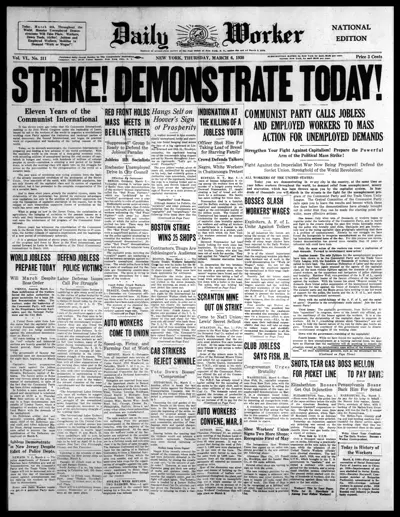
The Daily Worker was a newspaper published in New York City by the Communist Party USA, a formerly Comintern-affiliated organization. Publication began in 1924. While it generally reflected the prevailing views of the party, attempts were made to reflect a broader spectrum of left-wing opinion. At its peak, the newspaper achieved a circulation of 35,000. Contributors to its pages included Robert Minor and Fred Ellis (cartoonists), Lester Rodney (sports editor), David Karr, Richard Wright, John L. Spivak, Peter Fryer, Woody Guthrie and Louis F. Budenz.
