ANDREW JOHNSON

Senator Grimes thought that Andrew Johnson was a terrible President, but when the House of Representatives impeached President Johnson and he was tried before the Senate, Grimes voted for acquittal. His reason for the his vote was he thought that the Constitution did not provide for the removal if a President just because he has “Unacceptable.” Johnson survived removal from office by a single vote and had Grimes not been so principled about the Constitution, Johnson would have been removed from office. On the other hand, Johnson was a terrible President and many of the nations racial problems in later years emanated from his actions and inactions while in office.

Grant was so disgusted by Johnson’s performance and pandering to the former slave owners of the South that he ran for the presidency and became Johnson’s successor.

Johnson was probably the most racist president in American History. Also the most ignorant. He is the only President to have never attended a single day of school.

Referring to President Andrew Johnson:

Referring to President Andrew Johnson:

impeachment of President Andrew Johnson Garfield was then a Congressman

Garfield was then a Congressman.


Most of the factual accusations against Johnson were accurate. To this day it is argued whether the actions were impeachable offences or within the prerogatives and powers of the Presidency,
President Andrew Johnson had been impeached by the House of Representatives and was being tried in by the Senate. A majority of the Senators voted for conviction but the vote was 1 short of the two-thirds that were needed. Johnson remained in office.

This was America’s first Presidential impeachment which occurred just a few years after America’s greatest crisis—the Civil War. It was handled in an orderly, serious manner following the law throughout.

Butler had voted for the impeachment of President Andrew Johnson calling him a "criminal." He then attended the President's New Years reception and warmly greeted him. When asked to explain the seeming contradiction:
Professor Egerton documents how successful Reconstruction was in radically changing the positions of Blacks in the South. He points out that it was so effective that a hate-filled, racist group of Southern White terrorists, with murder, arson, torture and intimidation took over many of the governments of the South while President Andrew Johnson, who although he believed in the Union, was himself an inveterate racist and opponent of emancipation, would not use the force of the Federal Government to bring the terrorists to justice. (The KKK leaders were known in every state and county). They successfully overthrew Reconstruction and set the process back by 100 years.

In modern times, a President has the right to fire anyone in his own cabinet. However, at the time, there was a law that required a President to get the approval of Congress to fire a cabinet member who had been confirmed. The question for the impeachment trial was whether or not President Johnson’s breaking of the law was sufficiently serious a violation to constitute a “high crime or misdemeanor”. There are some who argue that the original meaning of “high crime” when the Constitution was written was treason.

He cast the deciding vote to acquit in the Andrew Johnson impeachment. He was the last of only 7 Republicans voting to acquit. His vote meant there would not be the required two/thirds of the Senate to vote in order to remove Johnson from office. His constituents were so angry with him that he was never reelected.
He had is slightly wrong. He also printed another error—that Lee and Defeated Grant in a Battle. Seward, although very badly wounded, survived.
Johnson was Vice President at the time. What he did not realize at the time was that one of the plotters was supposed to have killed him at the same time as the others, but the assassin got cold feet at the last minute and never entered Johnson’s house.
The then Vice President was accosted on the train by southerners who believed that he was on his way to his home state of Tennessee to persuade the legislature not to secede from the union. Amid cries to hang him and after he was punched by one of the mob, ex-Senator Wigfall—the man who had received the surrender sword at Sumter, who was also on the train, persuaded the crowd to hear Johnson out. Johnson thus began his speech which was potentially for his life, but never wavered from his view that secession was a mistake. Most of the crowd calmed down and as the train pulled out, they let him go though there were still a few shouts for “hanging.” There was no secret service protection for the President or vice President at the outbreak of the Civil War. Pinkerton had organized some informal protection for the President and thwarted some plots, but it was the Vice President who was attacked first. And there was not sufficient protection to prevent Lincoln’s assassination.
Publicly warning Louis Napoleon against his adventure in Mexico:
Under the pre-Civil War Southern economic system the poor whites had little chance of upward mobility and were in many wars as poorly off as slaves. Johnson saw this reform as much more important than the emancipation of the Negro.
For the required Oath, see {623308} . There were several to the amnesty. These included graduates of West Point and the Naval Academy who had joined the rebellion, senior officers and officials of the Confederacy, those who were accused of war crimes and abusing Union prisoners of war, persons who went abroad to help the Confederacy, and Northerners who had gone South to aid the rebellion. Many scholars think that although Lincoln had expressed his desire to provide an amnesty after the war was over, he probably would have been more lenient than Johnson who exempted many on the Southern side—especially the leaders. Ironically, Johnson was a Southerner but was personally, morally outraged at taking up arms against the United States and in that sense was much more of a hawk than Lincoln and many of the radical Republicans even. However, he was an inveterate racist and resisted most of the attempts to implement equality during the Reconstruction. Many argue that but for Johnson, Reconstruction might have been much more successful. It was easy for Southerners to resist equal rights for Blacks when they knew that the President was also opposed to measures to produce equality.
An armed, unruly band of hecklers interrupted a political rally and demanded that Johnson stop speaking:. The crowd was with him and he finished his speech without further trouble.
Johnson was probably the most racist president in American History. Also the most ignorant. He is the only President to have never attended a single day of school.
Johnson was a tailor by occupation, and was frequently derided as unfit for high public office. Jefferson Davis, one of his detractors, came in for his share of reply invective.
President Johnson was threatened with impeachment. His attorney, Jeremiah S. Black, suggested a government financial scheme that would enrich a small group of House members who were leaning toward impeachment:. Black was fired. The congressmen voted against Johnson. He was impeached.
Shortly after his presidential term expired:
An armed, unruly band of hecklers interrupted a political rally and demanded that Johnson stop speaking:. The crowd was with him and he finished his speech without further trouble.
When Jefferson Davis accepted the presidency of the Confederacy, Johnson observed:
The President was advised that if he maintained his policies he would be impeached:
Referring to the reconstruction period after the Civil War:
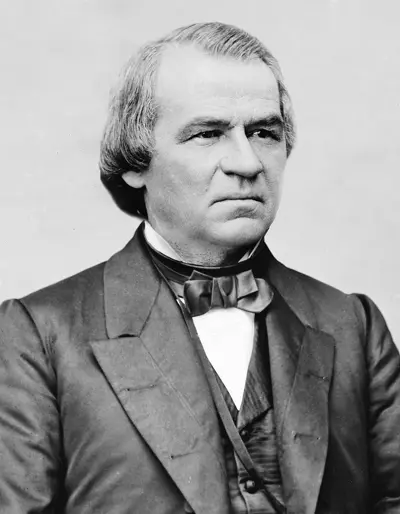
- Born: December 29, 1808
- Died: July 31, 1875
- Nationality: American
- Profession: President
Andrew Johnson was the 17th president of the United States, serving from 1865 to 1869. He assumed the presidency as he was vice president at the time of the assassination of Abraham Lincoln. Johnson was a Democrat who ran with Lincoln on the National Union ticket, coming to office as the Civil War concluded. He favored quick restoration of the seceded states to the Union without protection for the former slaves. This led to conflict with the Republican-dominated Congress, culminating in his impeachment by the House of Representatives in 1868. He was acquitted in the Senate by one vote.
