Andrew Johnson Quotes
The sovereignty of the States is the language of the Confederacy and not the language of the Constitution. The latter contains the emphatic words. This Constitution and the laws of the United States which shall be made in pursuance thereof and all treaties made or which shall be made under the authority of the United States, shall be the supreme law of the land and the judges in every State shall be bound thereby, anything in the constitution or laws of any State to the contrary notwithstanding
Johnson, Andrew. "First Annual Message." 4 Dec. 1865. A Compilation of the Messages and Papers of the Presidents, edited by James D. Richardson, vol. 6, Bureau of National Literature, 1897, p. 3555.


On June 12, 1789 a Senate committee proposed a federal court system for the nation. Maclay described it as:


This is the opinion that established the supremacy of the Supreme Court over state courts in Constitutional matters. There was an alternative view then that states were sovereign entities and their courts decisions could not be reviewed or overridden by the Federal courts. This case settled that issue,

Soon after Jackson's reelection, delegates from South Carolina, led by John C. Calhoun, moved quickly to declare "null, void, and no law" the Tariff Act of 1832. The president's reaction to the Ordinance of Nullification was swift.

When the 13 states were united only by the loose bonds of the Confederation, Jefferson wrote:


Commonly referred to as the Kentucky Resolution. This concept of Nullification was one of the factors that aggravated the tensions leading to the Civil War. Were the individual States to be the arbiters of whether or not a Federal act was Constitutional or was it to be the Supreme Court.


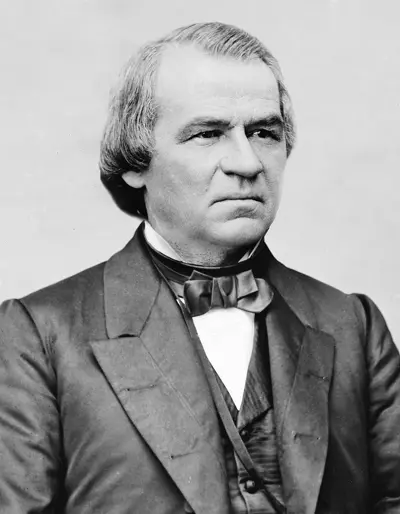
Andrew Johnson was the 17th president of the United States, serving from 1865 to 1869. He assumed the presidency as he was vice president at the time of the assassination of Abraham Lincoln. Johnson was a Democrat who ran with Lincoln on the National Union ticket, coming to office as the Civil War concluded. He favored quick restoration of the seceded states to the Union without protection for the former slaves. This led to conflict with the Republican-dominated Congress, culminating in his impeachment by the House of Representatives in 1868. He was acquitted in the Senate by one vote.
