John Marshall Quotes
So much of the several laws of the state of New York as prohibits vessels, licensed according to the laws of the United States, from navigating the waters of the state of New York, by means of fire or steam, is repugnant to the said Constitution and void…. the acts of New York must yield to the law of Congress
John Marshall, 1755-1835, Chief Justice of the U. S. Supreme Court, U. S. Congressman (Federalist, VA), U. S. Secretary of War, U. S. Secretary of State, Gibbons v. Ogden, 1824
Sourced by: Eigen's Political and Historical Quotations

Fulton issued permits and seized boats that operated without their endorsement. A steamboat operator, Thomas Gibbons, had received a permit from the Federal Government to operate steamboat service between New York City and the New Jersey Shore. Fulton and New York would not let him traverse Hudson Bay and land in New York. This set the stage for the most important Supreme Court Case on Interstate Commerce--Gibbons v. Ogden (1824). See {621351}.


President John Adams Alien and Sedition Acts were amongst the worst laws ever passed in America. It totally violated the First Amendment but at the time the Supreme Court had not ruled on the laws which prohibited criticizing the government. Ironically, it was Adams’s son, John Quincy Adams who finally led the repeal effort.


Martin and other anti-Federalists argued against ratifying the new Constitution as they thought that it was inimical to the state’s interest. The notion of Federalism as a danger to states is clearly stated in this quotation for the debate on Constitutional ratification. Fundamentally, are Senators representatives of their states or of the Federal Government. If the former, who can the senators be recalled or impeached by the states to who the presumably owe their loyalty? This issue, like so many others, was compromised. The States would control the selection and method of selection of the Senators but could not recall or impeach. Looking back, we see this as logically inconsistent. However, looking at it as a political compromise between two legitimate points of view, it seems quite reasonable. Early America was a combination of idealism and pragmatism which has carried throughout American history.


On June 12, 1789 a Senate committee proposed a federal court system for the nation. Maclay described it as:


Commonly referred to as the Kentucky Resolution. This concept of Nullification was one of the factors that aggravated the tensions leading to the Civil War. Were the individual States to be the arbiters of whether or not a Federal act was Constitutional or was it to be the Supreme Court.


The 10th Amendment reserves powers to the states and limits the Federal Government’s powers. However, there are other clauses in the Constitution, like the Commerce Clause (Article I Section 8), which gives the Federal Government authority and control over Interstate Commerce, which in modern society permeates almost all activities of State government, The result is that the federal government / state government power division has been a political issue and not really a constitutional one. At the time Republicans advocated a literal 10th Amendment interpretation and the Democrats favored a stronger Federal Government with more authority and power as stated by the Commerce Clause. Roy had been trying to explain to his fellow Republican strategists that it is hard to attract Blacks to the remainder to the Republican Platform as long as they were insensitive to what the 10th Amendment meant to Blacks historically. The Southern states cited the 10th Amendment more than any other part of the constitution to justify their right to maintain slavery. It was the Federal Government that ended slavery. Under the rubric of the 10th Amendment the South managed to get rid of most of the racial civil rights Reconstruction reforms that were imposed by the Federal Government on the Southern States. And it was the 19th Amendment that was the authority for Segregation for 100 years. And the terrorism of the Klu Klux Klan and the lynching and terror imposed on Blacks by Southern states claiming the 10th Amendment right to do so. Finally, it was the Federal Government, overriding the 10th Amendment with the Commerce Clause and other parts of the Constitution that passed and enforced the Civil Rights Act, the Voting Rights Act, Desegregation and the end to Lynching and other Southern State-Sponsored terrorism. Blacks will not any time soon accede to having the 10th Amendment literal view of the role of government and if Republicans insist on that there would continue to be very few Black Republicans,

She was explaining her antipathy to Muslim Fundamentalists having French citizenship or even sing allowed into the country.


Federal regulation of corporations involved in Interstate Commerce was then a “radical new notion”.
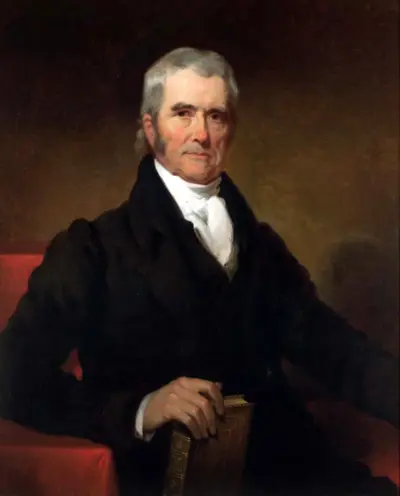
- Born: September 24, 1755
- Died: July 6, 1835
- Nationality: American
- Profession: Judge
John Marshall was an American politician and lawyer who served as the fourth Chief Justice of the United States from 1801 to 1835. Marshall remains the longest-serving chief justice and fourth-longest serving justice in Supreme Court history, and he is widely regarded as one of the most influential justices to ever sit on the Supreme Court. Prior to joining the Supreme Court (and for one month simultaneous to his tenure as Chief Justice), Marshall served as the United States Secretary of State under President John Adams.
