NEW YORK STATE
(New York)
While many use the invention and development of the Steamboat as an example of breakthrough technology by private enterprise, the reality was that Fulton and Livingston could not raise the private capital to develop the vessels and start operating them until the State government stepped in and granted them a monopoly for 20 years in the waters of the entire state of New York including the Hudson River and New York Harbor. This was one of the first examples of “corporate welfare” and subsidies for development of new technology. Fulton’s company used the courts to enjoin anyone else from operating a steamboat, and Fulton could charge very high rates as he had no competition thanks to New York State. Other boat operators then went to New Jersey which passed its own allowing anyone stopped by NY courts to sue Fulton & Livingston for triple damages. The lower Hudson River and New York Harbor was on the shores of BOTH states and each had an equal claim to jurisdiction. The Supreme Court settled the dispute in one of the major legal cases in American history. See {624485}
Note that in addition to getting rid of the authority of the King, New York—over a decade before the Bill of Rights and the First Amendment, provided for a ban on an established church or favoring one Christian sect over another. Even then New York was a multi religious and multi ethnic society with its strong Dutch tradition along with the English tradition. New York did not go as far as the First Amendment would do later in terms of freedom of religion. NY only mentioned Christian sects. However they did implement separation of church and state and an establishment clause. See {621429} for another clause that ensures separation of church and state.
This was one of the strongest statements of religious freedom in America prior to the Bill of Rights which came over a decade later.
New York State was so concerned about the separation of church and state that they would not allow any religious cleric or official, to serve in any position of the state militia or government. Delaware had earlier placed the same prohibition against clerics serving in any branch of the government. See {621428} The Bill of Rights did not go that far, but there are a few religions that also support this notion. Perhaps the most dramatic example was Pope John Paul’s prohibition of Priests running for elective office.
This was one of the early exceptions to the requirement for “oaths” and allowing affirmations for those who would be religiously offended by taking an oath.
In the early days of the republic, states not only had their own militias but some had their own navy. Texas today still has the right to have its own navy.
There are many methods of voting in a legislative body. “Viva Voce” is Latin for “by Voice” and is often called a “Voice Vote”. Voting by ballot takes longer but had the advantage or disadvantage of secrecy. The theory was that if the New York Legislators could vote in a secret ballot, the lobbies and special interests would not be as influential since they would never know for sure—unless there were a unanimous vote—how any particular legislator voted. A further advantage is that Party Discipline could not be imposed and parties or “factions” as they were then called would be less powerful—a great concern of all the patriots who tended to distrust parties. The disadvantage was that the people who elected the legislator would never know how he voted. Note the frank admission that this was an “experiment”. Americans of the era realized that almost everything they were doing was a political experiment and this introduced a pragmatic force into structure and procedures of American politics.
For those who doubt that there was intended a rigid separation between church and state, they have but to contemplate this passage. However, at about the same time, the State of South Carolina moved in its constitution in an opposite direction. See {612573}. When the framers of the Constitution met in 1787 in Philadelphia the separation of church and state issue was not really resolved and awaited the Bill of Rights where the separatists won out.
The Jury Trial was part of New York Law more than a century before the Constitution.
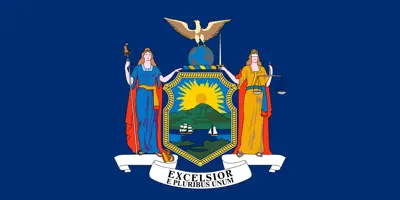
New York is a state in the Mid-Atlantic and Northeastern regions of the United States. It was one of the original thirteen colonies forming the United States. With a total area of 54,556 square miles (141,300 km2), New York is the 27th largest state; its population of more than 19 million people as of 2020 makes it the fourth most populous state in the U.S. The state is bordered by New Jersey and Pennsylvania to the south and Connecticut, Massachusetts, and Vermont to the east; it has a maritime border with Rhode Island, east of Long Island, as well as an international border with the Canadian provinces of Quebec to the north and Ontario to the northwest. It is sometimes referred to as New York State to distinguish it from New York City, which is its largest city.
