New York State Quotes
If, after a full and fair experiment shall be made of voting by ballot aforesaid, the same shall be found less conducive to the safety or interest of the State than the method of voting viva voce, it shall be lawful and constitutional for the legislature to abolish the same.
There are many methods of voting in a legislative body. “Viva Voce” is Latin for “by Voice” and is often called a “Voice Vote”. Voting by ballot takes longer but had the advantage or disadvantage of secrecy. The theory was that if the New York Legislators could vote in a secret ballot, the lobbies and special interests would not be as influential since they would never know for sure—unless there were a unanimous vote—how any particular legislator voted. A further advantage is that Party Discipline could not be imposed and parties or “factions” as they were then called would be less powerful—a great concern of all the patriots who tended to distrust parties. The disadvantage was that the people who elected the legislator would never know how he voted. Note the frank admission that this was an “experiment”. Americans of the era realized that almost everything they were doing was a political experiment and this introduced a pragmatic force into structure and procedures of American politics.
New York State, Article VI, New York Constitution, April 20, 1777
Sourced by: Eigen's Political and Historical Quotations


This constitution was written 7 years before the national constitutional convention. It shows that there was concern about the separation of powers in United States even before the Constitution was drafted. See {616749} for an even clearer statement of the separation of powers principle. The national legislatures in Europe had commonly declared people traitors and in many cases incarcerated or executed them. This clause, effectively presaged the national constitution of 1787 where the Congress was prohibited from trying people for treason or anything else except impearchment.

In most legislatures, the leader of the majority party can usually prevent any proposed legislation from coming to a vote. Many will use that individual power to block any legislation that they do not support. Others like Skelos believes that democracy requires that the entire legislature have the opportunity to vote on an issue and that a single individual or even a majority of the majority should not be able to block a vote as this would disenfranchise the legislators. In this case, the bill was to legalize Gay Marriage—a very controversial proposal. When the vote was taken, 4 Republicans and all but one Democrat voted in favor. The other Republicans and the one Democrat voted against. The bill passed and New York became the first large state to legalize Gay Marriage. Skelos, who opposed the bill, was castigated by conservatives of his own party for not using his power to prevent the vote from ever happening, and putting principle above party.


The University Presidents had written to the American Public arguing that the German aggression was the result of the militarists in the German society dominating the people and pushing them to war. They argued that most German people were not really responsible. Lamprecht took exception and argued that the German policy was the democratic will of the majority of the German people. He claimed that Germany at the time was more of a de facto democracy than America—as the Untied States did not have a Voting Rights Act or any way of de facto ensuring that all citizens could vote—particularly Negroes in the South. While he was accurate about the voting aspects of a democracy, Germany neither had the Constitution nor a judiciary that was independent and co-equal to the executive and legislature, but Germany did not have the institutions with democratic traditions. The greatest embarrassment to modern Germans is that Adolf Hitler was actually elected by a majority of Germans and was very popular until things in Germany started to go poorly. This quotation is very important in that it shows the importance of a Constitution to limit the powers of even a popularly elected government.


At the time most legislatures never had recorded votes but instead often depended on voice votes and other methods. Edison’s invention was a huge failure. Transparency was not a popular concept amongst politicians as it still is not, but some standards have changed.


In the English system there is no “separation of powers”. Parliament makes the laws and its ministers execute them. The highest judges are members of Parliament (the House of Lords) as well. So Lord Bereford was in the legislature when the statute was debated and passed.

This clause was a throwback to the days before the separation of powers where the legislature could imprison anyone they thought contemptuous or interfering with their deliberation. Contrast this with the earlier constitution of Massachusetts which forbade the legislature from acting as a judge or prosecutor. See {616750} and {616749}. Also this was a clear invasion of freedom of the press and freedom of speech provided by the Bill of Rights. However, at the time, it was not clear that the Federal Constitution was binding on State Governments on State Matters. Modern law is still ambiguous on this general point, but not on freedom of speech and the press which is currently definitely binding on the states.
This Cahier was the consensus of the Clergy of Blois in 1789. There were cahiers of several provinces of France—some by the clergy, some by the nobles. What is fascinating is the emergence of many of the pre-revolutionary French concepts. The example of the American revolution and its principles was known throughout the educated classes of France.


Whereas most revolutions radically change the law from the preexisting laws, the American revolution essentially embraced most of the common law of England, English statutes and New York Colonial Statutes. The New York constitution reserved the right to change any of them, but the change Americans sought was partial and limited to certain areas. See {621430} for some examples of changes.

When requested to have the assembly remove items in the proposed constitution at the last minute:

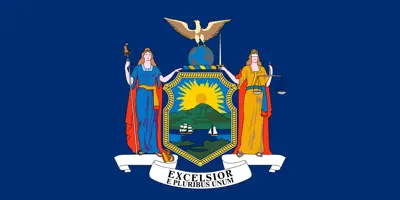
New York is a state in the Mid-Atlantic and Northeastern regions of the United States. It was one of the original thirteen colonies forming the United States. With a total area of 54,556 square miles (141,300 km2), New York is the 27th largest state; its population of more than 19 million people as of 2020 makes it the fourth most populous state in the U.S. The state is bordered by New Jersey and Pennsylvania to the south and Connecticut, Massachusetts, and Vermont to the east; it has a maritime border with Rhode Island, east of Long Island, as well as an international border with the Canadian provinces of Quebec to the north and Ontario to the northwest. It is sometimes referred to as New York State to distinguish it from New York City, which is its largest city.
