John Marshall Quotes
The legislature makes, the executive executes, and the judiciary construes the law; but the maker of the law may commit something to the discretion of the other departments, and the precise boundary of this power is a subject of delicate and difficult inquiry.
John Marshall, 1755-1835, Chief Justice of the U. S. Supreme Court, U. S. Congressman (Federalist, VA), U. S. Secretary of War, U. S. Secretary of State, Wayman v. Southard, 1825
Sourced by: Eigen's Political and Historical Quotations


When the Senate was debating the Gulf of Tonkin Resolution, which would empower the President to take "all necessary measures" to repel any armed attack on U. S. forces, Senator Morse was one of only two Senators opposing the resolution:

Hatch was the chairman of the Senate Judiciary Committee at the time.

The separation of powers concept was adopted from the American Constitution of the previous year. See {585394}.


The view that the Supreme Court was the final arbiter of constitutional controversies was not held in early America.


Jefferson’s fears were later reinforced by John Marshall in Marbury v. Madison {606468}

There was much argument over the desired relative strength and power of the three branches of government. Wilson suggested equality. We argue about it to this day.

This constitution was written 7 years before the national constitutional convention. It shows that there was concern about the separation of powers in United States even before the Constitution was drafted. See {616750} for an even clearer statement of the separation of powers principle.


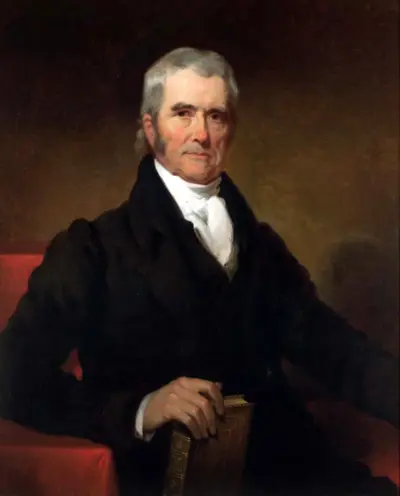
John Marshall was an American politician and lawyer who served as the fourth Chief Justice of the United States from 1801 to 1835. Marshall remains the longest-serving chief justice and fourth-longest serving justice in Supreme Court history, and he is widely regarded as one of the most influential justices to ever sit on the Supreme Court. Prior to joining the Supreme Court (and for one month simultaneous to his tenure as Chief Justice), Marshall served as the United States Secretary of State under President John Adams.
