Robert M. Gates Quotes
I wish I could set deadlines for the Congress, but that's just not the way the Constitution is written.
Gates, Robert M. Department of Defense Press Briefing. 19 Apr. 2007, The Pentagon, Arlington, VA.


This was an insult to the George W. Bush administration which had stretched the Constitution more so than any previous administration, had asserted Presidential powers that had never been asserted before and had had several of its more controversial policies and practices overturned by the Supreme Court.


In 2012 the Republicans controlled the House but not the Senate or the White House. As the nation grows, the Congressionally voted budgets have implications and the budget ceiling has to be raised to balance the two. That had always been a bipartisan process over the life of the nation. However, the Republicans in the House decided that they would hold the debt ceiling legislation hostage to pressure the Senate and the White House to pass legislation that the majority of the Senate and the President thought was bad for the country. Krugman advised the President and the Senate to resist giving in to this blackmail even if the debt ceiling was hostage to their demands.


His main reason for believing this is that all appropriations bills must be initiated by the House of Representatives. Lobbyists therefore often give the House more attention than the Senate.


This is an interesting variation of the FDR quotation regarding the President and Congress.


When the Senate was debating the Gulf of Tonkin Resolution, which would empower the President to take "all necessary measures" to repel any armed attack on U. S. forces, Senator Morse was one of only two Senators opposing the resolution:

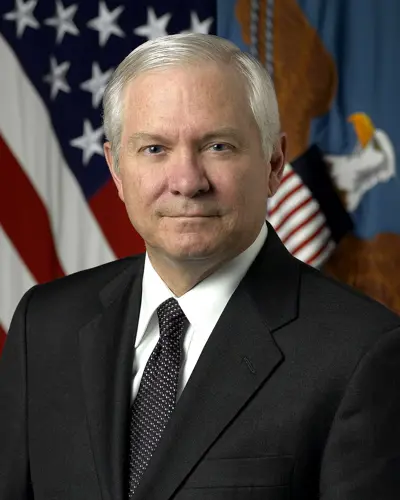
Robert Michael Gates is an American intelligence analyst, and university president who served as the 22nd United States secretary of defense from 2006 to 2011. He was originally appointed by President George W. Bush and was retained for service by President Barack Obama. Gates began his career serving as an officer in the United States Air Force but was quickly recruited by the Central Intelligence Agency (CIA). Gates served for 26 years in the CIA and the National Security Council, and was Director of Central Intelligence under President George H. W. Bush. After leaving the CIA, Gates became president of Texas A&M University and was a member of several corporate boards. Gates served as a member of the Iraq Study Group, the bipartisan commission co-chaired by James A. Baker III and Lee H. Hamilton, that studied the lessons of the Iraq War.
