HERBERT HOOVER
(Herbert Clark Hoover)

Although obvious oversimplifications, these were key strategic elements of these Presidential campaigns.

Hoover was a brilliant engineer. Harding was a little weak intellectually.

The ride was the 1933 inaugural where the outgoing President rode down Pennsylvania Avenue with his successor. Roosevelt had tried to engage Hoover in conversation and Hoover refused. For years after that FDR used to tell the story and would imitate Hoover with grunts and facial contortions.

World War I veterans had been promised bonuses for their service, but Congress and the President would not deliver. The economy was terrible and thousands of veterans came to Washington, set up a camp in Anacostia, and asked for help and their bonuses. Hoover had given orders to General Douglas MacArthur to remove the protesters from government buildings, but MacArthur, establishing a pattern that he would follow throughout his career, exceeded he orders and chased the protesters all the way back to their tent camp and then destroyed the camp. The Great Depression was raging and the protesters had no other place to live, and Hoover opposed any direct federal aid to the poor and needy making the Depression even worse. The public reaction was shock and anger. Hoover, however, demonstrating political character and integrity, took the responsibility and did not blame MacArthur. It was the nail in Hoover’s political coffin. Roosevelt easily won the election.
Herbert Hoover was the President of the Association at the time.

Some Democrats had been making personal attacks on Herbert Hoover, Baruch a Democratic supporter was outraged and put a stop to much of it. His letter to Hoover is the high water mark in the ethics and methods of Presidential campaigning. 80 years later, there was a Republican Presidential Nomination contest in which there was almost no content other than personal attacks on the other candidates interspersed with personal attacks on the incumbent President. It was one of the low points of Presidential campaigning.

New Deal opponents are generally thought of as Conservatives. However, the Communists are as much of an opponent as any of the right wing organizations. However, in classic Communist Party style, when Stalin and the Russians became war allies and Russia needed arms and financial assistance from the U. S., the American communists fell into line and flip-flopped on Roosevelt and the New Deal.

Ex-President Calvin Coolidge was giving advice to Herbert Hoover. Hoover's rejoinder was: No, but I do expect to see contented cows.
The wording implied that if the upcoming convention should draft him for a second term, he would run. But the convention was more interested in politics than in exegesis. Coolidge was ignored, and Herbert Hoover won the nomination.

The Banks and Wall Street were much to blame of the Great Depression which began in 1929. Many called for reform and heavy regulation of the finance industry. However President Hoover was very passive and the Depression became worse. Hoover also opposed ANY regulation of banking or Wall Street. Hence the names in this quotation. The Priest was the right wing demagogic radio host of his day. Virulently anti-Semitic and anti-Black, he was threatened with excommunication by the Catholic Church, which finally ordered him to cease us weekly radio show and stop the political hate.

The Germans had great respect for Hoover’s work feeding the hungry of Europe.

There was a little known, historical precursor to Watergate. In 1930 a beleaguered President Hoover was informed that a Democratic politician named O'Brien had accumulated a personal file on the President which was personally and politically damaging. Hoover, through Louis L. Strauss, turned to the Office of Naval Intelligence which conducted a "black bag job" and broke into O'Brien's office, which turned out to be empty. The files were never found, and the burglars were never caught:

Herbert Hoover had made a name for himself by his splendid administration of World War I famine relief, but he was also :

When the dam was under construction, it was referred to as the “Boulder Canyon Project”. However, the Great Depression was raging and President Hoover had to run for a second term the following year with a terrible economy. Hoover’s Secretary of the Interior, named it “Hoover Dam” and on February 14, 1931, Congress made the name "Hoover Dam" official. Hoover lost to FDR, and the Interior Secretary—a Republican—sent this memo calling the dam, “Boulder Dam” for the first time. At the time Hoover was one of the least popular names in the United States. The Stock Market crash and the Depression occurred on "Hoover's watch." Hoover was blamed not only for the economic crisis, but with being hard-hearted by not using the power of the Government to help the suffering families. Ickes thought it was essential that the public overcome their fear and hopelessness. Hoover was just the image that most people wanted to forget, and this in large part motivated the name change.
The nation was facing a ruined, unregulated economy with 25% unemployment.

Hoovervilles were camps of people who lived in city parks or empty land. Tar paper shacks sheltered some—others lived in boxes. People had no work and no prospects of work; they had no money for rent; they just lived a meager existence as best they could under conditions that today exist only in the third world. They were named Hoovervilles for the President at the time whose ineptness and philosophy simply let things deteriorate. Republicans were critical of many of Roosevelt’s economic policies, but the president would periodically remind them and the nation of what the situation was when the Republicans last ran the country.

Mellon was one of the richest men in America and a very powerful Treasury Secretary who served under 3 presidents. However, he was very independent with his own power base which was what made Norris’s line very funny. It was politically impossible for the President’s to fire Mellon.

What is particularly interesting in this quotation is her use of the term “untried methods”. To most conservatives of any party “untried methods” connotes something bad and to be avoided. Yet to Mrs. Roosevelt and her husband, along with the New Dealers and many other Democrats, viewed “untried methods” as a virtue and a President willing to use untried methods and experiment was to them dangerous and inadequate for the modern world. “Tried and true” approaches are fine as long as they work and the nation is not facing a new situation. Franklin Delano Roosevelt, assuming the Presidency in the midst of the Great Depression realized that President Herbert Hoover had tried all the “tried and true” methods and was an excellent administrator. Yet the nation was in mortal crisis. So the Roosevelts and the New Dealers tried a number of solutions that had never before been attempted—Social Security, Closing aA(the)ll banks and stopping foreclosures, the CCC, WPA are just a few. Some did not work; some were declared unconstitutional and we will never know whether or not they would have been effective, and some were so effective that they are now considered “tried and true” like Social Security.

This quotation amazes many people who believe that Hoover caused the Great Depression and that Roosevelt and the Democrats accused him of this. Actually, as Mrs. Roosevelt says here, the causes were the policies of the Republicans who preceded Hoover. Hoover was actually to blame for not doing much about the Depression. He believed philosophically that the Government should not “intervene” in the market place and that government assistance to individuals would damage their character. Most Americans saw this as uncaring and callous.

March 4, 1933 was the date that Franklin Delano Roosevelt had assumed the Presidency from Herbert Hoover and used government to combat the Great Depression whereas Hoover would not take any of these steps as the conservative wing of his party and he regarded anything that government did was “creeping socialism”. Historically, it is useful to recall what steps Roosevelt took that were described as socialism. These include Social Security, Federal Deposit Insurance for bank accounts, aid to farmers, the Civilian Conservation Corps, Regulation of the stock market, regulation of banks and many other things that are key elements of modern capitalism which virtually every capitalistic nations has in one form or another. Long after Truman was out of office, the most conservative elements of the Republican Party have accused every Democratic President of “creeping socialism” when they were actually quite opposed to socialism. Even when their career before their presidency was full of criticisms of socialism and policies that are opposite, as in the case of President Obama, the President has been accused of being a socialist. However, it started with Franklin Delano Roosevelt and Harry S Truman.

The Great Depression was afflicting the nation. Farmers and homeowners who lost jobs (over 35%) or could not sell produce at a decent price could not pay their mortgage debts and homes and farms were being foreclosed in record numbers. Veterans who had saved the nation in WWI and farmers who had fed the population were impoverished and homeless. Rankin appealed to President Herbert Hoover to place a moratorium in bank foreclosures, which not only ruined the individuals but drove down the value of real estate by throwing so much on the market at a time when few had money to buy. Hoover, an otherwise decent man and an excellent administrator, had a blind spot and would not consider having the government solve or alleviate any of these problems as he felt that this would be bad for the national character. By 1932, the voters threw Hoover out and elected Franklin Delano Roosevelt who used the power of government in new and imaginative ways, improved the economy. Profided relief, and prevented a popular revolution and many believed saved capitalism from its own excesses.

Ruth did have a great year. Hoover was floundering after presiding over the stock market crash and the Great Depression that followed.

Historically, these were not countries like Egypt, Tunisia, Morocco or Iran. They were created artificially by the European powers in the 20th century.

This quotation electrified the crowd as few speeches at Democratic conventions ever had. The speech turned Cuomo into a national political figure and made him the front runner for the Democratic Presidential Nomination for the next 8 years. But he never chose to run despite overwhelming support and polls indicating he would be victorious in a general presidential election.
There are some who believe that this quotation demonstrates more than any other Hoover’s blind spot regarding the non-rich in America which led to his inaction in the face of the Great Depression.
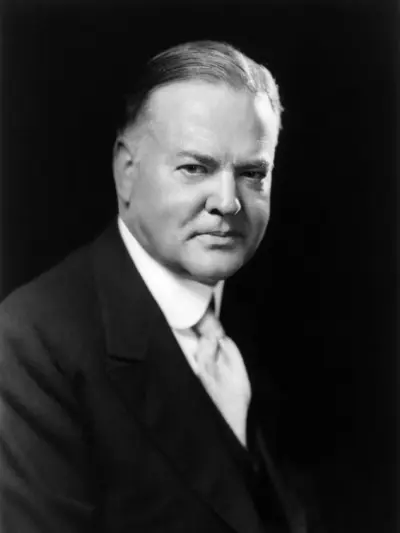
- Born: August 10, 1874
- Died: October 20, 1964
- Nationality: American
- Profession: President
Herbert Clark Hoover was an American politician, businessman, and engineer, who served as the 31st president of the United States from 1929 to 1933. A member of the Republican Party, he held office during the onset of the Great Depression. Before serving as president, Hoover led the Commission for Relief in Belgium, served as the director of the U.S. Food Administration, and served as the third U.S. Secretary of Commerce.
