Eleanor Roosevelt Quotes
Willkie stood head and shoulders above all the others. If his party had permitted him to act independently, he might possibly even have rivaled my husband's New Deal, or President Truman's Fair Deal, in an effort to give the people what he felt they were entitled to have. His defeat, I believe, was largely due to the fact that many people realized how well organized and conservative was the backbone of the Republican party and did not dare trust him at that time to meet the complicated problems arising which might call for the courage to use new and untried methods.
What is particularly interesting in this quotation is her use of the term “untried methods”. To most conservatives of any party “untried methods” connotes something bad and to be avoided. Yet to Mrs. Roosevelt and her husband, along with the New Dealers and many other Democrats, viewed “untried methods” as a virtue and a President willing to use untried methods and experiment was to them dangerous and inadequate for the modern world. “Tried and true” approaches are fine as long as they work and the nation is not facing a new situation. Franklin Delano Roosevelt, assuming the Presidency in the midst of the Great Depression realized that President Herbert Hoover had tried all the “tried and true” methods and was an excellent administrator. Yet the nation was in mortal crisis. So the Roosevelts and the New Dealers tried a number of solutions that had never before been attempted—Social Security, Closing aA(the)ll banks and stopping foreclosures, the CCC, WPA are just a few. Some did not work; some were declared unconstitutional and we will never know whether or not they would have been effective, and some were so effective that they are now considered “tried and true” like Social Security.
Eleanor Roosevelt, 1884-1962, First Lady (Franklin Delano Roosevelt), U. S. Delegate to the United Nations, Assessment of the Republicans who ran for President against her husband, Franklin Delano Roosevelt Newspaper Column, My Day, August 6, 1951
Sourced by: Eigen's Political and Historical Quotations

Dewey had been the Republican Presidential Candidate in 1948. Although he and the Republicans were the overwhelming favorites, Dewey lost to Harry S Truman. In 1952, Dewey was a major supporter of Robert Taft for the Presidency. But other Republicans including Dirksen wanted Dwight D. Eisenhower as the candidate. Dewey had given a rousing speech telling the Party to nominate Taft. Dirksen then responded. Such a public rebuke of a former standard bearer was considered very insulting. However, Dirksen was saying what most Republicans believed. Despite an intense effort by Taft and the very conservative wing of the Party, Eisenhower was selected as the nominee and he won the Presidency.

Republican Party primary elections had become very contentious. The radical right and the Tea Party, though a minority of the party, had the power to destroy almost any Republican candidate’s chances. So those Republican political candidates were forced to pander to the extreme right and then try and backtrack to the center for the general election. As a result, few people believed the statements of Republican office seekers as no one knew what they really believed including members of their own party, Bush, no longer running for any political position, found himself with much more credibility and influence in the party than those who were running for office. The problem of appealing to party extremes was not unique to the Republicans at that time, but the degree and extent was unprecedented accounting for the distrust.

This quotation shows FDR doing something that politicians rarely do. The country was in the midst of the Great Depression and he was running for the Presidency against Herbert Hoover who as President would do little to help the destitute part of the population or improve the economy. Roosevelt did not lay out specific programs which he claimed would fix the problem. He himself really didn’t know for certain what would and what would not. However he promised bold experimentation—trying new things. When he was elected, he was able to fail with one program and just shift to another until enough were successful. But the great contrast was to Hoover who would do little.
Two of the 20th centuries greatest political leaders were Mao Tse-Tung and Franklin Delano Roosevelt. In most respects, these two were polar opposites. However, they had one characteristic in common. They were both willing to try things they were not certain of. If they succeeded, make it a part of the national program. If it failed, try something else. See Mao {642795}.

He and many ultra conservatives believe that given a choice between a moderate Republican and a Democrat, the Democrat will win because the conservative wing of the party will never by enthusiastic about a moderate candidate. The moderate Republicans argue that Republicans are a minority party and especially so when it comes to electoral votes. To win a Republican must get Independent and Moderate Democrat votes. A very conservative candidate will never be able to do that.


In 2012, the Republican party had shifted to the right and was split between two factions. None of the 4 leading candidates had the support of a majority of the activist Republicans who vote in Primary elections. The then started to vie with each other for the most conservative elements of the party and did so by attacking the other candidates, making moral pronouncements and attacking President Obama. None of them offered any positive programs or solutions to the problems they claimed existed, and the attacks on the others were always that they were “really not conservative” and “could not get elected.” The result was that all the candidates negatives rose.

The Republican candidates were campaigning for the Primary election in Illinois. Lincoln was the first and the greatest of the Republican Presidents and a great liberal. The Republicans used to be the more liberal of the two American major parties and even referred to themselves as “radicals.” However the political parties flip flopped over time and in the 2012 primary campaign the Republican candidates were outdoing each other to show who was the most conservative and could trash liberals the most. Pointing out this contradiction between the politics of the first and most popular Republican President and the then current crop of contenders was a little embarrassing to some Republicans and a powerful anti-current Republican message to independents and Democrats.


She was a nondescript minor functionary in a Tea Party Active Southern County, and her hatred of the Black president was hardly noteworthy. What makes this an important quotation is that it was frequently shown to foreigners who really did not understand the great degree of freedom of speech. Here a public official being paid by the government, not only calls for the removal of a sitting president, but also openly asked the army to rebel against their commander in chief. She was not punished, nor even arrested or tried. She was not even dismissed from her elected government job. That was up to the voters in the next election. There likely is no other country in the world where that can happen.

This was very consistent with the programmatic philosophy of his boss, FDR, who campaigned on no specific solutions to the Great Depression but promised to try things and of the did not work, try others. His predecessor, Hoover, would try nothing as most ideas contradicted his philosophy or was not favored by the wealthy business interests of the day.
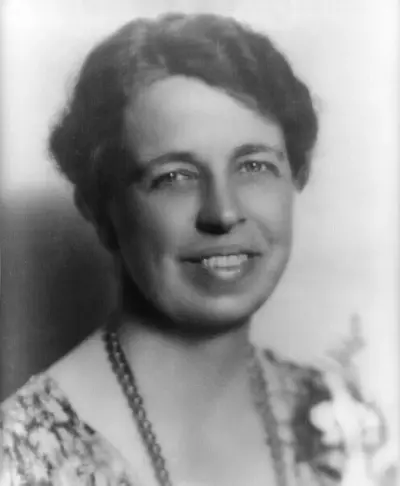
Anna Eleanor Roosevelt was an American political figure, diplomat and activist. She served as the First Lady of the United States from March 4, 1933, to April 12, 1945, during her husband President Franklin D. Roosevelt's four terms in office, making her the longest-serving First Lady of the United States. Roosevelt served as United States Delegate to the United Nations General Assembly from 1945 to 1952. President Harry S. Truman later called her the "First Lady of the World" in tribute to her human rights achievements.
