Lawrence Wilkerson Quotes
Vice President Cheney really knew how to bring out the cowboy in George W, Bush.
For the actual remark. See {621249}
Lawrence Wilkerson, Military Officer and Chief of Staff for Secretary of State Colin Powell, Comment regarding the remark Cheney made to the President causing him to follow Cheney’s lead and invade Iraq
Sourced by: Eigen's Political and Historical Quotations

Many historians believe that Cheney really knew how to manipulate the President. In this case, he left the President with the feeling that if he did not strike at Saddam, he was somehow weak. Bush was a Texan who viewed many things in the perspective of the old West. Also Bush’s father had not “taken care” of Saddam earlier and the right wing war hawks portrayed him as “weak.” for not finishing Saddam off. See {621248}


Bush, himself a born-again Christian, made religion in general and fundamentalist Christian values in particular, a major driver of policy making in his administration, subjugating science, medicine, research and social policy to the prevailing views of the evangelical and other fundamentalist Christians. He also claimed that God spoke though him as President. See {589627}.


President George W. Bush, to justify the invasion of Iraq had told the public that the Iraqi regime was developing nuclear weapons and other weapons of mass destruction, and had participated in the September 11 attack on the United States by assisting Al Qaeda. It turned out that these statements were false. The administration claimed that their error was well intentioned and the result of faulty intelligence. Opponents claimed that the administration officials knew that they were exaggerating and had pressured the intelligence agencies to create intelligence conclusions that supported their story.


President George W. Bush, to justify the invasion of Iraq had told the public that the Iraqi regime was developing nuclear weapons and other weapons of mass destruction, and had participated in the September 11 attack on the United States by assisting Al Qaeda. It turned out that these statements were false. The administration claimed that their error was well intentioned and the result of faulty intelligence. Opponents claimed that the administration officials knew that they were exaggerating and had pressured the intelligence agencies to create intelligence conclusions that supported their story.

The three leading “hawks” of the administration and the architects of the Iraq War. However, not only had none of them ever been in combat, but none had ever served on active duty in the military. None of the three had been drafted or enlisted during the Vietnam war except for Bush who was accepted into the Texas Air National Guard; parts of his service record has been last, but he never was outside the United States. Murtha, John Kerry, John McCain and many of the administration's critics were all decorated war heroes who had been wounded in action.


Alberto Gonzalez, White House Counsel and later Attorney General who was forced to resign and David S. Addington, Counsel to the Vice President, had come up with a novel view of the powers of the presidency. They argued that since the President is the Commander in Chief, in a war situation or intelligence gathering thereto, has the Constitutional responsibility for that function, he need not obey any laws of Congress as in the conduct of the war Congress would be impinging on the Constitutional separation of powers which itself was prohibited by the Constitution. The argument did not find any significant legal support but for a while the George W. Bush White House behaved as if this were the law, despite the fact that even in the American Revolution and the War of 1812 Congress passed laws regulating the conduct of the armed forces as is provided for in other parts of the Constitution. Yet even Goldsmith would allow the President some powers that many think are unconstitutional and/or belong to Congress. See {32436}.


Cheney had a great deal of power as Vice President initially given to him by Bush with actions like this.

While Bannon was more critical of anyone who disagreed wiuth him than most, it was unusual for a conservative to use such harsh tems about a conservative presidential administration.


Ford gave the confidential interview under the condition that it would not be made public until after he passed away. It was published by the Washington Post on December 26, 2006 just after Ford died. Ex-President’s are very reluctant to criticize a current President---especially on a foreign policy issue.

The General had differed with the George W. Bush Administration neoconservatives over the strategy regarding the invasion and war in Iraq. He was pushed out of office as a result. Later, it was clear that he was right originally, and the press, some members of Congress and others wanted him to comment. He refused.


Stark was opposing the George W. Bush ordered Invasion of Iraq and the subsequent Iraq War. “Big George” referred to his father who it is claimed arranged a deferment for George W. in the Vietnam War. George W. Bush had never served in combat but was willing to order others to fight. Most of the strong advocates in the Bush Administration for the Iraq War had never served in the military or seen combat either.

Abu Ghraib was the major prison in Iraq during the Iraq War. American military committed many crimes on prisoners ranging from murder to sexual humiliation. The actual perpetrators claimed that the higher ranks of officers knew what was ongoing and provided the policies, rules and culture of the prison. The president and the Vice President many thought were the officers responsible and violated the Uniform Code of Military Justice. Their administration had issued a legal memorandum that for the first time in American history would allow some kinds of torture of prisoners in the War on Terror. A few enlisted personnel were punished and a general was transferred but no senior military or civilian personnel were held responsible or punished.

The Type I thinker—one whose intuition is dominant—tends not to be conscious of the mental processes which go into his decision making. He does not analyze and ruminate as the Type II thinker does. See {625103}.


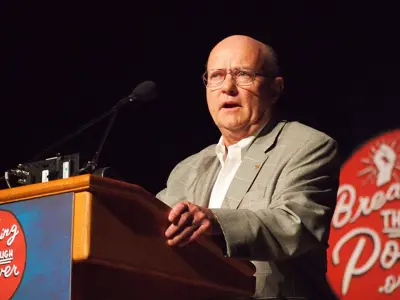
- Born: June 15, 1945
- Nationality: American
- Profession: Defense Analyst
Lawrence B. Wilkerson is a retired United States Army Colonel and former chief of staff to United States Secretary of State Colin Powell. Since the end of his military career, Wilkerson has criticized many aspects of the Iraq War, including his own preparation of Powell's presentation to the UN, as well as other aspects of American policy in the Middle East.
