Daniel Kahneman Quotes
We go to war, and then we look for the reasons…. George W. Bush is a classic example of a man whose mode of thinking is totally intuitive. He told us such.
The Type I thinker—one whose intuition is dominant—tends not to be conscious of the mental processes which go into his decision making. He does not analyze and ruminate as the Type II thinker does. See {625103}.
Daniel Kahneman, Israeli American Psychologist, Behavioral Economist, & Nobel Laureate, Interview. PBS The Charley Rose Show, February 28, 2012
Sourced by: Eigen's Political and Historical Quotations

His studies show that these types of leaders make poorer decisions on most important matters compared to those who are more analytical and take longer. See {625104}.

Podharetz was citing the Vietnam war. The two American occasions where the plausibility seemed to fade were the Vietnam War and The Irag war. Both Presidents Lyndon Baines Johnson and George W. Bush as Bismarck predicted, had much political trouble over the wars.

The three leading “hawks” of the administration and the architects of the Iraq War. However, not only had none of them ever been in combat, but none had ever served on active duty in the military. None of the three had been drafted or enlisted during the Vietnam war except for Bush who was accepted into the Texas Air National Guard; parts of his service record has been last, but he never was outside the United States. Murtha, John Kerry, John McCain and many of the administration's critics were all decorated war heroes who had been wounded in action.

Stark was opposing the George W. Bush ordered Invasion of Iraq and the subsequent Iraq War. “Big George” referred to his father who it is claimed arranged a deferment for George W. in the Vietnam War. George W. Bush had never served in combat but was willing to order others to fight. Most of the strong advocates in the Bush Administration for the Iraq War had never served in the military or seen combat either.


George W. Bush had told the country that the reason for the Iraq War was that Iraq had developed weapons of mass destruction. After the invasion it was determined that there were no such weapons that had justified the war. Debate since has concentrated in whether the Bush administration had pressured the intelligence experts to provide the information they wanted to justify the war or whether the administration was misled by their intelligence agencies.


At the time the President denied that he had decided to invade Iraq. Skelton saw the “handwriting on the world.”


The highest court in New York. Kent did not originate this concept. He was stating an age old principle of law: Posse vicinum impediri, ne in suo solo, sine alia causa suaque evidenti utilitate, munimentum nobis propinquum extruat, aut aliud quid faciat, unde justa formido periculi oriatur.

The first non-PRI President in over 70 years.

Kennen, one of the great American wise men for foreign affairs, could not have predicted the outcome of the Iraq war any better.

For the actual remark. See {621249}


Prior to this question, Thomas had not been called on at a White House press conference for 3 years. After it, she was again avoided.

Ford gave the confidential interview under the condition that it would not be made public until after he passed away. It was published by the Washington Post on December 26, 2006 just after Ford died. Ex-President’s are very reluctant to criticize a current President---especially on a foreign policy issue.

The “surge” was the short term injection of a large number of American combat troops into Iraq when the Iraq War was going badly. President George W. Bush, who at the urging of Vice President Cheney and the neoconservatives had invaded Iraq and while the invasion went well the administration botched the so-called peace and America was in the midst of a Iraqi civil war. Bush went ahead with the surge despite the advice of the Joint Chiefs. What makes the quotation particularly interesting, beyond the fact that the senior military advice was ignored, was that the President had always campaigned on the principle that the President should listen to the senior American Military officials on military tactics and strategy. He like Franklin Roosevelt, Harry Truman, Dwight Eisenhower, John F. Kennedy, and other presidents found that the military leadership perspective was often very narrow and not even militarily infallible. The Iraq War turned in our favor after the surge albeit that there have been arguments since then as to whether or not the surge was the reason or was it due to other factors which occurred at the same time. Probably, all were factors.

The Wars continued over a decade, costing thousands of American (and Coalition) troops their lives, many more their limbs and mental well-being, with a monetary cost of over trillions of dollars, and the achievements have been few and meager.
He served Presidents Reagan, Clinton, and both Bushes


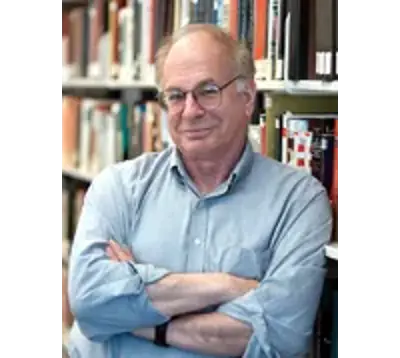
- Born: March 5, 1934
- Nationality: American, Israeli
- Profession: Psychologist
Daniel Kahneman is an Israeli psychologist and economist notable for his work on the psychology of judgment and decision-making, as well as behavioral economics, for which he was awarded the 2002 Nobel Memorial Prize in Economic Sciences (shared with Vernon L. Smith). His empirical findings challenge the assumption of human rationality prevailing in modern economic theory.
