Wesley Clark Quotes
Nothing could be a more serious violation of public trust than to consciously make a war based on false claims.
George W. Bush had told the country that the reason for the Iraq War was that Iraq had developed weapons of mass destruction. After the invasion it was determined that there were no such weapons that had justified the war. Debate since has concentrated in whether the Bush administration had pressured the intelligence experts to provide the information they wanted to justify the war or whether the administration was misled by their intelligence agencies.
Wesley Clark, U. S. General and NATO Commander, Candidate for the Democratic Presidential Nomination, Conference of Military Journalists, October, 2003
Sourced by: Eigen's Political and Historical Quotations

President George W. Bush, to justify the invasion of Iraq had told the public that the Iraqi regime was developing nuclear weapons and other weapons of mass destruction, and had participated in the September 11 attack on the United States by assisting Al Qaeda. It turned out that these statements were false. The administration claimed that their error was well intentioned and the result of faulty intelligence. Opponents claimed that the administration officials knew that they were exaggerating and had pressured the intelligence agencies to create intelligence conclusions that supported their story.

Alsop, a political hawk was convinced, as many other right wingers were at the time that the Russians had forged ahead of us in offensive missiles. When he asked President Eisenhower, the President never denied it, but never went to Congress to ask for more money to close the “missile gap”. Alsop made this shocking accusation which offended many Americans, but pleased the ultra-hawks and anti-communists. Most of the nation however then believed that there was a missile gap, with varying explanations of Eisenhower’s silence on the matter. Two years later John F. Kennedy, used the “missile gap” when running in 1960 against Nixon by attacking Nixon and Eisenhower for allowing us to fall behind the Russians at have a missile gap. When Kennedy became President, he was very surprised that there was no missile gap favoring the Russians—it was favoring the United States. Eisenhower did not want the Russians to know that he knew exactly what they were producing and deploying in missiles through great espionage sources. By not saying anything in the face of the accusations, the Russians assumed that the Americans really thought that they had more capacity than they did. And Eisenhower wanted that so that they would be secure that the United States had no real knowledge of their missile capacity. If Eisenhower had actually told the nation that the Russians were really behind us, the Russians would suspect a security leak and our sources could be compromised.

President George W. Bush, to justify the invasion of Iraq had told the public that the Iraqi regime was developing nuclear weapons and other weapons of mass destruction, and had participated in the September 11 attack on the United States by assisting Al Qaeda. It turned out that these statements were false. The administration claimed that their error was well intentioned and the result of faulty intelligence. Opponents claimed that the administration officials knew that they were exaggerating and had pressured the intelligence agencies to create intelligence conclusions that supported their story.

One of the major reasons that President George W. Bush had given for invading Iraq was that Iraq had weapons of mass destruction. None were found.


One classic example was the fact that in 2012 about one third of Republicans believed that President Obama was a Muslim when he was a devout Christian. The infamous lie had 3 grains of truth: Obama’s father was a Muslim. his middle name was an Islamic name. and he had lived and gone to school as a young boy in Indonesia, the largest Islamic country.

Allan Dulles was a long time Director of the CIA.

Prior to this question, Thomas had not been called on at a White House press conference for 3 years. After it, she was again avoided.


She was attacking George W. Bush who had started the Iraq War on the pretext that Iraq had weapons of mass destruction, while Clinton lied over sex and although it violated the law by lying under oath, there were no injuries or deaths, while hundreds of thousands died as a result of the Iraq war. Bush claimed that he did not intentionally lie, but was mislead by poor intelligence estimates. See {583802} for another view opposing the impeachment which ended when Clinton was Easily acquitted.

President George W. Bush, to justify the invasion of Iraq had told the public that the Iraqi regime was developing nuclear weapons and other weapons of mass destruction, and had participated in the September 11 attack on the United States by assisting Al Qaeda. It turned out that these statements were false. The administration claimed that their error was well intentioned and the result of faulty intelligence. Opponents claimed that the administration officials knew that they were exaggerating and had pressured the intelligence agencies to create intelligence conclusions that supported their story.

He was asked why the War Office maintained three sets of figures: 1st Earl of Oxford

He was parodying Lincoln’s famous quotation: {609284}.

Describing Martin Luther King Jr.:


After the invasion, much of the intelligence upon which America relied on Invading Iraq turned out to be completely wrong. It turned out that the Vice President at least, a major supporter of the invasion, had a role in “shaping” the intelligence and analysis to achieve a policy objective.

Cicely Isabel Fairfield

Marcus Fabius Quintilianus
The then CIA Director, Allen Dulles, fostered a practice of “adjusting” intelligence reports to support ideological policies and theories that were then in vogue. The agents in the field knew what was wanted and many adjusted their reports to coincide with the overall intelligence and policy. The station chiefs and other supervisors often ignored reports of their agents that they knew were not exactly accurate. Copeland however, just fabricated reports and “information” from sources. The honesty and integrity of the CIA intelligence operations have varied from time to time and depended much on the CIA Director at the time. Allen Dulles, though brilliant and able, fostered an ideological intelligence agency. He even went so far as to lie to the President on several occasions.
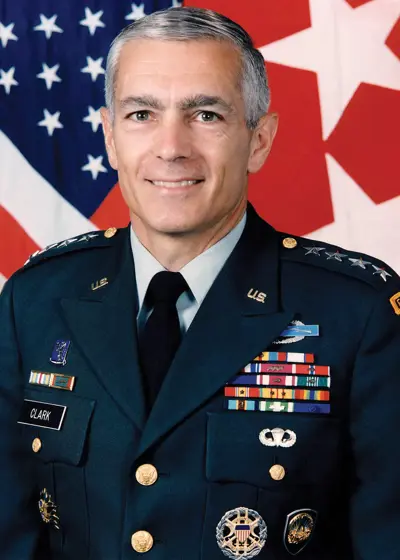
Wesley Kanne Clark, Sr. is a retired general of the United States Army. He graduated as valedictorian of the class of 1966 at West Point and was awarded a Rhodes Scholarship to the University of Oxford, where he obtained a degree in Philosophy, Politics and Economics. He later graduated from the Command and General Staff College with a master's degree in military science. He spent 34 years in the U.S. Army, receiving many military decorations, several honorary knighthoods, and the Presidential Medal of Freedom.
