Gerald R. Ford Quotes
Rumsfeld and Cheney and the President made a big mistake in justifying going into the war in Iraq. They put the emphasis on weapons of mass destruction. And now, I've never publicly said I thought they made a mistake, but I felt very strongly it was an error…
Ford gave the confidential interview under the condition that it would not be made public until after he passed away. It was published by the Washington Post on December 26, 2006 just after Ford died. Ex-President’s are very reluctant to criticize a current President---especially on a foreign policy issue.
Gerald R. Ford, 1913–2006, 38th President of the United States (Republican, MI), Speaker of the House, Assessment of President George W. Bush’s decisions regarding the Iraq War, Interview with Robert Woodward, July 2004
Sourced by: Eigen's Political and Historical Quotations


The claims of the President that Hussein even had weapons of mass destruction were untrue. Eagleburger’s criteria for war would have been even more stringent as is clear in this quotation. Foreign affairs experienced members of the President’s own party tried to dissuade him from this disastrous plan of invading Iraq but were unable to.

Bush had been allowed to join the Texas Air National Guard which meant that he did not have to serve in combat in Vietnam the way most other men his age did. However, there were no records of his having reported for duty during several months when he was to be in service. Bush claimed that he was on duty and there was no action taken against him by the then authorities which detractors attribute to his father’s high position and supporters refer to as evidence of the fact that he did nothing wrong. He had been arrested for drunk driving, and the WMD dispute has ever since raged of whether he had been honestly misled by bad intelligence. Bush was not a functional illiterate but had been a college graduate and had completed graduate school studies. He was a poor public speaker and was not an intellectually curious man and did not read much, but this was a huge exaggeration.

Prior to this question, Thomas had not been called on at a White House press conference for 3 years. After it, she was again avoided.


Alberto Gonzalez, White House Counsel and later Attorney General who was forced to resign and David S. Addington, Counsel to the Vice President, had come up with a novel view of the powers of the presidency. They argued that since the President is the Commander in Chief, in a war situation or intelligence gathering thereto, has the Constitutional responsibility for that function, he need not obey any laws of Congress as in the conduct of the war Congress would be impinging on the Constitutional separation of powers which itself was prohibited by the Constitution. The argument did not find any significant legal support but for a while the George W. Bush White House behaved as if this were the law, despite the fact that even in the American Revolution and the War of 1812 Congress passed laws regulating the conduct of the armed forces as is provided for in other parts of the Constitution. Yet even Goldsmith would allow the President some powers that many think are unconstitutional and/or belong to Congress. See {32436}.

President Bush claimed that he authorized the invasion because Iraq had developed and were about to deploy weapons of mass destruction. After the invasion, there were no such weapons ever found. Some believe Bush had acted on bad intelligence; others argued that Bush and the neocoms had wanted to invade Iraq for other reasons, and used the bad intelligence knowingly and actually suppressed intelligence that contradicted the hypotheis of weapons readiness.
Carter, who had his own share of blunders, may well have been right about this. History will have to judge.

The first non-PRI President in over 70 years.
The facts given by the administration to justify the preemptive invasion of Iraq turned out to be wrong. Moore who is usually not very circumspect in his accusations delicately used the term “misled” as the major debate became one or whether 1) the wrong intelligence was given to the President and his administration and they unknowingly used and reported the false information to the public. 2) the uncertainty of the intelligence accuracy and the contrary evidence was given to the administration which had a predisposition to believe one scenario and the deluded themselves and our allies and the public. 3) The decision to invade Iraq was made with full knowledge that the intelligence was wrong in some areas and weak in others and some administration members pressured the intelligence agencies to make the kind of assessment they administration wanted. “Misled” covers all 3 possibilities.


This quotation is a good example of how tolerant some nations can be in terms of maintaining diplomatic relations and trade relations with other countries. The American and English governments chose to simply protest and condemn the slanderous statement but decided that the Prime Minister was pandering to his political local Islamic base, so took no further action and kept open diplomatic relations. Mahathir had a history of being very accusatory of the West with respect to anything that affected the Arab Muslims. The number of Muslims killed by the Americans and British in the Iraq War was very small compared to the huge number of Muslims killed by other Muslims in their Sunni Shiite civil war. While Bush and Blair both generated support for the Iraq invasion by making claims of WMD development in Iraq that were false, it is not clear whether or not they knew their statements were false, should have known that they were false, created an atmosphere against Iraq that was likely to produce false accusations, or were simple misled by poor intelligence. Mahathir, of course, chose to assume the worst case, and claim it was true, which is what many people think Bush and Blair did in analyzing the intelligence on Iraq.


The administration of George W. Bush was the most unpopular in American history amongst most of the countries of the world. By the end of his second term, Bush himself was the most unpopular President in America since polls were taken to measure it. However, when Barack Obama went to Berlin, as a senator and presidential candidate he was very warmly received with a crowd of over 200,000 Germans turning out in Berlin to hear his speech.


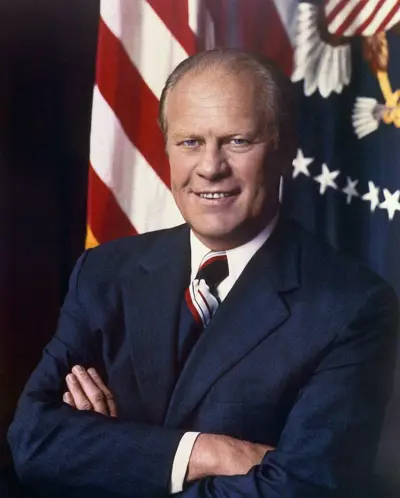
Gerald Rudolph Ford Jr. was an American politician and attorney who served as the 38th president of the United States from 1974 to 1977. A member of the Republican Party, Ford previously served as the 40th vice president of the United States from 1973 to 1974. To date, Ford is the only person to have served as both vice president and president without being elected to either office by the Electoral College.
