Jimmy Carter Quotes
Iraq is an unjust war. I thought then, and I think now, that the invasion of Iraq was unnecessary and unjust. And I think the premises on which it was launched were false.
President Bush claimed that he authorized the invasion because Iraq had developed and were about to deploy weapons of mass destruction. After the invasion, there were no such weapons ever found. Some believe Bush had acted on bad intelligence; others argued that Bush and the neocoms had wanted to invade Iraq for other reasons, and used the bad intelligence knowingly and actually suppressed intelligence that contradicted the hypotheis of weapons readiness.
Jimmy Carter, 39th President of the United States (Democrat, GA), Press Conference, Baptist World Alliance's Conference, Birmingham, England. July 30, 2005
Sourced by: Eigen's Political and Historical Quotations


He served Presidents Reagan, Clinton, and both Bushes


The CIA intelligence had been shared with key world leaders to gain support for the George W, Bush administration invasion of Iraq. Blix was bothered by the fact that although the intelligence was so certain why were not any of the locations known. The answer, of course, was that there was no such development and the intelligence was faulty, but at the time, only he seemed to be bothered by this point. See also {588115}.

This quotation is a good example of how tolerant some nations can be in terms of maintaining diplomatic relations and trade relations with other countries. The American and English governments chose to simply protest and condemn the slanderous statement but decided that the Prime Minister was pandering to his political local Islamic base, so took no further action and kept open diplomatic relations. Mahathir had a history of being very accusatory of the West with respect to anything that affected the Arab Muslims. The number of Muslims killed by the Americans and British in the Iraq War was very small compared to the huge number of Muslims killed by other Muslims in their Sunni Shiite civil war. While Bush and Blair both generated support for the Iraq invasion by making claims of WMD development in Iraq that were false, it is not clear whether or not they knew their statements were false, should have known that they were false, created an atmosphere against Iraq that was likely to produce false accusations, or were simple misled by poor intelligence. Mahathir, of course, chose to assume the worst case, and claim it was true, which is what many people think Bush and Blair did in analyzing the intelligence on Iraq.


The claims of the President that Hussein even had weapons of mass destruction were untrue. Eagleburger’s criteria for war would have been even more stringent as is clear in this quotation. Foreign affairs experienced members of the President’s own party tried to dissuade him from this disastrous plan of invading Iraq but were unable to.


This speech was given 5 months before President Georg W, Bush initiated the invasion of Iraq. Politicians either supported the idea of an Iraq War or simply remained silent lest they be labeled unpatriotic. Obama not only opposed the war, but by 2007 most Americans had also come to believe that Bush’s invasion was a “dumb” and “rash” war.


The George W. Bush Administration told Congress and the people of the world that Iraq had developed weapons of mass destruction and were about to deploy them. We invaded Iraq and it turned out that there were no WMD’s in Iraq. No one knows if the all in the administration honestly believed the intelligence, how many doubted it, and how many others suppressed contradictory evidence of which there was much. Some members of the administration wanted an invasion of Iraq for other reasons, personal and economic.


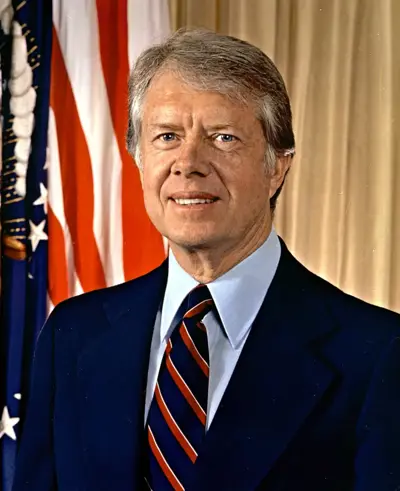
James Earl Carter Jr. is an American politician, businessman, and philanthropist who served as the 39th president of the United States from 1977 to 1981. A member of the Democratic Party, he previously served as a Georgia State Senator from 1963 to 1967 and as the 76th governor of Georgia from 1971 to 1975. Since leaving the presidency, Carter has remained engaged in political and social projects as a private citizen. In 2002, he was awarded the Nobel Peace Prize for his work in co-founding the Carter Center.
