CALVIN COOLIDGE
(John Calvin Coolidge Jr.)

Although obvious oversimplifications, these were key strategic elements of these Presidential campaigns.


In the 1924 election the New York Republican Congressman had difficulty supporting the extremely conservative Republican party platform and its candidate, Calvin Coolidge. The party leaders insisted on his party loyalty if he was to be renominated:. La Guardia ran as an independent with support from the American Labor and Socialist parties and won reelection by his largest majority.


Mellon was one of the richest men in America and a very powerful Treasury Secretary who served under 3 presidents. However, he was very independent with his own power base which was what made Norris’s line very funny. It was politically impossible for the President’s to fire Mellon.

Coolidge was not a gregarious of social personality as many politicians and Presidents were. He did not speak much to the press after his presidency and was known for his parsimony of words. Unlike her father, Coolidge had no influence upon and did not participate in politics after his presidency. Hence the dark humor.

Sometimes this is misquoted as 'The business of America is business.' See Woodrow Wilson for an earlier statement of this idea which is almost always incorrectly attributed to Coolidge as the originator of the idea.
Coolidge was distressed with the abuses of the investigatory power of probes of big business.
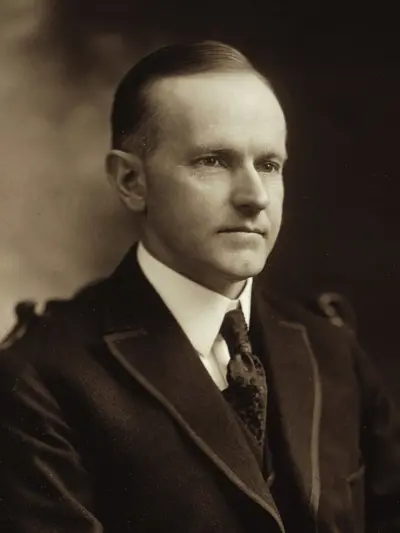
- Born: July 4, 1872
- Died: January 5, 1933
- Nationality: American
- Profession: President
Calvin Coolidge was an American lawyer and politician who served as the 30th president of the United States from 1923 to 1929. A Republican lawyer from New England, born in Vermont, Coolidge worked his way up the ladder of Massachusetts state politics, eventually becoming governor of Massachusetts. His response to the Boston Police Strike of 1919 thrust him into the national spotlight and gave him a reputation as a man of decisive action. The next year, he was elected the 29th vice president of the United States, and he succeeded to the presidency upon the sudden death of Warren G. Harding in 1923. Elected in his own right in 1924, he gained a reputation as a small-government conservative and also as a man who said very little and had a rather dry sense of humor.
