Calvin Coolidge Quotes
Men do not make laws. They do but discover them. Laws must be justified by something more than the will of the majority. They must rest on the eternal foundation of righteousness. That state is the most fortunate which has the aptest instruments for the discovery of laws.
Calvin Coolidge, 1872-1933 29th President of the United States (Republican, MA), Presidential address to the Massachusetts State Senate, January 20, 1914
Sourced by: Eigen's Political and Historical Quotations

This is the earliest surviving attempt of the Romans to formulate a legal code.


In the English system there is no “separation of powers”. Parliament makes the laws and its ministers execute them. The highest judges are members of Parliament (the House of Lords) as well. So Lord Bereford was in the legislature when the statute was debated and passed.
Generally we make laws to try and stop bad actions. Without the bad actions, there would generally be no laws.


She was referring to laws that supported slavery.


On the Fugitive Slave Act: As one of the leading American Catholic intellectuals during the 19th Century, Brownson’s opinions went far in keeping Catholics from joining the side of the abolitionists. However, just a few years later his tone would change and he would become one of the few Catholic writers to refuse to defend slavery, see {610710}. While the majority of Catholics refused to join the abolition movement, they often did so because abolitionism was closely tied to anti-Catholicism, see Gordon {611392} or Shaftesbury {611106}. Other reasons included Irish immigrants fearful of competition from Black labor and the fear of liberal individualism and social disorder, which was prevalent in 19th century Catholic thought. For a further explanation on the relationship between American Catholics and slavery, see McGreevy {612036}.


The Constitution sets the majority of each house as a quorum in order to conduct any business. Minorities, in order to obstruct proceedings, would often refuse to answer their names when a quorum call would made even though they were present in the House, Therefore they claimed they could not be counted towards a quorum. In those days there were always absences due to illness, transportation, family emergencies and the like. So the majority had to have most of its members on the floor at all times if the minority wanted too obstruct. The minority claimed it was their right under the Constitution, Reed said that interpreting the Constitution that way was tantamount to suicide for the House. He then changed the rule, and simply counted as present any member who was observed to be present, whether he answered a quorum call or not.


Things were difficult then, but no where near as bad as in 2008-2012 period where the minority Republicans had more filibusters than all other Senates since the nation began, and their stated purpose was to be sure that no legislation could pass for which President Barack Obama might get credit.


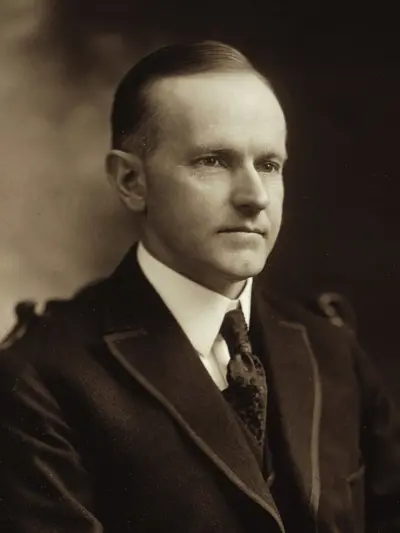
Calvin Coolidge was an American lawyer and politician who served as the 30th president of the United States from 1923 to 1929. A Republican lawyer from New England, born in Vermont, Coolidge worked his way up the ladder of Massachusetts state politics, eventually becoming governor of Massachusetts. His response to the Boston Police Strike of 1919 thrust him into the national spotlight and gave him a reputation as a man of decisive action. The next year, he was elected the 29th vice president of the United States, and he succeeded to the presidency upon the sudden death of Warren G. Harding in 1923. Elected in his own right in 1924, he gained a reputation as a small-government conservative and also as a man who said very little and had a rather dry sense of humor.
