WOODROW WILSON
(Thomas Woodrow Wilson)


Wilson is perhaps the only President in American history who actually presided over a reverse affirmative action. Other post Reconstruction presidents have either increased the degree of affirmative action in Federal positions or ignored affirmative action and did not pursue it. But only Wilson rolled it back.

President Wilson had gone to Paris for peace treaty negotiations. Ex-President Roosevelt was on his deathbed. But even then TR was his politically contentious self.


The French and English, with larger numbers and more experienced troops and officers, wanted the American units to come under the command or their officers and be integrated into the allied army. However Wilson established the tradition that American troops fighting abroad most always fight as an American Army under American Command. Although resented then and into the 21st century by America’s allies who are expected to fight under American command, it is a tradition that no American major politician has seriously challenged since then.

The Senate debate on the ratification of the Versailles Peace Treaty was difficult for President Wilson, who wanted the treaty ratified without reservations or exceptions:. Wilson would accept no reservations and the treaty was never ratified.

Leading the Senate opposition to the League of Nations proposed by Woodrow Wilson:

After the Senator and other members of the Foreign Relations Committee dined with President and Mrs. Wilson at the White House to discuss the League of Nations proposals that were before the Senate:

In the Democratic national convention of 1912, Clark had obtained a majority of the delegate votes and was well on his way to the two thirds necessary for the Presidential nomination. William Jennings Bryan, a close personal friend of Clark's, headed the Nebraska delegation which had already instructed Bryan to vote for Clark. However, in a dramatic repudiation of his old friend, Bryan switched to Woodrow Wilson and turned the tide against Clark, who characterized Bryan as:

Referring to Woodrow Wilson and his 14 points he insisted upon for the World War I peace treaty.

Writing about congressional investigations such as those carried out by the House Un-American Activities Committee:

On October 2, 1919 President Woodrow Wilson suffered a stroke. During his recuperation Edith Bolling Wilson, his wife, was the only source of communication between him and the officials of government:

The admiral and the First Lady lied to the press and public. Wilson had suffered a severe stroke. At the time there was no Constitutional provision for Presidential disability, See Joseph P. Tumulty {40716} and Edith Wilson {37880}.


Referring to President Woodrow Wilson's signing of the Treaty of Versailles and the League of Nations:
At the beginning of the First World War the senator called for surplus profits taxes on business to finance the war effort. President Wilson preferred bond financing and the business community castigated the Senator for not supporting the President's position. Later, when Wilson adopted the senator's view and called for additional taxes:


At the Versailles peace conferences British Prime Minister Lloyd George was often at odds with President Woodrow Wilson and Clemenceau of France: 1st Earl Lloyd-George of Dwyfor

This quotation has historical value, not only because he saw the weaknesses that President Wilson, a brilliant political scholar, and the Secretary of State and many intellectuals missed, but also because it illustrates something about politics at the time. Roosevelt and other leading politicians thought nothing of publicly disagreeing with a former or even current President of his own party about an issue of policy. The notion of party loyalty to the President requiring public support of all policies evolved only in the last half of the 20th century.
Roosevelt himself was a great orator and there were many who thought those same terms might apply to him.

Wilson was disabled and there was no provision for Presidential Disability then. Some suggested that he should be pressured to resign.

The President was Woodrow Wilson and the Peace Conference was that at the end of WWI. While the right of self determination is broadly accepted in American society, it was not always so.
This is a very important historical and political quotation. First, notice that the Secretary of State was criticizing the policies of his President, a refreshingly honest statement, but one which would never be made after the 1950s. The criticism was not even mild but very heavy. A political opponent could not be more negative. Next consider that while the Secretary of State and almost all the experienced diplomats thought the President foolishly wrong and naive about the practicality of self-determination, by the end of the 20th century, virtually every country in the world, capitalist, communist, secular or religious, wealthy or impoverished, all see self-determination is a basic right of all nations. The President was on the right side of history and all the professional diplomats on most nations were on the wrong side. However, Secretary of Lansing was right about one thing. The quest for self-determination has caused a fearful toll of human lives—not thousands as Lansing predicted but millions. He was also right about another aspect—namely that the unit of self-determination can be confusing and contentious. For example, the French Canadians of Quebec want a great deal of self determination and autonomy, but they do not want to give the same right of self-determination to the Mohawk Indians in Quebec who want to govern themselves. There is a continuous dispute in Turkey where the Kurds claim the right of self-determination within Turkey. Turkey has literally dozens of minority groups. Does self-determination mean that each can have its own nation within what is Turkey. And what about the Native Americans in the United States? Nonetheless, Wilson’s general principle is approved by all while the details are often contentious.
1st Earl Lloyd-George of Dwyfor
FDR even admitted that very wealthy men and corporations controlled most U. S. governments including the administration of his own political party. Roosevelt did a great deal to improve the situation but by the latter years of the 20th century, private financial entities gained back much of the influence and control. The result was the Meltdown of 2008 and the Great Recession, where another set of regulations and laws (Dodd-Frank) was made law by the Obama Administration. However, the financial corporations still had enormous political influence as a result of unlimited campaign contributions to politicians and unlimited lobbying.

Wilson ran for only two public offices in his political career: governor of New Jersey and President.

Wilson was very emotional and passionate in his relationships with his first wife who was very close to him both emotionally and intellectually she reviewed and critiqued all of his speeches. It was a side of him that a few people know about.

It was a 3-way race where the right wing of the Republican Party had stacked the deck so that Taft would be selected the nominee despite the greater popularity of TR who then decided to run as a 3rd party candidate. He beat the Republican nominee and incumbent President Taft soundly and the two of them together got many more votes than Wilson but Wilson had the most votes with only 42 percent. He got the loyal Democrat votes but lost the independents to Roosevelt who in turn lost the conservative Republicans to Taft. Wilson had the mathematics which made up for his personal weaknesses. What is very interesting about this quotation is that Wilson thought of himself as an intellectual as opposed to TR, but in reality Roosevelt was not only also an intellectual but the only President who was a world class scientists.


Woodrow Wilson had just finished speaking to the convention – see {638532}. This statement was thought be some to be insulting to the President who said he favored the right of women to vote, but did very little if anything to make that happen. Although Shaw was an ordained Methodist Minister, the Methodist Episcopal Church refused to allow her to preach because of her suffrage views.

See {640088} for what Theodore Roosevelt would have done at the beginning of the First World War. He thought Wilson soft.

The majority of the country strongly favored American participation in the League of Nation provided there were some reservations that made it explicitly clear, the American troops could not be committed without the approval of Congress and that nothing would impinge on U. S. domestic sovereignty. Wilson wanted no exceptions or reservations to the treaty he had negotiated and would not compromise in any way. The issues were soon forgotten in what had become a test of will and power between the Senate and the President. The treaty was never ratified and without the United States, the League of Nations collapsed.
Wilson did not threaten Germany when they invaded Belgium in WWI. TR thought Wilson “soft”. He entered the war 3 years later only after the Germans had torpedoed two American passenger liners. The Germans were hoping to keep America out of the war. TR would have threatened Germany at the beginning, and if they did not withdraw from Belgium, he would have sent American troops. Wilson was not sure public opinion would support American entry into the war, even after our first ship was sunk by German U-boats. It took two. Roosevelt, as he said in the letter, the American people would have followed him. He was probably right as his public popularity was very high and he had remarkable leadership skills. He did not assess public opinion. He made public opinion. Theodore Roosevelt, George Washington, and Franklin Delano Roosevelt are probably the only 3 American Presidents who had the trust and leadership ability to lead the country into a major war where we were not attacked first without lying as to the circumstances and the danger. President Clinton honestly led the country into the Balkan war, but it was to be an air war only with no soldiers fighting on the ground. It was a significant war that we won and did not lose a single fighter.

The Senate refused to ratify.

Sanger faced charges of obscenity for explaining birth control in a magazine she founded called the Woman Rebel. She got no political support from Wilson or the Democrats. The few politicians who did support her were Republican progressives and reformers.
There is some debate as to whether this statement was made at this time or different parts of it on two different occasions. The sentiment and position appears to be genuine but the issue of the timing is in doubt.
He also expressed his pleasure with the British Balfour Declaration granting the Jews their own country in part of Palestine ({594001}). Wilson had earlier committed himself to support the Zionist claim for Palestine. See {585124}.
Wilson was very candid that there would be high cost to war and sacrifice would be needed. See {584570} for other similar candor. This quotation was often used by critics of George W. Bush who initiated the Iraq War and then cut taxes for the rich, but then financed the war through the budgetary emergency appropriations bypassing the budget rules that the revenue must be specified to pay for it. His administration even claimed at an early stage in the war that the oil revenue from Iraq oil would defray the costs.
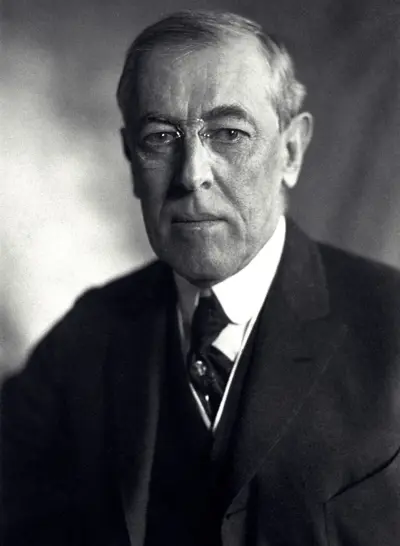
- Born: December 28, 1856
- Died: February 3, 1924
- Nationality: American
- Profession: President
Thomas Woodrow Wilson was an American politician and academic who served as the 28th president of the United States from 1913 to 1921. A member of the Democratic Party, Wilson served as the president of Princeton University and as the 34th governor of New Jersey before winning the 1912 presidential election. As President, Wilson led the United States into World War I in 1917. He was the leading architect of the League of Nations, and his progressive stance on foreign policy came to be known as Wilsonianism. Scholars have generally ranked Wilson in the upper tier of U.S presidents, although he has been criticized for supporting racial segregation and white supremacy.
