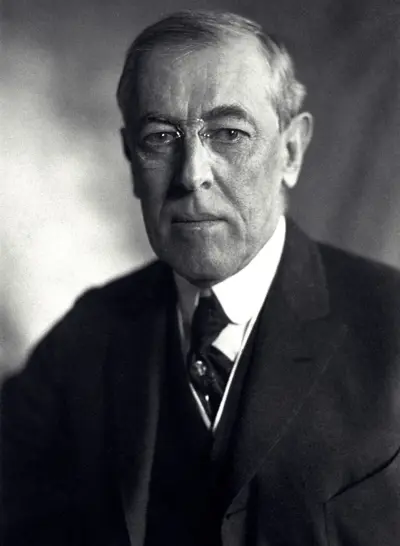
Woodrow Wilson Quotes
Americans know that war must be paid for and it is they who must pay for it.
Wilson was very candid that there would be high cost to war and sacrifice would be needed. See {584570} for other similar candor. This quotation was often used by critics of George W. Bush who initiated the Iraq War and then cut taxes for the rich, but then financed the war through the budgetary emergency appropriations bypassing the budget rules that the revenue must be specified to pay for it. His administration even claimed at an early stage in the war that the oil revenue from Iraq oil would defray the costs.
Woodrow Wilson, 1856-1924, 28th President of the United States (Democrat, NJ), Statement to Congress regarding WWI
Sourced by: Eigen's Political and Historical Quotations
Roosevelt was very candid with the American people that there would be high cost to war and sacrifice would be needed. See {584569} for other similar candor. This quotation was often used by critics of George W. Bush who initiated the Iraq War and then cut taxes for the rich, but then financed the war through the budgetary emergency appropriations bypassing the budget rules that the revenue must be specified to pay for it. His administration even claimed at an early stage in the war that the oil revenue from Iraq oil would defray the costs.
This is an excellent historical quotations showing how our government financed the Spanish American War. Wars have always placed economic stress on the nations which wage then. In the American Revolution we borrowed from individuals and from France. After that all our wars were financed by a combination of war bond sales, other borrowing, and tax increasesβall except the George W, Bush Afghanistan and Iraq Wars which were not funded thus complicating an economic crises caused by Bushβs Great Recession. While some critics saw Bushβs actions as reprehensible and irresponsibleβit was the only time in American history where tax rates were cut in wartime, Bushβs team had a plan. They had an ideological point of view that said that major tax cuts would spur the economy and lead to MORE government revenue as a result of the growth that would come. However, in this case there not only was no growth, but there was the worst recession in American History. But there was a plan to finance the warβit just went awry.
The prerogative of preparedness weakens after a war is won; everyone expects some sort of peace dividend.
FDRβs attempt to cap WWII income with any excess going to pay for the war failed as the wealthy in the country pulled out βall the stopsβ to defeat the proposal. Roosevelt was able, however, to get a maximum tax bracket of 88 percent on all income over $200,000 which was less onerous to the very rich but still terrible. They could not defeat that proposal.
The founder was Charles E. Coughlin, 1891-1979, a demagogic Catholic Priest who drafted the principles and invited others to join him. Hundreds of thousands did in this organization which began in idealism, and ended in scandal and hate mongering, so much so that Father Coughlin was ordered off the radio and out of politics by the Catholic Church. The National Union in 1936 had morphed into the Union Party which ran Presidential candidates in the 1936 election. In this principle there were two purposes: First to have the wealthy sacrifice something in time of war. Historically wealth could keep a man from the draft if he so wanted. Second, when the company went to war the argument went it was the rich who could profit who had more political influence and could make the war. This way, they would pay a high price and might oppose war. Many of Coughlinβs followers were pro-German and wanted to keep the country out of the European war.
The American Army had just liberated Bellau Wood, but had lost almost 8,000 men.
In every American war, there have been those leaders who wanted to fight it βon the cheap.β While most modern people are most aware of the George W. Bush Administration providing insufficient funds to our troops in the Iraq War, there was a problem in the First World War, and President Roosevelt had to twist conservative arms to get the funds necessary for the Second World War. But even the American Revolution had the same problem as this quotation illustrates.
The Centograph is a war memorial monument in London. On Remembrance Day, a British Patriotic Holiday, veterans march past the Centograph. The quotation is text uttered by one of her characters.
This quotation gives us a concept of the WWII home front effort where virtually everyone in American society was personally involved on a daily basis in the war. See also {637440}. This was so dramatically different from the home fronts for the wars in Afghanistan and Iraq where most of the American public had no direct contact with the war effort and was not called upon or even needed to do anything.
- Born: December 28, 1856
- Died: February 3, 1924
- Nationality: American
- Profession: President
Thomas Woodrow Wilson was an American politician and academic who served as the 28th president of the United States from 1913 to 1921. A member of the Democratic Party, Wilson served as the president of Princeton University and as the 34th governor of New Jersey before winning the 1912 presidential election. As President, Wilson led the United States into World War I in 1917. He was the leading architect of the League of Nations, and his progressive stance on foreign policy came to be known as Wilsonianism. Scholars have generally ranked Wilson in the upper tier of U.S presidents, although he has been criticized for supporting racial segregation and white supremacy.