Theodore Roosevelt Quotes
If I had been President, I should have acted on the thirtieth or thirty-first of July, as head of a signatory power of the Hague treaties, calling attention to the guaranty of Belgium's neutrality and saying [to Germany] that I accepted the treaties as imposing a serious obligation which I expected not only the United States but all other neutral nations to join in enforcing. Of course, I would not have made such a statement unless I was willing to back it up. I believe that if I had been President the American people would have followed me.
Wilson did not threaten Germany when they invaded Belgium in WWI. TR thought Wilson “soft”. He entered the war 3 years later only after the Germans had torpedoed two American passenger liners. The Germans were hoping to keep America out of the war. TR would have threatened Germany at the beginning, and if they did not withdraw from Belgium, he would have sent American troops. Wilson was not sure public opinion would support American entry into the war, even after our first ship was sunk by German U-boats. It took two. Roosevelt, as he said in the letter, the American people would have followed him. He was probably right as his public popularity was very high and he had remarkable leadership skills. He did not assess public opinion. He made public opinion. Theodore Roosevelt, George Washington, and Franklin Delano Roosevelt are probably the only 3 American Presidents who had the trust and leadership ability to lead the country into a major war where we were not attacked first without lying as to the circumstances and the danger. President Clinton honestly led the country into the Balkan war, but it was to be an air war only with no soldiers fighting on the ground. It was a significant war that we won and did not lose a single fighter.
Theodore Roosevelt, 1858-1919, 26th President of the United States (Republican, NY), Letter to Cecil Spring Rice, October 3, 1914
Sourced by: Eigen's Political and Historical Quotations

See {640088} for what Theodore Roosevelt would have done at the beginning of the First World War. He thought Wilson soft.


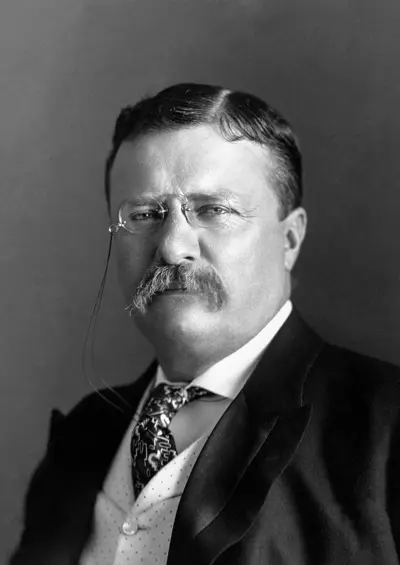
Theodore Roosevelt Jr., often referred to as Teddy or his initials T. R., was an American statesman, conservationist, naturalist, historian, and writer, who served as the 26th president of the United States from 1901 to 1909. He previously served as 33rd governor of New York from 1899 to 1900 and the 25th vice president of the United States from March to September 1901. Roosevelt emerged as a leader of the Republican Party and became a driving force for anti-trust and Progressive policies.
