Robert M. La Follette Quotes
He has signed an agreement to bind us to fight in every future world-war. He has entered into a treaty that is without a parallel in all history as a spoils-grabbing compact of greed and hate.
Referring to President Woodrow Wilson's signing of the Treaty of Versailles and the League of Nations:
Robert M. La Follette, 1855-1925, Governor of Wisconsin (Republican), U.S. Senator (Republican, WI), Presidential Candidate (Progressive), June 29, 1919
Sourced by: Eigen's Political and Historical Quotations

Trieste was occupied by the British and Americans theoretically, but Tito’s Yugoslavian troops had done most of the WWII fighting and dying in the area and wanted control for the Russian Allies of which Tito was then one. There were frequent armed standoff’s of Anglo Americans and Yugoslav troops that could easily have evolved to full scale fighting. Nine months later, Tito broke with Stalin. An interesting historical fact is that Richard M. Nixon was one of the Congressional Delegation then visiting Trieste.


In retrospect Marshall was prescient and if his advice had been followed, the country would have been much better off at the beginning of WWII. The nation was isolated politically and militarily with Republicans and southern Democrats often opposing President Roosevelt’s attempts to help them defend themselves. There was of yet no political will for military preparedness.


In both the First and Second World Wars the Western nations had a multilateral defense pact which did little good in the face of German aggression.


Baruch was the first politician to use of the phrase "cold war." It had actually been originated by a friend and speechwriter, Herbert Bayard Swope, who had proposed using the phrase earlier. Baruch thought that too early and waited.

This was the last letter she wrote from the White House after her husband was assassinated.


Peruvian Revolutionary Group. This speech was made from prison.


The Spanish had been beaten and bloodied by England, but no one else until Napoleon would come along later. So it was easy for Spain to bully and dominate the non-English countries.

The 6 Day War began less then 6 months later. This was another failure of U. S. Intelligence. Essentially, Rusk and others took the belligerent speeches of Nasser and other Arab leaders as rhetoric meant only for local consumption and did not realize that the Arabs had so deluded themselves that they thought that they could really destroy the state of Israel. American intelligence assumed that they knew better and their threats were just traditional Arab exaggeration and boasting.

Hoover and most Republicans were generally opposed to sanctions and an instrument of foreign policy. 25 years after his presidency, the Republican Party started embracing sanctions as a tool of foreign policy and by the end of the 20th century, Republicans were sanction hawks. This quotation illustrates how American political parties and their philosophies change over time.

The U. S. and Russia


No one knows whether or not Castro was really sincere in making this offer. The Russians rejected it of course. If they made a first strike on the United States, Russia would have been crippled completely by the retaliation, and they knew it. Castro knew that they knew it and might have been counting on the fact that the Russians would reject his heroic offer. Alternatively, he may have been enough of a fanatic to sacrifice his own life that that of every single Cuban.
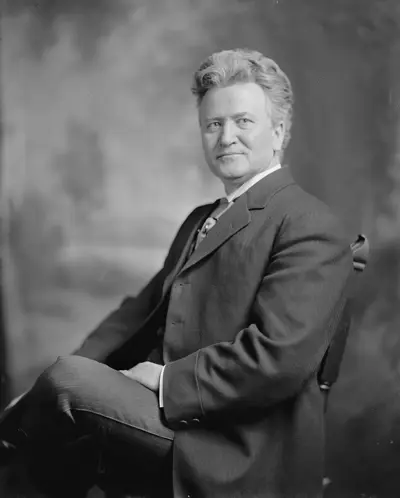
Robert Marion "Fighting Bob" La Follette Sr., was an American lawyer and politician. He represented Wisconsin in both chambers of Congress and served as the Governor of Wisconsin. A Republican for most of his career, he ran for President of the United States as the nominee of his own Progressive Party in the 1924 presidential election. Historian John D. Buenker describes La Follette as "the most celebrated figure in Wisconsin history."
