Fidel Castro Quotes
I propose the immediate launching of a nuclear strike on the United States. The Cuban people are prepared to sacrifice themselves for the cause of the destruction of imperialism and the victory of world revolution.
No one knows whether or not Castro was really sincere in making this offer. The Russians rejected it of course. If they made a first strike on the United States, Russia would have been crippled completely by the retaliation, and they knew it. Castro knew that they knew it and might have been counting on the fact that the Russians would reject his heroic offer. Alternatively, he may have been enough of a fanatic to sacrifice his own life that that of every single Cuban.
Fidel Castro, Cuban Premier, Offer made to the Russian leadership during the Cuban Missile Crisis, October 1962, Quoted in New York Times, October 23, 1992
Sourced by: Eigen's Political and Historical Quotations


One new danger that nuclear powers add to the usual problems of conflict, is that a nuclear power, about to lose a war in a humiliating way, might just use his nuclear weapons in revenge. So much damage will be done that the victory turned out to have been a bad thing. So ironically, with a nuclear enemy. Your military dare not win to dominantly with conventional weapons.

During the Cuban Missle Crises, Fidel Castro recommended that the Russians use the nuclear weaponin based in Cuba which would have assured that all Cubans and many Russians would die with the American retaliation.


When McNamara was itemizing the list of dangers with the Joint Chiefs’ Cuban invasion plan, McGeorge Bundy told the not to forget the possibility of a nuclear exchange. The Joint Chief’s plan and recommendation was to invade Cuba, which could have been accomplished with relative military ease they thought. However, they had not gone the next steps and had no planned responses to the various possible Russian responses. The Chiefs of Staff were senior battle hardened WWII and Korean War veterans whose tactical knowledge and leadership was as good as there was. However, none of the had any experience or training with the strategic aspects of military planning the way senior military officers did in the next generation of military leaders. The civilian leadership had to put the breaks on the Joint Chief’s notion of simplistic invading Cuba.
Trieste was occupied by the British and Americans theoretically, but Tito’s Yugoslavian troops had done most of the WWII fighting and dying in the area and wanted control for the Russian Allies of which Tito was then one. There were frequent armed standoff’s of Anglo Americans and Yugoslav troops that could easily have evolved to full scale fighting. Nine months later, Tito broke with Stalin. An interesting historical fact is that Richard M. Nixon was one of the Congressional Delegation then visiting Trieste.

There were some doubts the scientists developed after Germany had surrendered as Hitler had been their greatest fear. So they were briefed on the planned invasion of the Japanese mainland and the military medical preparations for treating and caring for ½ million serious wounded casualties. In addition, given the state of war, there was expected about the same number of American Military deaths. On top of that, there would be many more Japanese military casualties plus even more Japanese civilian deaths and wounded. The use of the Atom Bomb would save all those lives but have casualties of its own, but far fewer. At the time, surprising to most people now, the use of the atomic bomb was not an issue of controversy at all. There were no Congressman who questioned it, no newspapers which editorialized against the use of the bomb. There were not even any other counties which protested its use.


Giro'n is the Cuban name for the Bay of Pigs.
The U. S. and Russia
Statement to Secretary of State Dean Rusk just after they had been given a military briefing on every Russian city that would be wiped out with a nuclear bomb if war should break out, 1961.

The Booklet told people that even under an atomic attack there would be many survivors and it was everyone’s job to increase the number of survivors by taking precautions like building fallout shelters and maintaining a supply of food and water at home and ducking under desks and tables if there was an atomic attack. The implication was that despite the great firepower of the then Hydrogen Bombs there would be great survivability. The suggestions for protection ranged from minimal likely effect to absurd. The Publication also bore the imprimatur of the Executive Office of the President for credibility and many people believed it.

See {624449} for the essence of the letter.

This is a very important quotation. It is often cited by preventive war hawks to show that deterrence might not be a sufficient inhibitor against an extreme ideological enemy. In this case it was political philosophy that would make the enemy willing to have the majority of its population die to reach the ideological objective. More fearful is the prospect of the Theocracy of Iran where the leaders may believe that nuclear jihad is a commandment of God. More critical is the Islamic theology which says that if most of the Iranian Muslim population die in a nuclear war that they start all those people will be martyrs and immediately go to God’s Paradise. Thus, even the dead Muslims are not victims and the nonbelievers should be killed. For extremely fanatical Muslims nuclear war can be a logical and holy course of action.

The Scientific Project that developed the Atomic Bomb. The Scientific Project that developed the Atomic Bomb

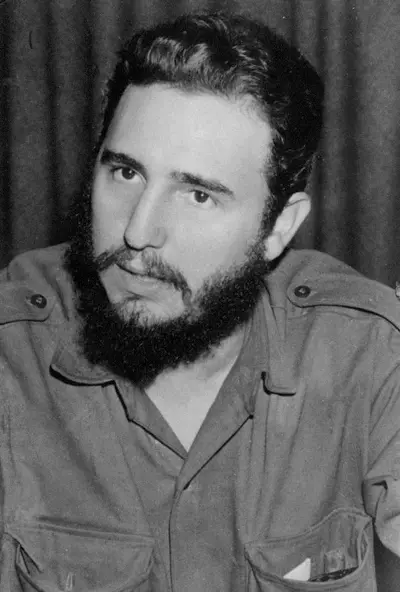
Fidel Alejandro Castro Ruz better known internationally as Fidel Castro, was a Cuban revolutionary and politician who served as Prime Minister of Cuba from 1959 to 1976 and President from 1976 to 2008. Ideologically a Marxist–Leninist and Cuban nationalist, he also served as the First Secretary of the Communist Party of Cuba from 1961 until 2011. Under his administration, Cuba became a one-party communist state; industry and business were nationalized, and state socialist reforms were implemented throughout society.
