Lyndon B. Johnson Quotes
I knew we were going to get into this sort of a mess when we went in there. And I don’t see how we’re ever going to get out of it without fighting a major war with the Chinese.
Lyndon Baines Johnson, 1908-1973, 36th President of the United States (Democrat, TX), Statement about Vietnam to Senator Richard Russell, May 27, 1964
Sourced by: Eigen's Political and Historical Quotations


Podharetz was citing the Vietnam war. The two American occasions where the plausibility seemed to fade were the Vietnam War and The Irag war. Both Presidents Lyndon Baines Johnson and George W. Bush as Bismarck predicted, had much political trouble over the wars.

Up to that time U. S. policy was to provide training and assistance to the South Vietnamese government and military, but not to attack the North. America had backed a corrupt and incompetent South Vietnamese government and Bundy and other policy makers were convinced that the North Vietnam would win, if the fighting and governing were solely left to the South Vietnamese. Johnson, who had resisted this policy for several weeks finally acceded. It was a major escalation of the Vietnam War.

sending American troops to Vietnam


War and international conflict had become very complicated in modern times. Americans and most other people associated victory in war with unconditional surrender. However, since the unconditional surrender is of WWII, no conflict has ended with an unconditional surrender.

Hoover and most Republicans were generally opposed to sanctions and an instrument of foreign policy. 25 years after his presidency, the Republican Party started embracing sanctions as a tool of foreign policy and by the end of the 20th century, Republicans were sanction hawks. This quotation illustrates how American political parties and their philosophies change over time.

Trieste was occupied by the British and Americans theoretically, but Tito’s Yugoslavian troops had done most of the WWII fighting and dying in the area and wanted control for the Russian Allies of which Tito was then one. There were frequent armed standoff’s of Anglo Americans and Yugoslav troops that could easily have evolved to full scale fighting. Nine months later, Tito broke with Stalin. An interesting historical fact is that Richard M. Nixon was one of the Congressional Delegation then visiting Trieste.

American official foreign policy had been officially isolationist—to not get involved in the squabbles and fights of other nations. Angell however pointed out that even before WWII, America had formally been involved in 6 foreign wars and used military incursions on foreign soil on almost 100 occasions.


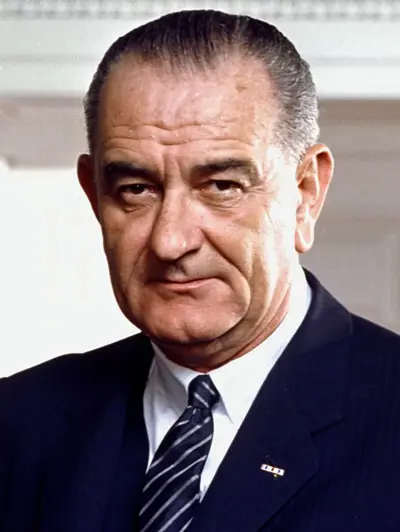
Lyndon Baines Johnson, often referred to by his initials LBJ, was the 36th president of the United States, in office from 1963 to 1969. He served as the 37th vice president from 1961 to 1963 and assumed the presidency following the assassination of President John F. Kennedy. A Democrat from Texas, Johnson was also a United States representative and later majority leader in the United States Senate. Johnson is one of only four people to have served, at various times, in all four federal elected positions.
