Curtis LeMay Quotes
That's the reason some schools of thinking don't rule out a destruction of the Chinese military potential before the situation grows worse than it is today. It's bad enough now.
LeMay, Curtis E., and MacKinlay Kantor. Mission with LeMay: My Story. Doubleday, 1965, p. 572.


Clark had commanded the American and NATO forces in the Serbian War where all the military and political objectives were accomplished with heavy losses to the Serbian’s and none to the allied side—what many think was the most successful war in American History. Like Eisenhower in WWII one great challenge was the political and strategic one of keeping the coalition of all the allied governments working together. His perspective had been like Eisenhower’s which was much wider and geopolitical than most military officers.

There were many who thought that the Russians would view the Mutual Security Act as aggressive and they might respond with some kind of aggressive retaliation and this could lead to war. Others felt that containment would reduce the likelihood of war.


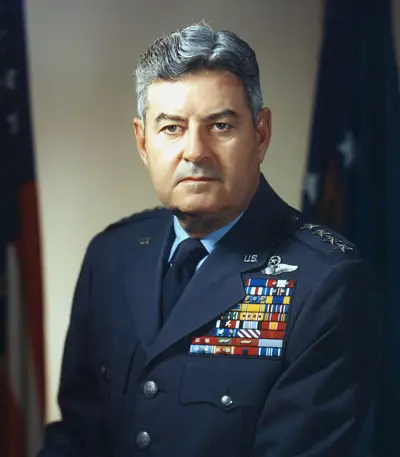
LeMay became a pursuit pilot and, while stationed in Hawaii, became one of the first members of the Air Corps to receive specialized training in aerial navigation. In August 1937, as navigator under pilot and commander Caleb V. Haynes on a Boeing B-17 Flying Fortress, he helped locate the battleship Utah despite being given the wrong coordinates by Navy personnel, in exercises held in misty conditions off California, after which the group of B-17s bombed it with water bombs. For Haynes again, in May 1938 he navigated three B-17s 620 nm (610 miles or 980 km) over the Atlantic Ocean to intercept the Italian liner SS Rex to illustrate the ability of land-based airpower to defend the American coasts. In 1940 he was navigator for Haynes on the prototype Boeing XB-15 heavy bomber, flying a survey from Panama over the Galapagos islands. War brought rapid promotion and increased responsibility.
