Wesley Clark Quotes
The best war is the one that doesn’t have to be fought, and the best military is the one capable and versatile enough to deter the next war in the first place.
Clark had commanded the American and NATO forces in the Serbian War where all the military and political objectives were accomplished with heavy losses to the Serbian’s and none to the allied side—what many think was the most successful war in American History. Like Eisenhower in WWII one great challenge was the political and strategic one of keeping the coalition of all the allied governments working together. His perspective had been like Eisenhower’s which was much wider and geopolitical than most military officers.
Wesley Clark, U. S. General and NATO Commander, Candidate for the Democratic Presidential Nomination, “The Next War”, The Washington Post, September 16, 2007
Sourced by: Eigen's Political and Historical Quotations


Not understanding this point has been the cause of much difficulty for military leaders from the war of 1812 through the Iraq war, the success or failure of the effort depended on a successful peace.


Ironically, Lieberman was using this quotation to campaign against Bush’s son, George W. Bush.


There were many who thought that the Russians would view the Mutual Security Act as aggressive and they might respond with some kind of aggressive retaliation and this could lead to war. Others felt that containment would reduce the likelihood of war.

1st Earl Baldwin of Bewdley. Though members of the same Conservative Party, Churchill was a major opponent of Baldwin’s peace and “appeasement” efforts and publicly castigated Prime Minister Baldwin. Yet Baldwin, if he could not stave off war, wanted his critic to serve as Prime Minister if war was inevitable. Churchill never had much respect for Baldwin. See {626930}.

Barry Goldwater in the 20th century used a variation of this quotation. See {601784}.


See a similar sentiment by Tallyrand


The War Plan that the Germans had developed--{642092}—had gone awry at the battle of the Marne in late 1914.


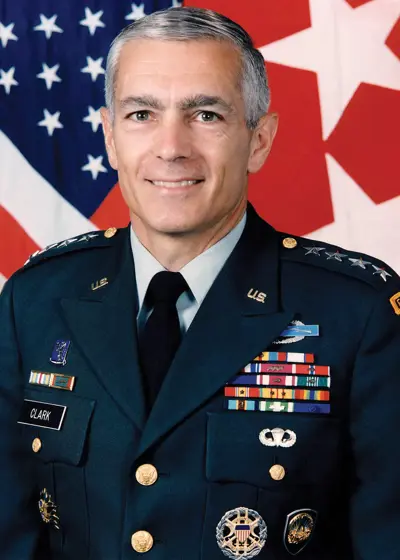
Wesley Kanne Clark, Sr. is a retired general of the United States Army. He graduated as valedictorian of the class of 1966 at West Point and was awarded a Rhodes Scholarship to the University of Oxford, where he obtained a degree in Philosophy, Politics and Economics. He later graduated from the Command and General Staff College with a master's degree in military science. He spent 34 years in the U.S. Army, receiving many military decorations, several honorary knighthoods, and the Presidential Medal of Freedom.
