CURTIS LEMAY
(Utah)

On March 9-10, 1945, over three hundred B-29 Superfortresses, loaded with 2,000 tons of incendiary bombs flew over Tokyo bombing the city in waves for 6 hours. Over 250,000 buildings were destroyed and more people killed than would be in either Hiroshima or Nagasaki which were destroyed by atomic bombs. The fact that the Japanese would not surrender even after such complete destruction of their capital and largest industrial city, was used by American leaders in assessing whether to use the atomic bomb afterwards. There were many who believed that the atomic bomb would not be enough for motivate a Japanese surrender as Japanese culture prohibited surrender. Indeed, even after the 1st atomoc bomb, the Japanese did not surrender, and after the 2nd, the war council was split 3-3 and the Emperor historically broke the tie. Even the atomic bomb might not have worked. Later generations found this resistance to surrender hard to understand but Japanese culture was amazingly strong then.
The production of military equipment and supplies during WWII was little short of miraculous. The military procurement and contractor delivery was one of the major factors in our winning the war. However there were mistakes and one of the worst was the engines of the B-29 heavy bombers. Many American airmen died or were injured as a result of these defects. One of the worst was that to save weight so more bombs could be loaded, many of the parts of the B-29 engines were made of magnesium. The unanticipated consequence was that if the engines caught on fire, there was no way to put the fire out—in the air or on the ground. The magnesium was very flammable and burned at such a high temperature that there was no remedy for the fire which spread faster than fires in engines without magnesium. However, in the midst of the war, those planes had to fly with the risky engines. Fortunately the atom bomb was detonated ending the war and the B-29s could then be retrofitted.
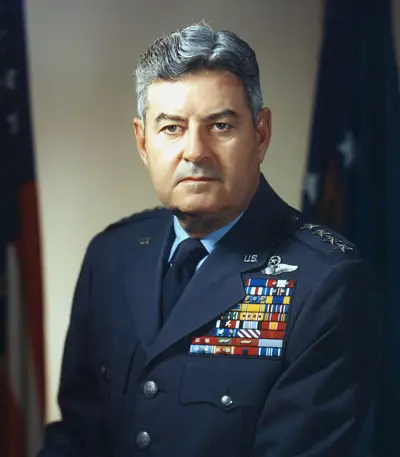
LeMay became a pursuit pilot and, while stationed in Hawaii, became one of the first members of the Air Corps to receive specialized training in aerial navigation. In August 1937, as navigator under pilot and commander Caleb V. Haynes on a Boeing B-17 Flying Fortress, he helped locate the battleship Utah despite being given the wrong coordinates by Navy personnel, in exercises held in misty conditions off California, after which the group of B-17s bombed it with water bombs. For Haynes again, in May 1938 he navigated three B-17s 620 nm (610 miles or 980 km) over the Atlantic Ocean to intercept the Italian liner SS Rex to illustrate the ability of land-based airpower to defend the American coasts. In 1940 he was navigator for Haynes on the prototype Boeing XB-15 heavy bomber, flying a survey from Panama over the Galapagos islands. War brought rapid promotion and increased responsibility.
