Leona Marshall Libby Quotes
I certainly do recall how I felt when the atomic bombs were used. My brother-in-law was captain of the first minesweeper scheduled into Sasebo Harbor. My brother was a Marine, with a flame thrower, on Okinawa. I'm sure these people would not have lasted in an invasion. It was pretty clear the war would continue, with half a million of our fighting men dead not to say how many Japanese. You know and I know that General [Curtis] LeMay firebombed Tokyo and nobody even mentions the slaughter that happened then.
The bombing of Tokyo to which she referred, killed over 100,000 Japanese in a single raid, more than each of the two atomic bombs. However, those who, in hindsight, raise the issue of the morality of using the atomic bombs, say nothing about the firebombing. The graphic is of Dr. Libby when she was working with Enrico Fermi to create the first nuclear chain reaction to prove the feasibility of a nuclear bomb. She was the only female on the team.
Leona Marshall Libby, Physicist, One of the few female scientists who had a significant role in the Manhattan Project to build the Atom Bomb, Reflection on the decision to use the Atom Bomb in WWII, Reflection on her feelings after the two atomic bombs were used in WWII, Interview with S. L. Sanger at her office at UCLA, 1986
Sourced by: Eigen's Political and Historical Quotations

Dr. Libby worked with Enrico Fermi to create the first nuclear chain reaction to prove the feasibility of a nuclear bomb. She was the only female on the team.


Bethe and other European refugees joined American and British scientists at Los Alamos, NM, for the development of the atomic bomb.

The second atomic bomb had just been dropped.


On March 9-10, 1945, over three hundred B-29 Superfortresses, loaded with 2,000 tons of incendiary bombs flew over Tokyo bombing the city in waves for 6 hours. Over 250,000 buildings were destroyed and more people killed than would be in either Hiroshima or Nagasaki which were destroyed by atomic bombs. The fact that the Japanese would not surrender even after such complete destruction of their capital and largest industrial city, was used by American leaders in assessing whether to use the atomic bomb afterwards. There were many who believed that the atomic bomb would not be enough for motivate a Japanese surrender as Japanese culture prohibited surrender. Indeed, even after the 1st atomoc bomb, the Japanese did not surrender, and after the 2nd, the war council was split 3-3 and the Emperor historically broke the tie. Even the atomic bomb might not have worked. Later generations found this resistance to surrender hard to understand but Japanese culture was amazingly strong then.

At the time, surprising to most people now, the use of the atomic bomb was not an issue of controversy at all. There were no Congressman who questioned it, no newspapers which editorialized against the use of the bomb. There were not even any other counties which protested its use. The blessing of ending the war, even at the cost of less than 200,000 deaths seemed a clearly desirable tradeoff when compared with the many millions of deaths that would have occurred had the bomb not been used. As an example, the conventional bombing of Tokyo before the nuclear weapons were used killed as many Japanese as either Hiroshima or Nagasaki.

There were some doubts the scientists developed after Germany had surrendered as Hitler had been their greatest fear. So they were briefed on the planned invasion of the Japanese mainland and the military medical preparations for treating and caring for ½ million serious wounded casualties. In addition, given the state of war, there was expected about the same number of American Military deaths. On top of that, there would be many more Japanese military casualties plus even more Japanese civilian deaths and wounded. The use of the Atom Bomb would save all those lives but have casualties of its own, but far fewer. At the time, surprising to most people now, the use of the atomic bomb was not an issue of controversy at all. There were no Congressman who questioned it, no newspapers which editorialized against the use of the bomb. There were not even any other counties which protested its use.
Truman had been briefed on the number of Japanese who committed suicide rather than surrender—including civilians—in Saipan, Okinawa, Iwo Jima, and other locations where United States troops had invaded. He and his experts agreed that the Japanese would not surrender unless there was a new dramatic factor that was outside the usual thinking—the atomic bomb. He was proved right about the warning. Not only did the Japanese ignore it, but they did not even surrender after the nuclear devastation at Hiroshima. It took a second bomb dropped on Nagasaki to motivate the surrender. So even a demonstration with all those Japanese casualties did not cause the surrender until it was repeated.


Truman had just told Stalin about the new technology. Stalin had actually already known something about it as the result of Soviet espionage in the United States.
Germany had some world class physicists. Our scientists, military intelligence people, and political leadership assumed that the Germans were also seeking to develop the Atomic Bomb. Ironically, it turned out that they were not, and what Truman reported in this quotation was untrue (although that was not fully known at the time.) Einstein and several of the scientists who were early pioneers in modern physics were Jewish, and Hitler referred to the study of nuclear fission and fusion as “Jewish Science.” As a result, the German government did not commit the resources to the development of an atomic bomb. Instead, they were betting on the development of the Jet Airplane which they succeeded in deploying against the Allies at the end of the war. But they did not have enough or enough pilots left alive to fly them, and Germany was overrun by the Allied Troops. Prior to Truman’s erroneous report about the German development of an atomic bomb, there had only been one piece of evidence that the Germans were not developing one. An OSS secret agent, Moe Berg, had talked with Werner Heisenberg, at a Swiss scientific conference during the war. He was going to assassinate the greatest of the German physicists if Berg thought he was working on a nuclear device. Berg concluded from his discussions that Heisenberg did not know enough about nuclear fission to have been working on that. Berg did not kill Heisenberg, and reported that he did not think the Germans were developing a bomb as if they were Heisenberg would have been deeply involved. However, the American intelligence people and the American scientists, did not trust Berg’s analysis and conclusion. Berg was not a trained scientist. He was a professional baseball player—the NY Yankee backup catcher to Bill Dickey. He was a college graduate, a brilliant guy and a very fast learner who had studied physics books and papers before his assignment. Berg turned out to have been right, but that was not confirmed until a few years after the war. Truman had relied on an incorrect intelligence estimate when he made this quotation. It was not the first such error of intelligence analysis in American history and it would not be the last.
While this sounds like an idiotic statement, at the time very little was known by anyone about the effects of large doses of radiation. Groves had not then the benefit of the medical reports or interviews about the Japanese who had received high doses of radiation from the 2 atomic bomb attacks.

When the American troops invaded Okinawa, the individual Japanese soldiers and civilians would not surrender, even when completely surrounded and out numbered. Surrender was culturally dishonorable and the Japanese had been told by their leadership that if they did surrender the Americans would kill them anyway. Almost all the Japanese died and the United States forces had an astoundingly high casualty rate—37%. Truman was fearful that there might be hundreds of thousands American casualties in the subduing of the Japanese mainland. The atomic bomb solved that problem.


Although generally a right wing conservative, Clark today sounds like almost like an extreme leftist on the issue. At the time however, many thought that he had taken leave of his senses. He not only was completely contrary to bipartisan national policy but opposed by almost universal American public opinion. He is one of the very few significant American officials to oppose the war policies.

Bombing had reached the point where conventional bombing raids on industrial cities like Tokyo and Hamburg produced even more civilian casualties than did the atomic bomb at Hiroshima. Tibbets’ view, through the lens of hindsight, was developed by many of the Allied servicemen who had been forced into war by expansionist and militaristic nations like Japan and Germany both of which placed much of their war material manufacturing capability in the midst of their otherwise civilian cities. Both brutally violated the laws of war and committed atrocities many times over before the allies began retaliating. There are still some who believe that it was wrong to drop the atomic bomb on Japan. Some even feel that the mass bombing of Japanese and German cities in retaliation and in furtherance of the war effort was morally wrong. But at the time, the millions of casualties anticipated in the invasion of the Japanese mainland, persuaded virtually every American soldier and civilian that there was nothing wrong with use of the Atomic bomb, and many saw it as an absolute Godsend to prevent all the American and Japanese causalities that would have come otherwise. Many scholars remark on how it was virtually impossible to find any significant number of misgivings before or just after Hiroshima. Tibbet’s view was typical.

This declaration, drafted by Russell and Einstein two days before Einstein’s death was signed by a number of other prominent scientists.

There were an additional 69 co-signers at the Manhattan Project "Metallurgical Laboratory" in Chicago


The Scientific Project that developed the Atomic Bomb. The Scientific Project that developed the Atomic Bomb
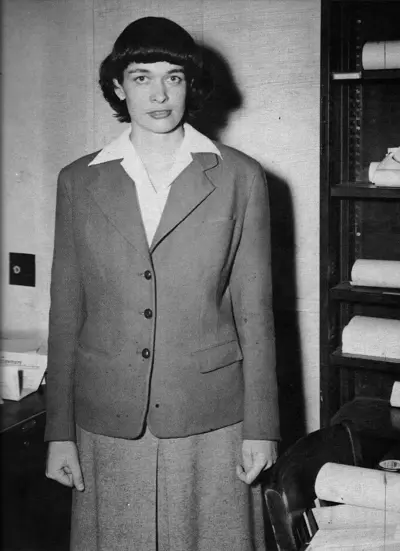
Leona Harriet Woods, later known as Leona Woods Marshall and Leona Woods Marshall Libby, was an American physicist who helped build the first nuclear reactor and the first atomic bomb.
