Albert Einstein Quotes
In the tragic situation which confronts humanity, we feel that scientists should assemble in conference to appraise the perils that have arisen as a result of the development of weapons of mass destruction.... There lies before us, if we choose, continual progress in happiness, knowledge, and wisdom. Shall we, instead, choose death, because we cannot forget our quarrels? We appeal, as human beings, to human beings: Remember your humanity, and forget the rest. If you can do so, the way lies open to a new Paradise; if you cannot, there lies before you the risk of universal death.
This declaration, drafted by Russell and Einstein two days before Einstein’s death was signed by a number of other prominent scientists.
Bertrand Russell, 1872-1970, British Philosopher & Reformer, Albert Einstein, 1879-1955, Nobel laureate in Physics, Russell-Einstein Appeal, July 9, 1955
Sourced by: Eigen's Political and Historical Quotations


Under this initiative the US declassified and distributed technical, previously secret information, about atomic science to the world for scientific development. It has been very successful and there are few modern nations that have not benefitted from the program.


The Scientific Project that developed the Atomic Bomb. The Scientific Project that developed the Atomic Bomb

The lecture was on radium and the radioactivity that scientists had recently discovered. This appears to be the first time a scientist suggested the possibility of using atomic energy to produce a powerful weapon. At the same time, note that he also mentioned the possible destruction of the earth. “Heavy matter” referred to the elements—many of which had not yet been discovered—that had larger atomic numbers than radium like uranium.

Quoting the Baghavad-Gita at the first atomic bomb test, Alamogordo, NM, July 16, 1945


Dr. Libby worked with Enrico Fermi to create the first nuclear chain reaction to prove the feasibility of a nuclear bomb. She was the only female on the team.
The bombing of Tokyo to which she referred, killed over 100,000 Japanese in a single raid, more than each of the two atomic bombs. However, those who, in hindsight, raise the issue of the morality of using the atomic bombs, say nothing about the firebombing. The graphic is of Dr. Libby when she was working with Enrico Fermi to create the first nuclear chain reaction to prove the feasibility of a nuclear bomb. She was the only female on the team.


Having just been told of the Hiroshima atomic bombing:

The claims of the President that Hussein even had weapons of mass destruction were untrue. Eagleburger’s criteria for war would have been even more stringent as is clear in this quotation. Foreign affairs experienced members of the President’s own party tried to dissuade him from this disastrous plan of invading Iraq but were unable to.

He was the first man to see the experimental evidence of nuclear power and he realized that it had the potential for an incredibly powerful weapon. It was his message about the possibilities about the atomic bomb that Albert Einstein transmitted to FDR, leading to American development of the bomb.(See {624449}.) By the time the atomic bomb had been developed, Germany had surrendered and Szilard and others felt that there was no longer a need to beat the Germans to the development. So he went from the biggest enthusiast to the most serious opponent.

The atomic bomb had just been used the year before. However, in the next decades, nuclear weapons were not used again as those nations with nuclear capability also had potential enemies with nuclear weapons. The fear of Mutually Assured Destruction prevented nuclear weapons from being used for a long time.


At the time, surprising to most people now, the use of the atomic bomb was not an issue of controversy at all. There were no Congressman who questioned it, no newspapers which editorialized against the use of the bomb. There were not even any other counties which protested its use. The blessing of ending the war, even at the cost of less than 200,000 deaths seemed a clearly desirable tradeoff when compared with the many millions of deaths that would have occurred had the bomb not been used. As an example, the conventional bombing of Tokyo before the nuclear weapons were used killed as many Japanese as either Hiroshima or Nagasaki.
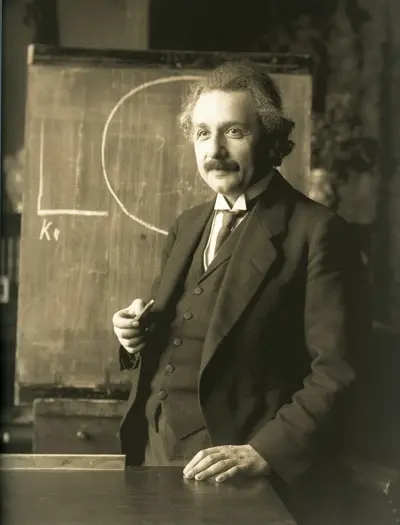
Albert Einstein was a German-born theoretical physicist, widely acknowledged to be one of the greatest physicists of all time. Einstein is known for developing the theory of relativity, but he also made important contributions to the development of the theory of quantum mechanics. Relativity and quantum mechanics are together the two pillars of modern physics. His mass–energy equivalence formula E = mc2, which arises from relativity theory, has been dubbed "the world's most famous equation". His work is also known for its influence on the philosophy of science. He received the 1921 Nobel Prize in Physics "for his services to theoretical physics, and especially for his discovery of the law of the photoelectric effect", a pivotal step in the development of quantum theory. His intellectual achievements and originality resulted in "Einstein" becoming synonymous with "genius".
