Albert Einstein Quotes
Some recent work by E. Fermi and L. Szilard, which has been communicated to me in manuscript, leads me to expect that the element uranium may be turned into a new and important source of energy in the immediate future .... This new phenomenon would also lead to the construction of bombs .... A single bomb of this type, carried by boat or exploded in a port, might very well destroy the whole port together with some of the surrounding territory.
The letter was actually delivered to President Roosevelt on October 11. It was the stimulus for the Manhattan Project to develop the atomic bomb. It had been drafted in large part by physicist Leo Szilard whose idea it was that Einstein sign the letter. As the world’s most prestigious scientist Einstein, Szilard felt, would make more of an impression on FDR than he, Fermi or other scientists even though Einstein was a theoretician and never did work on the development of the bomb. The military men did not understand Szilard and thought him a danger to the nation. So the two men who initiated the idea of the development of an atom bomb did not do any, of the work on it.
Albert Einstein, 1879-1955, Nobel laureate in Physics, Letter to President Franklin Delano Roosevelt, August 2, 1939
Sourced by: Eigen's Political and Historical Quotations

See {624449} for the essence of the letter.

He was the first man to see the experimental evidence of nuclear power and he realized that it had the potential for an incredibly powerful weapon. It was his message about the possibilities about the atomic bomb that Albert Einstein transmitted to FDR, leading to American development of the bomb.(See {624449}.) By the time the atomic bomb had been developed, Germany had surrendered and Szilard and others felt that there was no longer a need to beat the Germans to the development. So he went from the biggest enthusiast to the most serious opponent.

The Scientific Project that developed the Atomic Bomb. In the development of the atomic bomb there was a hypothetical possibility that the Earth as we know it might be destroyed. Robert Oppenheimer the scientist who directed the bomb development and his staff framed the question which Oppenheimer presented to Arthur Compton. The decision was that Oppenheimer’s team would calculate every possibility and make sure that such a catastrophe was not within the realm of possibility. They did all the calculations, concluded that there was no possibility, the bomb was exploded, and the question was then finally answered in the negative.

Morrison was then a graduate student of Oppenheimer. The quotation is important, not because it shows how quickly the “father of the atomic bomb” realized that a nuclear bomb could be made and how, but how relatively easy and rapid it was for a competent theoretical physicist could conceptually design a nuclear weapon if they first had knowledge of the Hahn / Strassmann Experiment and the Meitner / Frisch explanation of what had happened ({640924}). Note Leo Szilard’s letter at about the same time--{640925}.


Meitner and her nephew Frisch had been the first people to realize that the atom had been split. Meitner had described the process to her nephew and he made some drawings of the process she described. A few of these looked like a bacteria dividing. Frisch happened to meet with William A. Arnold, an American Biologist doing research in Stockholm. He asked Arnold what the biologists called it when a bacteria divided, and he replied, “fission”. Frisch told his aunt and she decided that they should use that term in the scientific article they were preparing on the splitting of the atom.


Rutherford had been the first to split the atom in 1919.

This was a political use of sarcasm and irony. Oak Ridge was the site of the largest facility for producing fissionable material in the world as the result of the Manhattan Project. And yet the problem of what to do with the radioactive waste has never been resolved. So Oak Ridge was producing more and more radioactive uranium in the area without a resolution in sight. The “joke” was that the people in the area were immune, so production could continue without a solution to radioactive waste.
Reflecting on the two scientists different views immediately after nuclear fission had first been demonstrated and explained--{640924}. The different “conservative” views reflect the norms and mores contrasts of the scientists and the political world. To the scientist saying something is possible before it has actually been demonstrated is unethical, and estimates of likelihood of success is not taken into account until there is evidence—that it has happened. Szilard’s conservatism was not concerned with undue optimism about something that has not yet occurred, but pragmatically it might happen and if so the political and practical implications for a world at war were so profound that preparations should be made even if a chain reaction could not be produced in the next years. In this disagreement, Szilard’s view prevailed and the two scientists led the efforts that produced the first chain reaction months later.

During the meltdown of the Japanerse nuclear reactors at Fukashima, American sailors were deployed to provide critical assistance fram an American aircraft carrier in the area. They played a significant role in getting the reactors under control. Many of the Japanese at the emergency area had suffered serious illness from the radiation exposure abd a number died. The crew of the aircraft carrier had developed a highly unusual prevelance of serious illness assocated with radiation exposure. The U. S. Defense Department was "styding the matter" but had not decided that the unusual illness patern was related to their assignment assisting in th emergency. A number of the sailors had come to japan and asked for damages from the Raactor company which like most American Corporations would not do or say anything. The Japanese government also was silent on the issue when the sailors came to Japan, However, this former prime minister felt so strongly that he visited the Sailors and took up their cause in letting the Japanese public know what had happened and how the government and the electic company were acting. This was Koizumi's tearful response to the press covering the saolors and their request.
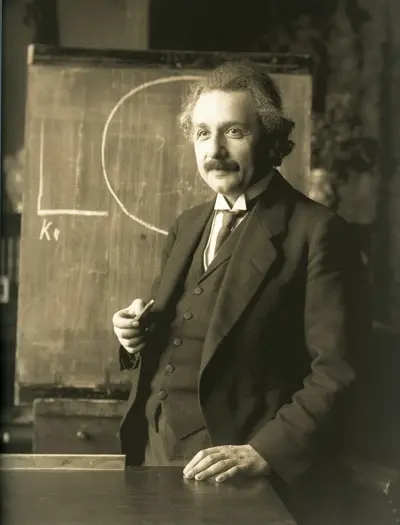
- Born: March 14, 1879
- Died: April 18, 1955
- Nationality: German, Swiss, American
- Profession: Physicist
Albert Einstein was a German-born theoretical physicist, widely acknowledged to be one of the greatest physicists of all time. Einstein is known for developing the theory of relativity, but he also made important contributions to the development of the theory of quantum mechanics. Relativity and quantum mechanics are together the two pillars of modern physics. His mass–energy equivalence formula E = mc2, which arises from relativity theory, has been dubbed "the world's most famous equation". His work is also known for its influence on the philosophy of science. He received the 1921 Nobel Prize in Physics "for his services to theoretical physics, and especially for his discovery of the law of the photoelectric effect", a pivotal step in the development of quantum theory. His intellectual achievements and originality resulted in "Einstein" becoming synonymous with "genius".
