WILLIAM JENNINGS BRYAN

The “subversive” ideas that Bryan espoused included going off the gold standard and a whole series of reforms that we take for granted today. In a certain irony, Carnegie and other capitalists were really worried about Bryan (as opposed to other so called reformers) as he believed Bryan was too honest and meant exactly what he said.

In the Democratic national convention of 1912, Clark had obtained a majority of the delegate votes and was well on his way to the two thirds necessary for the Presidential nomination. William Jennings Bryan, a close personal friend of Clark's, headed the Nebraska delegation which had already instructed Bryan to vote for Clark. However, in a dramatic repudiation of his old friend, Bryan switched to Woodrow Wilson and turned the tide against Clark, who characterized Bryan as:

The presidential nomination of William Jennings Bryan in 1896 split the Democratic party. Governor Hill was a strong party man, but couldn't abide Bryan's "free silver" and other positions, so when a reporter asked him if he was still a Democrat, and would campaign for Bryan, the governor answered:

In the 1896 presidential campaign, McKinley refused to campaign against the great orator, William Jennings Bryan. He won anyway:

Referring to William Jennings Bryan:


Bryan was the Democratic candidate for the Presidency 3 times and lost each one. He was a populist who could connect with common non-educated people. He was a religious fundamentalist who wanted the state to prohibit the teaching of evolution in schools. He was however, one of the great political orators of American History,

The two insulting adjectives are used very rarely these days, but they were in common use at the turn of the end of the 19th century. “Briefless” when applied to a lawyer connoted little intellectual substance, as the important facets of a case are usually in an attorney’s briefs. “Jackleg” described a unprofessional, shoddy person with no standards of excellence. Eg. A person who made do with a temporary jack to hold up a large piece of furniture rather than a proper leg. These were very insulting terms at the time.


Actually, both political parties had a range of opinion on the issue of control of the trusts, monopolies and large corporations. Roosevelt and his liberal wing of the Republic opinion were for regulating corporations and strengthening and enforcing the anti-trust laws. However, many of his party refused to admit that there were any abuses and/or if there were, the effect of Federal regulation and anti-trust enforcement would be worse that then problems caused by the trusts. At the same time, the Democrats had Bryan’s wing that wanted to break up the trusts and large corporations, and that is why Roosevelt had so much public support—enough to pass the legislation and make the President’s initiatives very popular. Roosevelt a shrewd campaigner attacked the Democrats knowing full well that many agreed with him, and ignored the conservative wing of his own party who were the ones who actively opposed his corporate reform effort.
Taft was a jurist whose tendency was to respond to each point his opponent made and argue it logically and then to on to the next point much as in a formal debate. However, Bryan was a very dynamic speaker who was a populist and demagogue. Roosevelt who could debate logically or thunder like a demagogue was of the opinion that you should not let a demagogue control the agenda in a campaign. Trying to answer was futile. Instead attack the demagogue where he is weak and stay on the attack. This was hard for Taft to do as he was not the skilled speaker or politician that TR was. Taft won, but Roosevelt was actively campaigning for him and attacking Bryan. The notion of attack, as Theodore Roosevelt used it was NOT negative campaigning. Roosevelt did not attack Bryan personally or make ad hominum arguments. What he advocated was that when Bryan made a speech and criticized a policy that Taft supported, instead of answering him point by point, as one would do in a debating society (at which Taft excelled) attack some of the worst policies that Bryan was advocating or had advocated. Control the agenda so that Bryan would have to answer Taft’s criticism, not the other way around.
Huey P. Long credited this quotation for the origin of his famous slogan, "Every Man a King, but No Man Wears a Crown”. See {609936}
Bryan participated as a prosecutor in the infamous Scopes Trial in Tennessee where a school teacher was convicted of a crime for discussing the idea of evolution in a high school classroom. He had written this for his summary to the jury, but the summaries were dispensed with when it was obvious that Scopes would be convicted. He had admitted to breaking the law, but the law itself was on trial.
Bryan's concept of struggling masses included farmers and small businessmen.
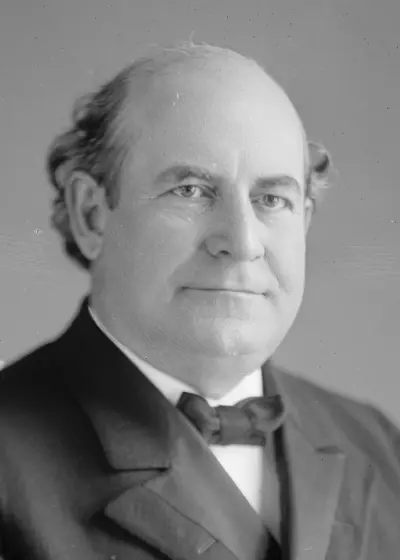
- Born: March 19, 1860
- Died: July 26, 1925
- Nationality: American
- Profession: Lawyer
William Jennings Bryan was an American orator and politician from Illinois and Nebraska. Beginning in 1896, he emerged as a dominant force in the Democratic Party, running three times as the party's nominee for President of the United States in the 1896, 1900, and 1908 elections. He also served in the United States House of Representatives and as the United States Secretary of State under Woodrow Wilson. Because of his faith in the wisdom of the common people, he was often called "The Great Commoner".
