Bertrand Russell Quotes
This idea of weapons of mass extermination is utterly horrible and is something which no one with one spark of humanity can tolerate. I will not pretend to obey a government which is organizing a mass massacre of mankind.
3rd Earl Russell of Kingston
Bertrand Russell, 1872-1970, British Philosopher & Reformer, Speech in Birmingham, England encouraging civil disobedience in support of nuclear disarmament, April 15, 1961
Sourced by: Eigen's Political and Historical Quotations

He was the Secretary of State in the War Office at the time. The Royal Air Force had suggested an experiment---gassing “recalcitrant Arabs” from the air. This predated Sadaam Hussein's gassing of Hussein's gassing of his own people by over 70 years.

Fermi was the scientist who organized and planned the first controlled nuclear chain reaction as a part of the Manhattan Project and was one of the major scientific advisors to the Atomic Energy Commission until he, Oppenheimer, and several other scientists opposed the development of the Super (the name Edward Teller had given to the proposed hydrogen bomb). The scientists knew that we had and could make enough atomic bombs to destroy any nation and to make it doable with just a few bombs as opposed to many they saw as of little military
value. They further expected that the Russians and some others would be forced to keep up with us in an arms race and that the bomb would never be able to be used without retaliation in kind and the destruction of most of America. The politicians and military did not really believe that the Russians had the scientific capability to develop hydrogen weapons and some thought if we had them and no one else did, we could dictate a “pax Americana” to the world. Others feared that Russia or some other country would develop a hydrogen weapon and then dictate to us. We did have a monopoly on the Super for a few years and America never dictated to the rest of the world. When other countries developed the weapons, we entered the era of Mutually Assured Destruction (MAD).


The First World War had recently ended with the mass of horrible casualties that resulted from the use of poison gas. Permanently debilitated veterans were trying to rebuild a life all over England. Many Englishmen wanted to ban English use of poison gas. Churchill objected as the Middle East was a cauldron of various forms of terrorism then in areas that the British were “responsible for” under the Peace Treaty. He argued that there was little difference be gas and shells, but that did not persuade many others. Churchill was outvoted and overruled and the British have never used poison gas since although they had a large supply and were prepared to use it in WWII if the Germans did. This quotation was a blot on Churchill’s reputation. One issue was whether or not it was human to use poison gas. Churchill was willing to say no where white Christians were concerned but was perfectly willing to use them on the “uncivilized”.


Some think that for Europe, Nuclear Weapons performed this function.

Lawrence of Arabia. In the Middle East, Lawrence led a small Arab army against the Turks and the Germans. In a battle near Tafas, the captured 250 Turkish and German soldiers as prisoners. They them shot them all in cold blood with their Hotchkiss machine gun. What makes this quotation so significant is that one of the great British heroes of WWI was actually guilty of War Crimes. An American journalist gave Lawrence and his exploits great publicity without mentioning the atrocities. The British chain of command also ignored the transgression of one of the most fundamental rules of war even though the clear evidence was in basic battle report files. However, the British never removed the report from the files or destroyed it. The Turks and the Germans while they respected the rules of war with the English, French, and most allies, treated the Arabs much more harshly and murdered Arab prisoners on many occasions. In part this atrocity at Tafas was an act of vengeance and retaliation. But Lawrence never even tried to explain it.


The atomic bomb had just been used the year before. However, in the next decades, nuclear weapons were not used again as those nations with nuclear capability also had potential enemies with nuclear weapons. The fear of Mutually Assured Destruction prevented nuclear weapons from being used for a long time.
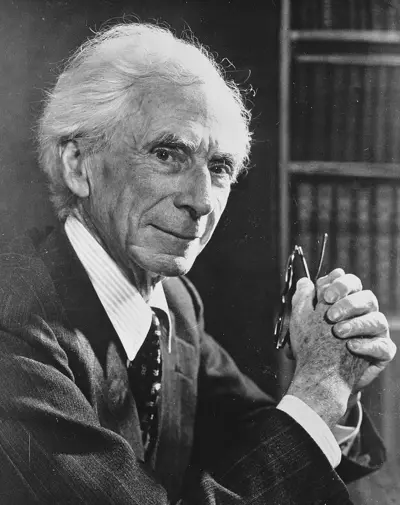
Bertrand Arthur William Russell, 3rd Earl Russell OM FRS was a British polymath, philosopher, logician, mathematician, historian, writer, social critic, political activist, and Nobel laureate. Bertrand Russell was one of the most influential and widely known intellectual figures of the twentieth century. In 1950 he was awarded the Nobel Prize in Literature for his extensive contributions to world literature and for his “rationality and humanity, as a fearless champion of free speech and free thought in the West.“
