Leo Szilard Quotes
The development of atomic power will provide the nations with new means of destruction. The atomic bombs at our disposal represent only the first step in this direction, and there is almost no limit to the destructive power which will become available in the course of their future development. Thus a nation which sets the precedent of using these newly liberated forces of nature for purposes of destruction may have to bear the responsibility of opening the door to an era of devastation on an unimaginable scale.
There were an additional 69 co-signers at the Manhattan Project "Metallurgical Laboratory" in Chicago
Leo Szilard, 1898-1964, Hungarian-American Nuclear Scientist, Petition to the President, July 17, 1945
Sourced by: Eigen's Political and Historical Quotations


At the time, surprising to most people now, the use of the atomic bomb was not an issue of controversy at all. There were no Congressman who questioned it, no newspapers which editorialized against the use of the bomb. There were not even any other counties which protested its use. The blessing of ending the war, even at the cost of less than 200,000 deaths seemed a clearly desirable tradeoff when compared with the many millions of deaths that would have occurred had the bomb not been used. As an example, the conventional bombing of Tokyo before the nuclear weapons were used killed as many Japanese as either Hiroshima or Nagasaki.


The bombing of Tokyo to which she referred, killed over 100,000 Japanese in a single raid, more than each of the two atomic bombs. However, those who, in hindsight, raise the issue of the morality of using the atomic bombs, say nothing about the firebombing. The graphic is of Dr. Libby when she was working with Enrico Fermi to create the first nuclear chain reaction to prove the feasibility of a nuclear bomb. She was the only female on the team.


There were some doubts the scientists developed after Germany had surrendered as Hitler had been their greatest fear. So they were briefed on the planned invasion of the Japanese mainland and the military medical preparations for treating and caring for ½ million serious wounded casualties. In addition, given the state of war, there was expected about the same number of American Military deaths. On top of that, there would be many more Japanese military casualties plus even more Japanese civilian deaths and wounded. The use of the Atom Bomb would save all those lives but have casualties of its own, but far fewer. At the time, surprising to most people now, the use of the atomic bomb was not an issue of controversy at all. There were no Congressman who questioned it, no newspapers which editorialized against the use of the bomb. There were not even any other counties which protested its use.

The Scientific Project that developed the Atomic Bomb


Quoting the Baghavad-Gita at the first atomic bomb test, Alamogordo, NM, July 16, 1945


Stimpson had told him that “We are on the verge of splitting the atom.” The Senator thought that was frivolous technology. When the Senator later finally realized the implication of the Secretary’s statement, he was actually instrumental in helping fund the Manhattan Project. See {586360}.


The second atomic bomb had just been dropped.


Truman had been briefed on the number of Japanese who committed suicide rather than surrender—including civilians—in Saipan, Okinawa, Iwo Jima, and other locations where United States troops had invaded. He and his experts agreed that the Japanese would not surrender unless there was a new dramatic factor that was outside the usual thinking—the atomic bomb. He was proved right about the warning. Not only did the Japanese ignore it, but they did not even surrender after the nuclear devastation at Hiroshima. It took a second bomb dropped on Nagasaki to motivate the surrender. So even a demonstration with all those Japanese casualties did not cause the surrender until it was repeated.

Alvarez was a scientist who worked on the Manhattan Project developing the atomic bomb:

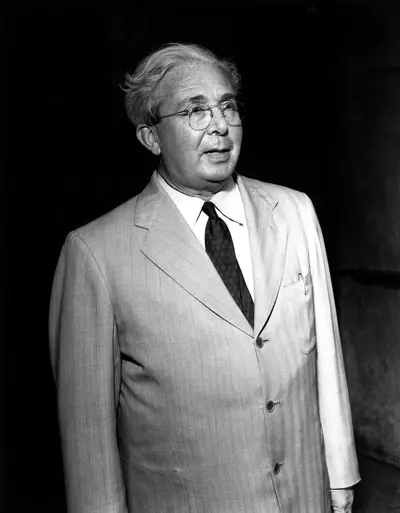
Leo Szilard was a Hungarian-American physicist and inventor. He conceived the nuclear chain reaction in 1933, patented the idea of a nuclear fission reactor in 1934, and in late 1939 wrote the letter for Albert Einstein's signature that resulted in the Manhattan Project that built the atomic bomb. According to György Marx he was one of the Hungarian scientists known as The Martians.
