J. Robert Oppenheimer Quotes
Now I am become death, the destroyer of worlds.
Quoting the Baghavad-Gita at the first atomic bomb test, Alamogordo, NM, July 16, 1945
J. Robert Oppenheimer, 1904-1967, Physicist and Scientific Director of the Manhattan Project Quoting the Baghavad-Gita at the first atomic bomb test, Alamogordo, NM, July 16, 1945
Sourced by: Eigen's Political and Historical Quotations

The Vedas are a large body of religious texts originating in ancient India. Composed in Vedic Sanskrit, the texts constitute the oldest layer of Sanskrit literature and the oldest scriptures of Hinduism. Oppenheimer's admiration for the Vedas highlights his broader fascination with Eastern thought and his recognition of the value of ancient wisdom in shaping contemporary understanding.


He was the first man to see the experimental evidence of nuclear power and he realized that it had the potential for an incredibly powerful weapon. It was his message about the possibilities about the atomic bomb that Albert Einstein transmitted to FDR, leading to American development of the bomb.(See {624449}.) By the time the atomic bomb had been developed, Germany had surrendered and Szilard and others felt that there was no longer a need to beat the Germans to the development. So he went from the biggest enthusiast to the most serious opponent.


This is one of the earliest uses of the phrase “weapons of mass destruction.” Panneloek quoted it in 1948, so it was used by Urey before then.


This declaration, drafted by Russell and Einstein two days before Einstein’s death was signed by a number of other prominent scientists.

I can go into my office and pick up the telephone, and in 23 minutes 70 million people will be dead.
He had been asked if the impeachment proceedings weakened him as the President.


he cupped his two hands Fermi was the scientist who organized and planned the first controlled nuclear chain reaction
Fermi was the scientist who organized and planned the first controlled nuclear chain reaction as a part of the Manhattan Project and was one of the major scientific advisors to the Atomic Energy Commission until he, Oppenheimer, and several other scientists opposed the development of the Super (the name Edward Teller had given to the proposed hydrogen bomb). The scientists knew that we had and could make enough atomic bombs to destroy any nation and to make it doable with just a few bombs as opposed to many they saw as of little military
value. They further expected that the Russians and some others would be forced to keep up with us in an arms race and that the bomb would never be able to be used without retaliation in kind and the destruction of most of America. The politicians and military did not really believe that the Russians had the scientific capability to develop hydrogen weapons and some thought if we had them and no one else did, we could dictate a “pax Americana” to the world. Others feared that Russia or some other country would develop a hydrogen weapon and then dictate to us. We did have a monopoly on the Super for a few years and America never dictated to the rest of the world. When other countries developed the weapons, we entered the era of Mutually Assured Destruction (MAD).


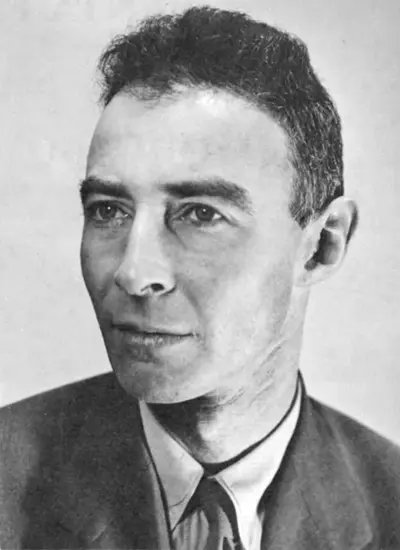
- Born: April 22, 1904
- Died: February 18, 1967
- Nationality: American
- Profession: Physicist
J. Robert Oppenheimer was an American theoretical physicist and professor of physics at the University of California, Berkeley. Oppenheimer was the wartime head of the Los Alamos Laboratory and is among those who are credited with being the "father of the atomic bomb" for their role in the Manhattan Project, the World War II undertaking that developed the first nuclear weapons. The first atomic bomb was successfully detonated on July 16, 1945, in the Trinity test in New Mexico.
