RICHARD NIXON
(Richard Milhous Nixon)

The text was actually written by John Kenneth Galbraith who was writing speeches for Stevenson.

The Nixon "Southern Strategy" was that if the Republican Party made extensive efforts to appeal to minorities, given the previous decades of support of white supremacy, they would only be successful with a few, whereas if the Party went in the other direction and supported the Whites fighting against the Democratic initiated, racist hated, Civil Rights Act, they would get almost all the racist Southern Democrats, which were most white males and many white females. This racist policy enabled the Republicans to gain control of the Federal Government more often than not whereas before, it was very unusual.

Before the 1968 election, President Johnson, and gotten the North Vietnam Communists to agree to Peace Talks with the U. S. and South Vietnam. Then Candidate Nixon thought that if the peace talks were ongoing and making progress, there would be more support for the Democrats and Nixon's opponent Hubert Humphrey. So Nixon secretly send a secret emissary to South Vietnamese President Nguyen Van Thieu telling him that he would not get a very good deal because President Nixon claimed that President Johnson was too eager to end the Vietnam war. He suggested that if Thieu boycotted the peace talks, then when Nixon was elected, he would guarantee a much better deal for South Vietnam and Thieu personally. President Thieu boycotted the peace talks and there could be no progress. However there is a Federal Law, the Logan Act, that makes it a felony for a private American citizen to conduct or interfere with foreign policy or negotiations with a foreign government. President Johnson found out about Nixon's sabotage of the Peace Talks, called Nixon (see {583263}) and threatened him with prosecution if he interfered further. LBJ had decided that with the left wing at odds with the U. S. Government over the Vietnam war, a prosecution of Nixon would cause the Right Wing to challenge the government also and the country didn't need further polarization. He would do that only if Nixon did not heed the President's warning. But when Nixon won the election and became President, he was terribly anxious that his pre-election crimes would be made public, and spent much of his time and staff effort trying to find out who knew about his politically self-serving felony and who might make his crime public.

Before the 1968 election, President Johnson, and gotten the North Vietnam Communists to agree to Peace Talks with the U. S. and South Vietnam. Then Candidate Nixon thought that if the peace talks were ongoing and making progress, there would be more support for the Democrats and Nixon's opponent Hubert Humphrey. So Nixon secretly send a secret emissary to South Vietnamese President Nguyen Van Thieu telling him that he would not get a very good deal because President Nixon claimed that President Johnson was too eager to end the Vietnam war. He suggested that if Thieu boycotted the peace talks, then when Nixon was elected, he would guarantee a much better deal for South Vietnam and Thieu personally. President Thieu boycotted the peace talks and there could be no progress. However there is a Federal Law, the Logan Act, that makes it a felony for a private American citizen to conduct or interfere with foreign policy or negotiations with a foreign government. President Johnson found out about Nixon—s sabotage of the Peace Talks, called Nixon and threatened him with prosecution if he interfered further. LBJ had decided that with the left wing at odds with the U. S. Government over the Vietnam War, a prosecution of Nixon would cause the Right Wing to challenge the government also and the country didn—t need further polarization. He would do that only if Nixon did not heed the President—s warning. But when Nixon won the election and became President, he was terribly anxious that his pre-election crimes would be made public, and spent much of his time and staff effort trying to find out who knew about his politically self-serving felony and who might make his crime public. See {583264}.

The object was to be able to use the IRS records to obtain information about their "enemies" to either intimidate them by threating to make embarrassing information public if their behavior did not change, or releasing the information and impairing the critic's credibility—all of which were and are crimes.

Ailes suggested plan was not implemented by President Nixon. However. Ailes, an arch conservative who has always believed the media was biased against conservatism, later implemented his idea very successfully. This idea was the intellectual forerunner" to Fox News, which Ailes launched as a "fair and balanced" news network in 1996. The Nixon Administration however, concerned about the extremes of many of his recommendations finally fired him, which turned out to be very positive for Ailes career thereafter.


“Camels” and “Chesterfields” were the brand names of 2 of the very popular cigarettes of the time when the danger of cigarette smoking was not as well understood and a much higher proportion of the nation smoked.

In Tuck’s most famous dirty trick, he had signs printed welcoming Nixon. The first line was in English but the second was in Chinese Characters. Tuck, working against Nixon, had the signs printed and pretending to be a Nixon aide passed them out to the Nixon staff who gave them to people in the crowd. The Chinese 2nd line referred to the scandal where Nixon had taken a “loan” from Howard Hughes—the financier and industrialist and Nixon was desperately trying to get that story supplanted by other news. Tuck also did the same with Chinese fortune cookies and Nixon people enthusiastically distributed them.

The President was asked at a press conference to give an example of a Richard M. Nixon idea that Eisenhower had adopted in their first administration.


Nixon was a very aggressive campaigner, with a great flair for smearing opponents. Kennedy had been an intellectual, Ivy League gentlemen type and his brother, his campaign manager, wanted JFK to get down in the mud with Nixon. He was more assertive than usual and didn’t back down, but he did not go for the low blows that had been readied for him.

This quotation illustrates one of Nixon’s major character flows. He was so insecure that he could not tolerate any of his “team” disagreeing in the slightest. It is expected that when an issue is decided by the president, the VP and the cabinet support that, but at the cabinet meeting the President is supposed to be getting advice.
She was writing regarding the first use of television in a presidential campaign and the first time the public had ever been exposed to spot political ads. The practice, innovated in the Eisenhower campaign of 1952, was thought of as playing to the lowest element of the electorate’s psyche—selling politicians as if they were breakfast cereal or soap flakes. However, the technique worked incredibly well electing Eisenhower over Stephenson. Mannes wrote this after the election commenting on what politics had become.
Richard M. Nixon was, even before the Watergate scandal very disliked as both a politician and a person. However, this was one of the first major public figures who castigated Nixon, the man, in a major public address. Many followed, In this collection there are many more insults to Richard M. Nixon than any other politican.

Richard M. Nixon had beaten McGovern and then disgraced himself in the Watergate Scandal. Had Nixon lost, he would have been considered a leading statesman of his time, and not died in disgrace and remembered by history as the a dishonest failure.

He was famous for his comical impressions of Richard M. Nixon.


He was the lead investigator of President Jacques Chiraq who had admitted being present, when mayor of Paris, at major payoffs of kickbacks to his party associates for awarding of public contracts. However, the French authorities gave the President immunity and ordered the investigation halted.

At this point Nixon was drinking heavily and clearly not well mentally. Earlier, Nixon was the butt of many Carson jokes as well as those of all political comedians at the time. However, Carson was one of the few who realized the true condition of the President and just laid off further public televised jokes.

Steinbeck had been approached by Democratic political operatives (not connected with JFK) to write a novel attacking Richard Nixon. See {629629}. “Swift” referred to Jonathan Swift, the great English Satirical Writer who was greatly admired but did not achieve any political objectives.

The memo proposed having a good novelist write a fictional novel with Nixon as the main character. The great Nobel Laureate John Steinbeck was approached for the project. See {629628} for his reaction.

Critics were divided as to whether this illustrated that Graham was very naïve or very hypocritical. Graham had given Nixon a platform but he attended many Nixon events and was thought of as close to the President. When Watergate finally broke out in the open, Graham, had a major realignment of his view of politicians and has never gotten as close to any politician or appeared to favor a politician since.


Just as the brief was received, Kissinger received a Cable from the American Embassy in Cyprus stating that the Greek forces had moved in Cyprus and decimated the Cypriot forces and burned the Presidential Palace. Nixon was furious at the CIA which based their entire brief on one agent talking to the Greek dictator in Greece and had no agents who could report on what everyone in Cyprus could see. {634509}, {634503} and {634502} for examples of Nixon flaming the CIA. This was one of the reasons he came down on them.


Nixon had just made a television address explaining why he had asked for the resignations of his two most senior White House aides in the midst of the Watergate scandal. Nixon continued his lies and there were some of his supporters, like Graham, who were still fooled. Note the reference to Ruth—Graham’s wife. Nixon, himself, had been one of the first to perpetuate the Red Scare and blame communists for anything that goes wrong and to smear any critics by calling them communists who were just trying to destabilize the country.


Nixon, not a warm person to even his best friends was not very enthused about the enthusiastic British overtures they were making. Kissinger turned him around with this statement.


When Nixon and Kissinger went to China in the midst of the cold war, there are many American right-wingers who objected and thought that it was a betrayal of America’s fundamental principles At the same time, the extreme left wing, hard line Communists objected for the exact same reasons to China allowing the visit. This quotation is an excellent example of the latter.

Columnist Joseph Alsop was hosting a dinner party and as Harrimann arrived, he ran into Richard M. Nixon who had just defeated Helen Gahagan with dirty, smear campaign tactics. The Governor started to leave. This was what he told his hosts. Mrs. Alsop implored him to stay. He did, but at dinner, turned over his plate, turned off his hearing aid and refused to eat or speak

There was no way of reopening the investigation into the assassination without the public finding out that the CIA and FBI both had deliberately misled the Warren Commission and the House Investigating Committee in the original investigation. Nixon and other politicians who likely knew of the scandal did not want the confidence of the public eroded in this important agencies, and that was probably his motivation for the turn down rather than trying to cover up facets about the assassination itself.
This quotation was uncovered in 2010 when more of the Nixon White House tapes were relaeased. Nixon tended to have the worst stereotyped view of all minority groups.
The popularly elected president Salvador Allende was a left leaning socialist and Nixon wanted a right wing Government in place who would deal more firmly with the communists. General Augusto Pinochet thus came to power, murdered Allende, and instituted a reign of terror with death squads, torture and disappearances, that eventually led him to be indicted for crimes against humanity.
Reference to the British Economist John Maynard Keynes who advocated government action to manage the economy.
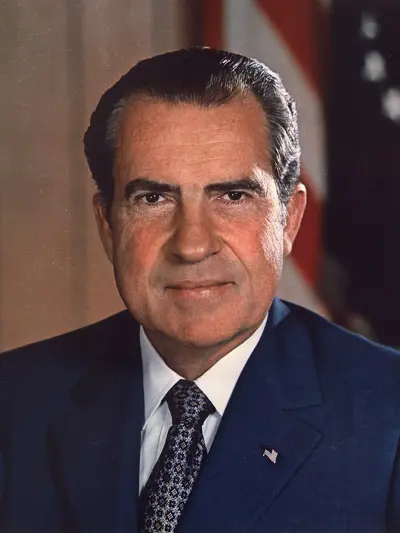
- Born: January 9, 1913
- Died: April 22, 1994
- Nationality: American
- Profession: President
Richard Milhous Nixon was the 37th president of the United States, serving from 1969 to 1974. A member of the Republican Party, Nixon previously served as the 36th vice president from 1953 to 1961, having risen to national prominence as a representative and senator from California. After five years in the White House that saw the conclusion to the U.S. involvement in the Vietnam War, détente with the Soviet Union and China, and the establishment of the Environmental Protection Agency, he became the only president to resign from the office, following the Watergate scandal.
