John Steinbeck Quotes
I think the boy [Richard Nixon] should be attacked, but frontally, not obliquely.... Reference was made to lampoons and satires in times past. What we did not discuss was whether they were successful. Did Swift ever win an election? ... The more I think of it the less convinced I am that it is a good, meaning effectual, plan at all. We need direct attacks-- kidney punch zingers, like “Nixon plays both sides of the gutter” or “Part Boy Scout and part scorpion” … All of these are dirty, but as I said, the man who tries Queensberry against gutter fighting is going to get the hell kicked out of him.
Steinbeck had been approached by Democratic political operatives (not connected with JFK) to write a novel attacking Richard Nixon. See {629629}. “Swift” referred to Jonathan Swift, the great English Satirical Writer who was greatly admired but did not achieve any political objectives.
John Steinbeck, 1902-1968, Nobel Laureate in Literature, Letter, June 7, 1960
Sourced by: Eigen's Political and Historical Quotations

The memo proposed having a good novelist write a fictional novel with Nixon as the main character. The great Nobel Laureate John Steinbeck was approached for the project. See {629628} for his reaction.

His older brother was running for Consul—the highest elected office of the Roman Empire. The Handbook, was his advice to his brother as to how to conduct his campaign.

At the time political parties and some candidates had their own newspapers and attacked their opponents through those rather than directly themselves which would have been seen as gross and undignified, Slander and attacks have been a part of American politics since its inception. The degree and extent reached its pinnacle in the early 21st century.


He was one of the very few American politicians who could truthfully make that statement.

A few weeks before his election his opponent accused him of sexually molesting a woman two decades earlier.

Calumnaire fortiter, et aliquid adhaerebit. See Pierre Beaumarchais for a later version of this political tactic.


Describing political advertising of the era:
Sinclair was a writer who had written about some of the worst scandals in American politics, leaned toward socialized democracy, and decided to run as a reform candidate in California where he lived. He won the Democratic primary easily even though he had no money, political experience, or backing. He terrified the Republicans who ran one of the dirtiest campaigns in American History to defeat him spending more money than in any election up to then including the Presidential elections. Rogers, who did not usually support individual politicians, made fun of them all, but he thought that Sinclair would be a good political leader. Sinclair lost, but it was close.

In 2011 and 2012, there were several candidates vying for the Republican Nomination for the Presidency. The contest was close, and the candidates unleashed on each other the negative advertising and outrageously false accusations which they had previously only reserved to attack Democrats. They were so good at it, that they all drove up each others’ negatives—so much so that the potential Republican Candidate would be permanently scarred in the minds of the public. More mature and senior Republicans like McCain urged an end to the face to face confrontations of debates.


Msny critics agree with him observing that, with his rough and tumble campaign tactics, he made them that way.


The George W. Bush re-election campaign tactics were so polarizing that the two parties would not work together thereafter and little was accomplished at a time when the Bush administration had led the country into terrible problems. Ironically, what seemed like a brilliant re-election for a Republican Administration in retrospect caused an atmosphere where the voters ousted the Republican control margin in 2006, and by the election of 2008, Bush had the lowest approval rating of any President in history, and many historians felt he had become the worst President in American History.
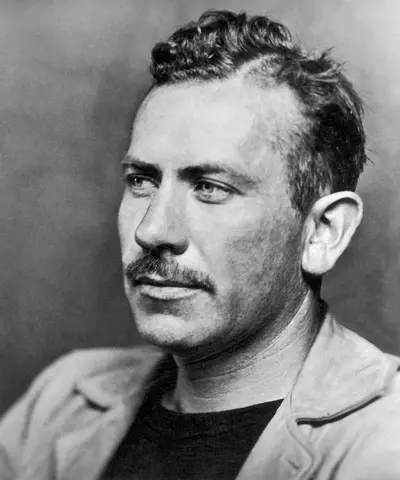
- Born: February 27, 1902
- Died: December 20, 1968
- Nationality: American
- Profession: Novelist, Short Story Writer
John Ernst Steinbeck Jr. was an American author and the 1962 Nobel Prize in Literature winner "for his realistic and imaginative writings, combining as they do sympathetic humour and keen social perception." He has been called "a giant of American letters," and many of his works are considered classics of Western literature.
