Theodore Roosevelt Quotes
The tone of a portion of the press of the country toward public men, and especially toward political opponents, is degrading, all forms of coarse and noisy slander being apparently considered legitimate weapons to employ against men of the opposite party or faction.
At the time political parties and some candidates had their own newspapers and attacked their opponents through those rather than directly themselves which would have been seen as gross and undignified, Slander and attacks have been a part of American politics since its inception. The degree and extent reached its pinnacle in the early 21st century.
Theodore Roosevelt, 1858-1919, 26th President of the United States (Republican, NY), “The College Graduate and Public Life”, The Atlantic Monthly, August 1894
Sourced by: Eigen's Political and Historical Quotations

His older brother was running for Consul—the highest elected office of the Roman Empire. The Handbook, was his advice to his brother as to how to conduct his campaign.


Steinbeck had been approached by Democratic political operatives (not connected with JFK) to write a novel attacking Richard Nixon. See {629629}. “Swift” referred to Jonathan Swift, the great English Satirical Writer who was greatly admired but did not achieve any political objectives.

He was the only candidate who was not visciously attacked and slandered by the others, and he did no attacking himself. However, he simply did not attract the voters as did the other candidates who were so negative about their opponents. The Republican party primary voters were so insistent on political party purity that most of the candidates were reduced to the lowest forms of debate and standards of veracity. All the candidates were weakened and diminished by that form of negative primary process. Mitt Romney finally won the nomination but had been bruised badly by the Republican primary election. He last the general election badly.

There have been few modern politicians who would be so firm against negative campaigning by members of his own party. In reality, although Roosevelt was very popular amongst the people, he was never a favorite of the party politicians. For example, see {585078}.

He was one of the very few American politicians who could truthfully make that statement.
Calumnaire fortiter, et aliquid adhaerebit. See Pierre Beaumarchais for a later version of this political tactic.

The text was actually written by John Kenneth Galbraith who was writing speeches for Stevenson.

During the 1988 presidential campaign, Senator Gary Hart of Colorado was accused of womanizing. Reporters from The Miami Herald staked out Hart's Washington DC townhouse and determined that a young woman spent Friday night and Saturday with him while his wife was in Denver. Confronted with the story, Hart's campaign manager said:. Shortly after this statement was made, Hart withdrew from the race. The story was true.

35 years later Richard Gephardt used the same phrase to describe Republican tactics.
At that time, most of the leading Republicans practiced negative campaigning with vicious personal attacks that were often untrue. He was the only one of the 9 candidates who did not engage in the technique. He came in close to last.


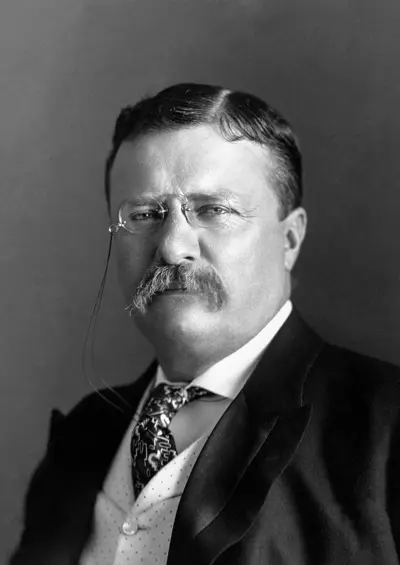
Theodore Roosevelt Jr., often referred to as Teddy or his initials T. R., was an American statesman, conservationist, naturalist, historian, and writer, who served as the 26th president of the United States from 1901 to 1909. He previously served as 33rd governor of New York from 1899 to 1900 and the 25th vice president of the United States from March to September 1901. Roosevelt emerged as a leader of the Republican Party and became a driving force for anti-trust and Progressive policies.
